Fishing in Chile
- Lakes
- 1,676
- Rivers
- 5,933
- Access
- 926
- Boat Ramps
- 60
- Shops
- 9
Chile stretches nearly 4,300 kilometres from the Atacama to Cape Horn, but when anglers talk about fishing here, they're almost always talking about the south — a long corridor of rivers, lakes, and fjords running through the Los Lagos and Aysén regions down into Patagonia and Tierra del Fuego.
The landscape shifts from dense Valdivian rainforest and glacier-fed lakes in the north of this zone to the open steppe and wind-scoured channels of the far south.
The fish are almost entirely introduced — brown and rainbow trout, plus chinook and coho salmon that either escaped fish farms along the fjords or were deliberately stocked — but they've been here long enough to behave like wild fish, and in many rivers they grow large.
The season runs roughly October through April, with the peak months falling between mid-November and late March.
November brings caddis and mayfly emergences along with blizzard hatches of small moths; by January the rivers are lower and clearer, with dragonfly patterns working well on lakes like Lago Yelcho; March sees hopper and Cantaria beetle fishing on the grassy banks.
Each month fishes differently enough that returning anglers often say it feels like a different fishery. The Aysén region is the gravitational centre of the scene.
The Simpson, Baker, Palena, and Cochrane rivers are the most accessible, many of them reachable from the Carretera Austral. The Baker holds strong rainbow trout runs; the Simpson has a reputation among lodge-based anglers for consistent fly fishing.
Further into the Lake District, the Río Futaleufú, Río Palena, Río Rosselot, and Río Yelcho form a network of bigger water that rewards float fishing and jet-boat access.
Closer to the coast in Aysén, chinook and sometimes Atlantic salmon turn up — fish-farm escapees that have established themselves in the river systems feeding the fjords.
Further south, Tierra del Fuego offers a different kind of fishing: remote, lightly visited, and heavily dependent on logistics.
The Río Grande, Río Azopardo, and the larger lakes of the Timaukel commune — Fagnano among them — hold trout in country that takes real effort to reach.
Near Puerto Natales, the Río Serrano runs close to Torres del Paine, and Lago Sofía offers fishing within reach of town. A sport fishing licence is required and is issued by Sernapesca, Chile's National Fisheries and Aquaculture Service.
Licences are available online through Sernapesca's recreational fishing portal or at their offices, and can be shown digitally on a phone. Three protected rivers — Cuimilahue, Pescado, and Sur — require a separate permit.
Check current rules directly with Sernapesca before you go; bag limits and season dates vary by region and species and are updated regularly. The fish here aren't native, and the ecosystems they inhabit are fragile.
Most serious anglers fishing Chilean Patagonia practice catch and release, and biosecurity matters — washing and disinfecting waders and gear between river systems helps keep invasive species from spreading.
The water is still clean enough in most of these valleys that you can see a trout holding thirty feet away. That's worth protecting.
Species & education
Learn what type of fish are in Chile and what's needed to catch them.
Find which waters have the species you want to catch

Rainbow Trout
Oncorhynchus mykiss

Brown Trout
Salmo trutta

Albacore
Thunnus alalunga

Bilagay
Cheilodactylus variegatus

Black Cusk-eel
Genypterus maculatus

Blanquillo
Prolatilus jugularis

Blue Shark
Prionace glauca

Broadbill Swordfish
Xiphias gladius

Cauque de maule
Odontesthes mauleanum

Chilean Jack Mackerel
Trachurus murphyi

Chilean Silverside
Odontesthes regia
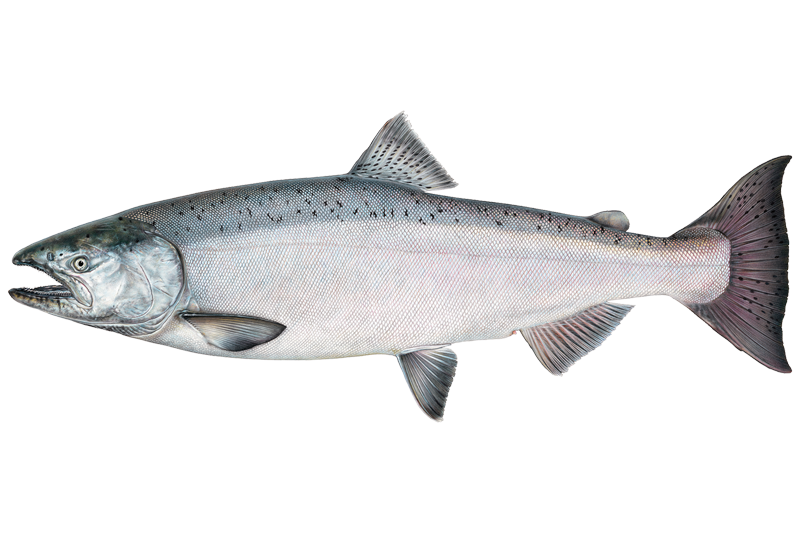
Chinook Salmon
Oncorhynchus tshawytscha

Corvina Drum
Cilus gilberti

Fine Flounder
Paralichthys adspersus

Flathead Mullet
Mugil cephalus

Marine Jerguilla
Aplodactylus punctatus

Pacific Sardine
Sardinops sagax

Palm Ruff
Seriolella violacea

Patagonian Blenny
Eleginops maclovinus

Patagonian Redfish
Sebastes oculatus

Peruvian Grunt
Anisotremus scapularis

Peruvian Rock Seabass
Paralabrax humeralis

Pink Cusk-eel
Genypterus blacodes

Puye
Galaxias maculatus

Red Cusk-eel
Genypterus chilensis

Rollizo
Pinguipes chilensis

Sea Trout
Salmo trutta

Sevengill Shark
Notorynchus cepedianus

Shortfin Mako
Isurus oxyrinchus

Snoek
Thyrsites atun

Southern Hake
Merluccius australis

Southern Rays Bream
Brama australis

South Pacific Hake
Merluccius gayi

Vieja
Graus nigra

Yellowfin Tuna
Thunnus albacares

Yellowtail Amberjack
Seriola lalandi
Fish smarter with real-time insights
Whether you're en route and conditions shift or you're looking for the best spot based on current flows, we enable you to make informed decisions on the fly.




Cities in Chile
- Alto del Carmen, Atacama
- Alto Hospicio, Tarapacá
- Ancud, Los Lagos
- Andacollo, Coquimbo
- Angol, La Araucanía
- Antofagasta, Antofagasta
- Arica, Arica y Parinacota
- Baquedano, Antofagasta
- Bulnes, Ñuble
- Calama, Antofagasta
- Calbuco, Los Lagos
- Caldera, Atacama
- Camiña, Tarapacá
- Carahue, La Araucanía
- Castro, Los Lagos
- Cauquenes, Maule
- Chiguayante, Biobío
- Chile Chico, Aysén
- Chillán Viejo, Ñuble
- Chillán, Ñuble
- Chimbarongo, O'Higgins
- Cochrane, Aysén
- Coelemu, Ñuble
- Coihueco, Ñuble
- Colchane, Tarapacá
- Colina, Santiago Metropolitan
- Combarbalá, Coquimbo
- Concepción, Biobío
- Constitución, Maule
- Copiapó, Atacama
- Coquimbo, Coquimbo
- Coronel, Biobío
- Corral, Los Ríos
- Coyhaique, Aysén
- Curicó, Maule
- Cuya, Arica y Parinacota
- Diego de Almagro, Atacama
- El Carmen, Ñuble
- Freirina, Atacama
- Futrono, Los Ríos
- Graneros, O'Higgins
- Hualpén, Biobío
- Huara, Tarapacá
- Huasco, Atacama
- Illapel, Coquimbo
- Iquique, Tarapacá
- La Calera, Valparaíso
- La Serena, Coquimbo
- La Unión, Los Ríos
- Labranza, La Araucanía
- Lago Ranco, Los Ríos
- Lanco, Los Ríos
- Lautaro, La Araucanía
- Limache, Valparaíso
- Linares, Maule
- Llanquihue, Los Lagos
- Lo Prado, Santiago Metropolitan
- Longaví, Maule
- Los Andes, Valparaíso
- Los Ángeles, Biobío
- Los Lagos, Los Ríos
- Los Vilos, Coquimbo
- Lota, Biobío
- Machalí, O'Higgins
- María Elena, Antofagasta
- Maullín, Los Lagos
- Mejillones, Antofagasta
- Molina, Maule
- Monte Patria, Coquimbo
- Nueva Imperial, La Araucanía
- Osorno, Los Lagos
- Ovalle, Coquimbo
- Padre Las Casas, La Araucanía
- Paillaco, Los Ríos
- Panguipulli, Los Ríos
- Parral, Maule
- Pica, Tarapacá
- Pichilemu, O'Higgins
- Pinto, Ñuble
- Porvenir, Magallanes
- Pozo Almonte, Tarapacá
- Pucón, La Araucanía
- Puerto Aysén, Aysén
- Puerto Cisnes, Aysén
- Puerto Montt, Los Lagos
- Puerto Natales, Magallanes
- Puerto Varas, Los Lagos
- Puerto Williams, Magallanes
- Punta Arenas, Magallanes
- Purranque, Los Lagos
- Putre, Arica y Parinacota
- Quellón, Los Lagos
- Quillón, Ñuble
- Quillota, Valparaíso
- Quilpué, Valparaíso
- Rancagua, O'Higgins
- Rengo, O'Higgins
- Requínoa, O'Higgins
- Río Bueno, Los Ríos
- Salamanca, Coquimbo
- San Antonio, Valparaíso
- San Carlos, Ñuble
- San Clemente, Maule
- San Felipe, Valparaíso
- San Francisco de Mostazal, O'Higgins
- San Javier, Maule
- San Pedro de Atacama, Antofagasta
- San Pedro de la Paz, Biobío
- San Vicente de Tagua Tagua, O'Higgins
- Santa Cruz, O'Higgins
- Santiago, Santiago Metropolitan
- Sierra Gorda, Antofagasta
- Talca, Maule
- Talcahuano, Biobío
- Taltal, Antofagasta
- Temuco, La Araucanía
- Tierra Amarilla, Atacama
- Tocopilla, Antofagasta
- Tomé, Biobío
- Valdivia, Los Ríos
- Vallenar, Atacama
- Valparaíso, Valparaíso
- Victoria, La Araucanía
- Vicuña, Coquimbo
- Villa Alemana, Valparaíso
- Villa Mercedes, Biobío
- Villarrica, La Araucanía
- Viña del Mar, Valparaíso
- Yungay, Ñuble
Explore Chile waters
Top fishing waters
Popular Cities
Loading popular cities...

Smarter Fishing Starts in the App.
onWater Fish gives you everything you need to plan smarter, fish better, and own every trip from first cast to last.