Chinook Salmon
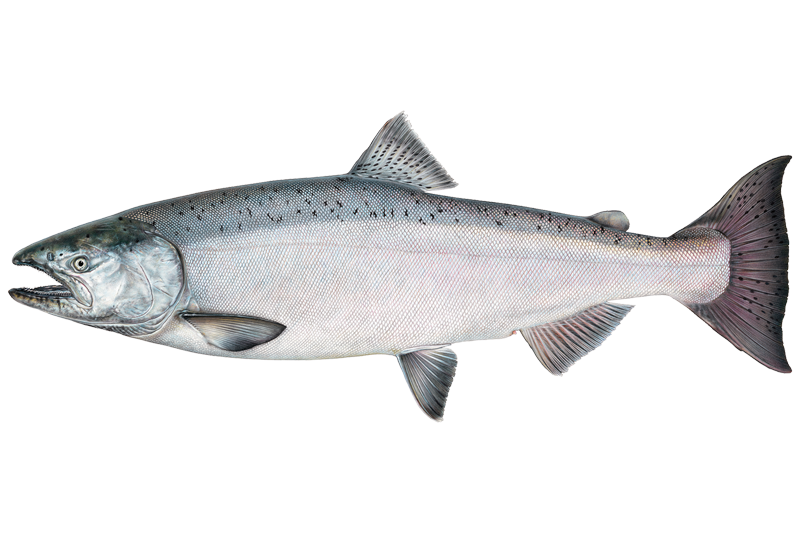
Chinook salmon — known locally as salmón rey or king salmon — were introduced to southern Chile starting in 1924, planted into the Maullín, Cochamó, and Puelo rivers.
They naturalised far beyond those original stocking sites and now run dozens of rivers along the Patagonian coast.
With minimal predation pressure and cold, food-rich Pacific waters, Chilean kings grow to sizes that dwarf most North American runs — 30- to 50-lb fish are common, and 60-lb-plus specimens are caught regularly.
Scientific Name: Oncorhynchus tshawytscha
Also known as Salmón rey, king salmon
- Blue-green back, bright silver sides, white belly in fresh-run fish; black spots on the upper body and both lobes of the tail fin.
- Distinctive black pigment along the gum line — the "blackmouth" mark that separates Chinook from other Pacific salmon species.
- Spawning fish turn olive-brown, red, or purplish; males develop a pronounced hooked upper jaw (kype).
- Typical river fish in Chile run 25–50 lbs; fish over 60 lbs are documented, and fish above 70 lbs have been spotted.
What to know
Habitat Distribution
- Introduced, not native — first planted in 1924 into the Maullín, Cochamó, and Puelo rivers; now established across most major river systems in Chilean Patagonia.
- Anadromous: juveniles rear in freshwater, migrate to the Pacific to grow, then return to rivers to spawn — the same life cycle as in their native North Pacific range.
- River runs concentrate in the fjord-fed drainages south of Puerto Montt, including the Petrohue, Puelo, Cochamó, Maullín, Serrano, and the unnamed river fished by Austral Kings.
- Ocean fish are present in coastal and estuarine waters along the southern Chilean Pacific coast, accessible by boat from areas like the Estero Reloncaví.
Key Locations
- Río Petrohue (Lakes District, near Puerto Varas) — one of the original stocking rivers and still a primary destination; fish enter mid-February through April.
- Río Puelo and Río Cochamó — large fjord-fed rivers south of Puerto Montt with established wild runs; both were among the first introduction sites in 1924.
- Río Maullín — another original introduction river with a long-running fishery.
- Río Serrano (Torres del Paine region) — the southernmost well-known run; fish migrate through from mid-December to February.
- Austral Kings river (remote Patagonia, exact location undisclosed) — a private fishery with an estimated 50,000–60,000 fish run and average weights above 30 lbs.
Specific Spots
- Deep, slow pools and tailouts just above tidal reach hold the freshest chrome fish — these are the first major resting lies after salmon leave saltwater.
- Large boulders, submerged ledges, and current seams give salmon a break from the main flow; fish hold tight to these features, especially in high-gradient glacial rivers.
- Braided lower reaches with wide gravel bars concentrate fish during low water; the edges of braids where current converges are productive swing water.
- Tidal water and river mouths hold fish staging before they commit to the upstream migration — trolling or swinging near estuaries can intercept fresh-run fish.
Chinook Salmon FAQ
Answers from onWater's species guide.
What are the best lures and bait for Chinook Salmon?
For ocean trolling: large spoons, hoochies, and cut-plug herring on downriggers are the go-to approach; flashers ahead of the lure add vibration that draws fish from distance.
What flies work for Chinook Salmon?
Large swung flies are the primary method in rivers: Intruder-style patterns and big tube flies (4–6 inches) tied with rabbit, marabou, and synthetic materials, these create movement and push water that triggers a strike response even from non-feeding fish.
When is the best time to fish for Chinook Salmon?
Ocean trolling: November through March, with the peak of large fish in December–February. Río Petrohue river run: mid-February through April; timing shifts earlier with heavy rain, later in dry summers. Río Serrano (Torres del Paine): mid-December through February.
How do you catch Chinook Salmon?
Most river fishing is done wading from the bank, swinging large flies or lures through deep pools and tailouts with two-handed rods and heavy sink tips. Jet boats access upper sections on larger rivers.
What do Chinook Salmon eat?
In the ocean, Chilean kings feed heavily on sardines, anchovies, and other baitfish, trolled lures and flies that imitate small fish (Clouser Minnows, large Deceivers, spoons) match this forage directly.
See it in the app
Most maps show you water.
onWater shows you Chinook Salmon.



- 01 · Species map filter
Map every Chinook Salmon water
Pick Chinook Salmon and the map zeroes in on the waters they call home. No more guessing which lake holds them.
- 02 · Waterbody species
Tap any water. See what lives there.
Species, behavior and seasonal patterns for every lake, river and pond, before you leave the driveway.
- 03 · Angler Intelligence
Ask how to catch Chinook Salmon
Tactics, gear and timing from onWater's AI fishing guide, tuned to the species and the water you're on.
Stop guessing where Chinook Salmon are.
Open the map, filter by Chinook Salmon, and head to water that holds them. Download onWater and plan your next trip in minutes.
- Species map filter
- Angler Intelligence
- Fishing journal
Explore other species
Trout, bass, salmon, panfish and everything in between. Each guide unpacks the behavior, seasons, and tactics that put fish in the net.
No species information available.

Smarter Fishing Starts in the App.
onWater Fish gives you everything you need to plan smarter, fish better, and own every trip from first cast to last.