Rainbow Trout
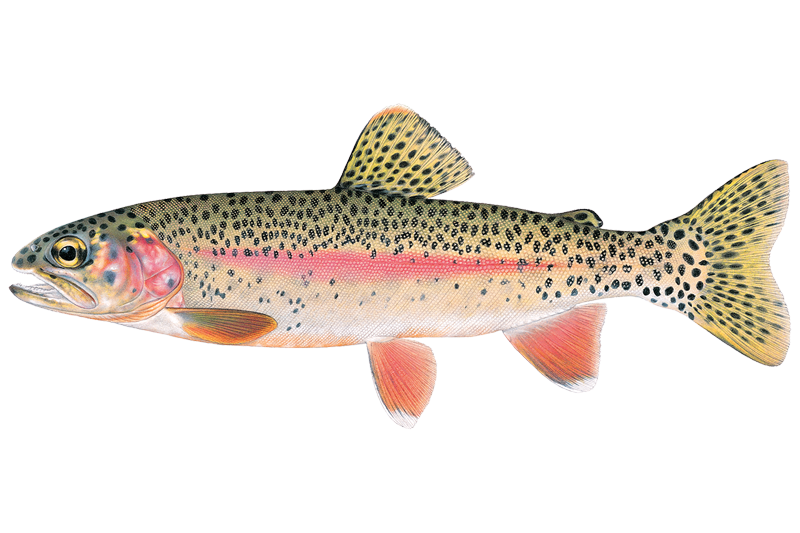
Rainbow trout were introduced to Chile between 1905 and 1920 and have since naturalized across the country, from the Elqui and Limarí rivers in the north all the way south through Patagonia.
The fishery's heart sits in the Coyhaique region and along the Río Baker drainage, where gin-clear rivers and glacial lakes hold resident fish to 15 pounds alongside sea-run rainbows that can push 30.
Scientific Name: Oncorhynchus mykiss
Also known as Trucha arcoíris, trucha de mar (sea-run form)
- Silver to olive-green body with a distinctive pink-to-red lateral band running from gill to tail; black spots scattered across the back, sides, and fins.
- Sea-run fish (trucha de mar) are much brighter silver overall, with the pink band faint or absent until they've been in freshwater a while.
- Resident river fish in Chilean Patagonia commonly run 4–8 pounds; fish to 15 pounds are caught regularly, and sea-run fish average around 12 pounds with some exceeding 30.
- Distinguished from brown trout by the absence of red spots and the presence of spots on the tail fin — browns have an unspotted or lightly spotted tail.
What to know
Habitat Distribution
- Introduced, now naturalized; distributed from Antofagasta (23°S) south through Patagonia to Tierra del Fuego (55°S) — one of the broadest ranges of any introduced salmonid in South America.
- Resident fish occupy cold, clear rivers and glacial lakes throughout the Aysén and Los Lagos regions; the Coyhaique area and Río Baker drainage are particularly productive.
- A sea-run form uses the coastal fjords and river mouths of southern Chile, entering rivers to spawn and growing to exceptional size in the ocean.
- Northern populations in the Elqui and Limarí basins represent the arid-climate edge of the range and are genetically distinct from Patagonian fish.
Key Locations
- Río Baker (Aysén Region) — one of Chile's largest rivers, with strong populations of resident rainbows holding in seams, eddies, and along forested banks below Lago Bertrand.
- Coyhaique area rivers — the Paloma, Azul, Simpson, Nireguao, Cisnes, and Manihaules rivers all hold good numbers of rainbows within a roughly 100-mile radius of Coyhaique.
- Coastal fjords near Cisnes River mouth — the lower Cisnes and adjacent fjords are known for sea-run rainbow trout of exceptional size.
- Northern Patagonia around Puerto Montt — glacial lakes and rivers in the Los Lagos region provide accessible trout fishing with strong infrastructure.
- Torres del Paine area — the far south holds rainbows in rivers and lakes within and around the national park.
Specific Spots
- Seams and current breaks where fast water meets slow — rainbows hold here to intercept drifting food without burning energy fighting the main current.
- Undercut banks and shelves along densely forested river edges on the Río Baker and similar rivers; fish tuck tight to structure, especially larger individuals.
- Large eddies below rapids or lake outlets, where food concentrates and fish can feed with minimal effort — the enormous eddy below Lago Bertrand on the Baker is a classic example.
- Shallow riffles and runs during surface-feeding activity, particularly as afternoon water temperatures rise; sight-casting to individual rising fish is a hallmark of Chilean Patagonia fishing.
Rainbow Trout FAQ
Answers from onWater's species guide.
What are the best lures and bait for Rainbow Trout?
Small to medium spoons and spinners (Mepps-style) in silver or gold are reliable across Chilean rivers and lakes, covering water efficiently when fish aren't visibly rising.
What flies work for Rainbow Trout?
Dry-dropper rigs combining a large foam hopper or Water Walker (imitates a grasshopper) with a small flashy nymph dropper are the go-to setup for covering water efficiently in Chilean Patagonia's summer season.
When is the best time to fish for Rainbow Trout?
The main fishing season runs from November through April (Chilean spring through early autumn), when rivers are accessible and insect activity is at its peak.
How do you catch Rainbow Trout?
Most anglers in Chilean Patagonia fish from the bank or wade, covering water by moving steadily upstream and making short presentations to the best-looking runs rather than working any single spot for long.
What do Rainbow Trout eat?
Aquatic insects form the backbone of the diet in Chilean rivers, mayflies, caddisflies, and stoneflies in various life stages. Match the hatch with nymphs like a Pheasant Tail (imitates mayfly nymphs) or Hare's Ear (imitates a range of nymphs), and dries like a Parachute Adams or Elk Hair Caddis when fish are rising.
See it in the app
Most maps show you water.
onWater shows you Rainbow Trout.



- 01 · Species map filter
Map every Rainbow Trout water
Pick Rainbow Trout and the map zeroes in on the waters they call home. No more guessing which lake holds them.
- 02 · Waterbody species
Tap any water. See what lives there.
Species, behavior and seasonal patterns for every lake, river and pond, before you leave the driveway.
- 03 · Angler Intelligence
Ask how to catch Rainbow Trout
Tactics, gear and timing from onWater's AI fishing guide, tuned to the species and the water you're on.
Stop guessing where Rainbow Trout are.
Open the map, filter by Rainbow Trout, and head to water that holds them. Download onWater and plan your next trip in minutes.
- Species map filter
- Angler Intelligence
- Fishing journal
Explore other species
Trout, bass, salmon, panfish and everything in between. Each guide unpacks the behavior, seasons, and tactics that put fish in the net.
No species information available.

Smarter Fishing Starts in the App.
onWater Fish gives you everything you need to plan smarter, fish better, and own every trip from first cast to last.