Spotted Bass
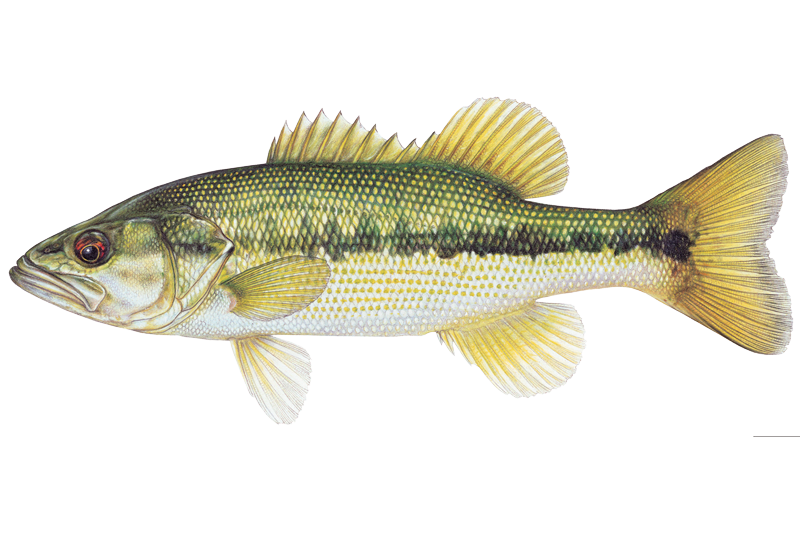
Spotted bass arrived in South Africa in 1939, introduced from North America, and have since established themselves in rivers, streams, and dams across the Western Cape, Eastern Cape, KwaZulu-Natal, Gauteng, and Mpumalanga.
They're the least common of the three bass species here, often misidentified as largemouth or smallmouth bass, but they take a fly or lure readily and punch well above their modest average size.
Scientific Name: Micropterus punctulatus
Also known as Spotty, Spots
- Olive-green body fading to white on the belly, with rows of dark spots below the lateral line — the feature that gives the species its name.
- Jaw line stops at or before the eye — the clearest field mark separating it from largemouth bass, whose jaw extends past the eye.
- Rough, sandpaper-like patch of teeth on the tongue — run a finger across it and you'll know immediately; neither largemouth nor smallmouth has this.
- Typically 20–60 cm in South African waters; average fish run 0.2–0.4 kg, though the species can reach over 5 kg globally.
What to know
Habitat Distribution
- Introduced from North America in 1939; fully established as an invasive species across multiple provinces including the Western Cape, Eastern Cape, KwaZulu-Natal, Gauteng, and Mpumalanga.
- Found in rivers, streams, and dams — gravitates toward slower-moving or still water with some turbidity rather than the clear, rocky runs preferred by smallmouth bass.
- Documented in the Olifants-Doring River system (Western Cape) and various farm dams and reservoirs; distribution is patchy and not as widespread as largemouth bass.
- Does not generally share the same reaches as smallmouth bass — if you're in clear, fast mountain water, the fish is more likely a smallmouth.
Key Locations
- Western Cape dams and rivers — the species is established here, though active eradication efforts have removed them from some river systems like the Thee River in the Olifants-Doring catchment.
- KwaZulu-Natal reservoirs and farm dams — part of the broader bass fishery that includes largemouth and smallmouth bass.
- Gauteng and Mpumalanga impoundments — spotted bass share these waters with largemouth bass and are caught incidentally during bass sessions.
- Eastern Cape farm dams — present across the province, often alongside largemouth bass in mixed-species waters.
Specific Spots
- Deeper, darker sections of dams and slow rivers — spotted bass use depth and murky water as cover the way largemouth use weed mats.
- Submerged timber, rocky ledges, and undercut banks give them a place to hold and wait for prey to pass; work lures tight to structure.
- Weed edges and hyacinth mats in reservoirs concentrate baitfish and frogs, drawing bass up to feed, especially in low light.
- Current breaks where a slow river narrows or bends — fish hold on the downstream side of the obstruction to intercept food with minimal effort.
Spotted Bass FAQ
Answers from onWater's species guide.
What are the best lures and bait for Spotted Bass?
Soft-plastic worms and grubs on a wacky rig (hook threaded through the middle of the worm so it wriggles on both ends) or light jig head, effective year-round, especially when fish are holding deep or slow.
What flies work for Spotted Bass?
Woolly Buggers (size 6–10, olive, black, or brown) imitate leeches and small fish, a reliable all-round pattern stripped back with short, sharp pulls. Clouser Minnows imitate small baitfish and get down quickly in deeper dam water; white-and-chartreuse or white-and-olive are proven colour combinations.
When is the best time to fish for Spotted Bass?
Spring (August–October), fish move shallow to spawn as water warms; some of the most consistent action of the year as males hold near nests and strike at anything that comes close.
How do you catch Spotted Bass?
Most South African anglers encounter spotted bass while fishing for largemouth or smallmouth bass, using lures from a boat or the bank. Dedicated fly anglers targeting spotted bass focus on slower rivers and dams, working streamers and surface poppers around structure in low light.
What do Spotted Bass eat?
Feeds on smaller fish, frogs, crabs, worms, and insects, match this with soft-plastic worms or grubs on a wacky rig or jig head, crankbaits that imitate small baitfish, or surface frog lures over weed cover.
See it in the app
Most maps show you water.
onWater shows you Spotted Bass.



- 01 · Species map filter
Map every Spotted Bass water
Pick Spotted Bass and the map zeroes in on the waters they call home. No more guessing which lake holds them.
- 02 · Waterbody species
Tap any water. See what lives there.
Species, behavior and seasonal patterns for every lake, river and pond, before you leave the driveway.
- 03 · Angler Intelligence
Ask how to catch Spotted Bass
Tactics, gear and timing from onWater's AI fishing guide, tuned to the species and the water you're on.
Stop guessing where Spotted Bass are.
Open the map, filter by Spotted Bass, and head to water that holds them. Download onWater and plan your next trip in minutes.
- Species map filter
- Angler Intelligence
- Fishing journal
Explore other species
Trout, bass, salmon, panfish and everything in between. Each guide unpacks the behavior, seasons, and tactics that put fish in the net.
No species information available.

Smarter Fishing Starts in the App.
onWater Fish gives you everything you need to plan smarter, fish better, and own every trip from first cast to last.