Rainbow Trout
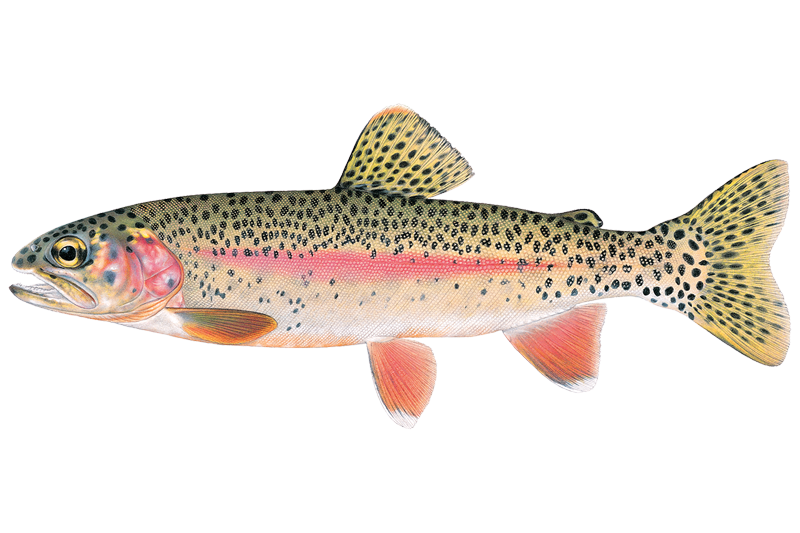
Rainbow trout are the backbone of South Africa's freshwater fly-fishing scene.
Introduced from Pacific North America in the late 1800s, they've established self-sustaining populations in the cold mountain streams and high-altitude dams of Mpumalanga, KwaZulu-Natal, Eastern Cape, Western Cape, and Free State.
Towns like Dullstroom and Rhodes have built entire angling economies around them.
Scientific Name: Oncorhynchus mykiss
Also known as Reënboogforel, Rainbow
- Distinctive pink-to-red lateral band running from gill plate to tail, with a scattering of black spots across the back, sides, and fins — the easiest ID in hand.
- Silvery flanks that can take on a brassy or golden hue in still-water fish; stream fish tend to be darker and more heavily spotted.
- Typical river fish in South Africa run around 0.5 m and 1.5 kg; still-water and farm-dam fish grow larger, with the recorded South African maximum around 5.4 kg.
What to know
Habitat Distribution
- Introduced species, not native to Africa — first stocked in South African streams in the 1880s and now established in montane waters across five provinces.
- Restricted to high-altitude streams, rivers, and dams where cold water persists year-round; the thermal ceiling of roughly 24–26°C defines the lower boundary of viable habitat.
- Strongest populations in Mpumalanga (Dullstroom area), the Eastern Cape highlands around Rhodes and the Drakensberg foothills, KwaZulu-Natal river systems, and the Cape Fold Belt mountains near Stellenbosch.
- Conservation authorities are actively demarcating which catchments may hold trout; fish are not permitted outside designated areas.
Key Locations
- Dullstroom, Mpumalanga — the centre of South Africa's trout industry, with numerous fly-fishing dams and cold mountain streams within easy reach.
- Rhodes, Eastern Cape — a highland hamlet surrounded by hundreds of kilometres of productive trout streams in the Drakensberg foothills near the Lesotho border.
- KwaZulu-Natal river systems — the Mooi, Bushmans, Loteni, and Umngeni rivers hold rainbows in their upper, cold-water reaches.
- Cape Fold Belt mountains, Western Cape — streams near Stellenbosch and the surrounding mountain ranges support trout in their higher, colder sections.
Specific Spots
- In streams, look for fish holding in the seam between fast and slow water — the current break at the edge of a run is where food funnels past and fish sit with minimal effort.
- Pool heads and tails concentrate fish, especially in low-light periods; the tail of a pool is a classic feeding station as water shallows and insects drift through.
- In still-water dams, fish patrol weed edges and drop-offs where invertebrates and small baitfish concentrate — work the margins at dawn and dusk.
- Rocky pocket water in mountain streams holds fish tight behind boulders; a short, accurate cast into the pocket often beats a long drift in open water.
Rainbow Trout FAQ
Answers from onWater's species guide.
What are the best lures and bait for Rainbow Trout?
Small gold or silver spinners (sizes 1–2) and inline spoons are reliable across stream and dam fishing, the flash and vibration trigger strikes even when fish aren't actively surface feeding.
What flies work for Rainbow Trout?
Woolly Buggers (imitating baitfish, leeches, or large nymphs) are the single most widely used fly in South African trout dams, strip them slowly along weed edges or let them sink and twitch near drop-offs.
When is the best time to fish for Rainbow Trout?
September and October (early spring), water temperatures drop into the optimal range after winter, fish become active, and insect hatches begin; widely considered the best time to start the season.
How do you catch Rainbow Trout?
Most South African rainbow trout fishing is done on foot, wading or walking the banks of mountain streams and working upstream with flies or light lures. Still-water dam fishing from the bank or a float tube is equally popular, particularly around Dullstroom where purpose-built fly-fishing dams are the norm.
What do Rainbow Trout eat?
Aquatic insects form the core of the diet: mayflies, caddisflies, midges, dragonflies, and damselflies at various life stages, nymph patterns like a Pheasant Tail (imitates mayfly nymphs) or Hare's Ear (imitates a range of nymphs) cover most situations subsurface.
See it in the app
Most maps show you water.
onWater shows you Rainbow Trout.



- 01 · Species map filter
Map every Rainbow Trout water
Pick Rainbow Trout and the map zeroes in on the waters they call home. No more guessing which lake holds them.
- 02 · Waterbody species
Tap any water. See what lives there.
Species, behavior and seasonal patterns for every lake, river and pond, before you leave the driveway.
- 03 · Angler Intelligence
Ask how to catch Rainbow Trout
Tactics, gear and timing from onWater's AI fishing guide, tuned to the species and the water you're on.
Stop guessing where Rainbow Trout are.
Open the map, filter by Rainbow Trout, and head to water that holds them. Download onWater and plan your next trip in minutes.
- Species map filter
- Angler Intelligence
- Fishing journal
Explore other species
Trout, bass, salmon, panfish and everything in between. Each guide unpacks the behavior, seasons, and tactics that put fish in the net.
No species information available.

Smarter Fishing Starts in the App.
onWater Fish gives you everything you need to plan smarter, fish better, and own every trip from first cast to last.