Largemouth Bass
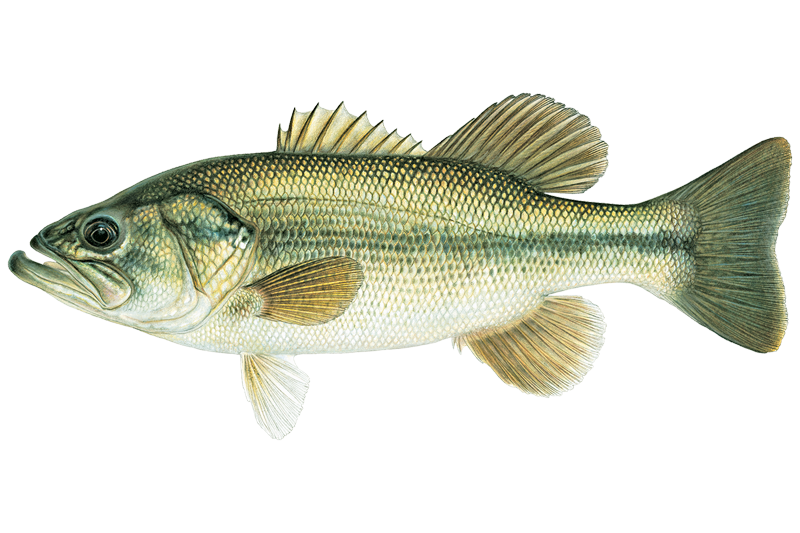
Largemouth bass were introduced to South Africa in 1928 — a handful of fish from North America that have since colonised nearly every major reservoir in the country.
Today they're the backbone of South African freshwater sport fishing, supporting a tournament scene with purpose-built bass boats, local rod manufacturers, and anglers who fish the same techniques as their counterparts in the American South.
Scientific Name: Micropterus salmoides
Also known as Baars, Grootbek baars, Largie
- Olive-green back fading to white belly, with a dark lateral stripe running the length of the body — the key field mark separating it from smallmouth and spotted bass.
- The upper jaw extends well past the rear edge of the eye — the feature that gives the fish its name and distinguishes it from the smallmouth at a glance.
- Most fish caught in South African dams run 1–3 kg; Florida-strain fish in waters like Loskop Dam are capable of exceeding 4–5 kg.
- Deep, laterally compressed body with a notched dorsal fin — front spiny section clearly separated from the soft rear section.
What to know
Habitat Distribution
- Introduced from North America in 1928; now spread across nearly all major reservoirs in South Africa, from the Western Cape through the Eastern Cape, KwaZulu-Natal, Gauteng, Limpopo, and Mpumalanga.
- Florida-strain fish arrived around 1980 and have established particularly strong populations in warmer lowveld impoundments like Loskop Dam on the Olifants River in Mpumalanga.
- Found in large public dams, farm dams, and some river systems — though river populations are considered a biodiversity concern and are managed differently from impoundment fish.
- The Western Cape holds all three bass species; Clanwilliam Dam is the only water in South Africa where largemouth, smallmouth, and spotted bass coexist.
Key Locations
- Loskop Dam, Mpumalanga — a 6,000-acre impoundment on the Olifants River with a strong Florida-strain population and potential for very large fish.
- Wriggleswade Dam, Eastern Cape — a major tournament venue and the site of formal bass movement research.
- Clanwilliam Dam, Western Cape — the only water in South Africa holding all three bass species; a destination for smallmouth and largemouth anglers alike.
- Albert Falls Dam and Inanda Dam, KwaZulu-Natal — both regarded primarily as bass fisheries and popular with KZN anglers.
- Hartebeespoort Dam, Gauteng, and Ebenezer Dam, Limpopo — accessible, well-known bass waters with established fishing pressure and infrastructure.
Specific Spots
- Timber and submerged structure draw fish year-round — bass use fallen trees and drowned brush as cover to intercept prey moving through.
- Water hyacinth mats are a major target in South African reservoirs; bass hold tight underneath where shade and oxygen levels concentrate baitfish and frogs.
- In winter, fish move into deeper sections of the main impoundment basin; as water warms, they push back into the shallows near river inlets and creek arms.
- Rocky points, cliff faces, and bluff walls — common in Eastern Cape game reserve waters — concentrate fish where depth changes quickly.
Largemouth Bass FAQ
Answers from onWater's species guide.
What are the best lures and bait for Largemouth Bass?
Spinnerbaits and crankbaits are the workhorses on South African reservoirs, effective across a range of water clarities and depths, and well-proven on tournament waters like Wriggleswade. Hollow-body frog lures fished over hyacinth mats and lily pads produce explosive surface takes where vegetation is thick.
What flies work for Largemouth Bass?
Deer-hair or foam poppers fished along weedlines and over structure imitate frogs and struggling surface prey, one of the most effective fly approaches for South African bass in warm months.
When is the best time to fish for Largemouth Bass?
Spring (August–October), warming water triggers pre-spawn and spawn activity; fish move shallow and feed actively, making this one of the most productive periods. Summer (November–March), fish are active but move deeper or into shade during midday heat; early morning and late afternoon sessions produce best.
How do you catch Largemouth Bass?
Most South African bass anglers fish from boats on large impoundments, targeting structure, hyacinth mats, timber, rocky points, with lures. Shore fishing from dam walls and rocky banks is common on public waters.
What do Largemouth Bass eat?
In South African impoundments, bass feed heavily on smaller fish, kurper (tilapia), bluegill, and juvenile barbel, making swimbaits, crankbaits, and spinnerbaits that imitate baitfish the go-to choices.
See it in the app
Most maps show you water.
onWater shows you Largemouth Bass.



- 01 · Species map filter
Map every Largemouth Bass water
Pick Largemouth Bass and the map zeroes in on the waters they call home. No more guessing which lake holds them.
- 02 · Waterbody species
Tap any water. See what lives there.
Species, behavior and seasonal patterns for every lake, river and pond, before you leave the driveway.
- 03 · Angler Intelligence
Ask how to catch Largemouth Bass
Tactics, gear and timing from onWater's AI fishing guide, tuned to the species and the water you're on.
Stop guessing where Largemouth Bass are.
Open the map, filter by Largemouth Bass, and head to water that holds them. Download onWater and plan your next trip in minutes.
- Species map filter
- Angler Intelligence
- Fishing journal
Explore other species
Trout, bass, salmon, panfish and everything in between. Each guide unpacks the behavior, seasons, and tactics that put fish in the net.
No species information available.
Smarter Fishing Starts in the App.
onWater Fish gives you everything you need to plan smarter, fish better, and own every trip from first cast to last.