Common Carp
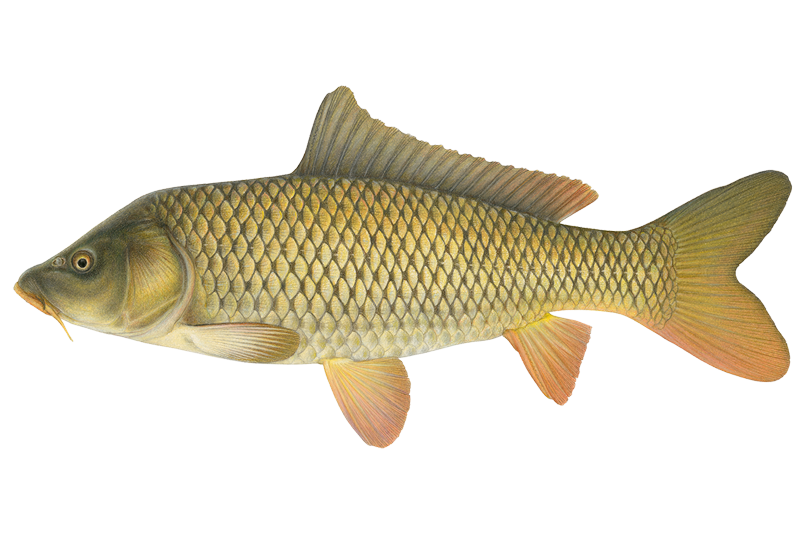
Common carp were introduced to South Africa in the 1700s and have since spread to nearly every river and impoundment in the country.
Conservation authorities classify them as invasive, but among freshwater anglers they're one of the most widely targeted species — big fish, widespread access, and a fight that earns respect. Dams, slow rivers, and vleis across all nine provinces hold carp.
Scientific Name: Cyprinus carpio
Also known as European Carp, Eurasian Carp, Karp (Afrikaans)
- Gold to dark brown body with large, even scales; reddish-tinted fins and a blunt, downward-angled snout with two small barbels at the corners of the mouth.
- Deep, slab-sided body that deepens noticeably with age — older fish look almost hump-backed compared to juveniles.
- Most fish caught run 2–8 kg; specimens over 15 kg are well within reach in productive dams, and South African angling records approach 40 kg.
- Mirror carp — a cultivated variant with large, irregular scales — occasionally turn up and are closely related but visually distinct.
What to know
Habitat Distribution
- Introduced from Europe and Asia; now present in almost all rivers and impoundments across South Africa — one of the most widespread freshwater fish in the country.
- Prefer slow-moving or still water: large dams, farm ponds, vleis, and the quieter pools and backwaters of rivers rather than fast-flowing runs.
- Share water with barbel (catfish), yellowfish, grass carp, and blue kurper in many of the country's major impoundments.
- Illegally introduced into isolated systems like Groenvlei (Lake Pleasant) in the 1990s, showing how persistently the species has spread beyond its original stocking sites.
Key Locations
- Vaal Dam and the Vaal River — one of the country's best-known carp fisheries, with large fish and easy access for bank anglers.
- Hartebeespoort Dam (North West/Gauteng) — heavily fished and productive for carp despite water quality challenges.
- Loskop Dam (Mpumalanga) — known for a variety of species including big carp, with good camping and bank-fishing infrastructure.
- Impofu Dam (Eastern Cape/KwaZulu-Natal border area) — specifically noted for large common carp.
- Komati River (Mpumalanga) — holds big carp alongside barbel in its slower pools and deeper bends.
Specific Spots
- Steep drop-offs close to the bank concentrate carp — they follow the bottom contour while rooting through silt, so the shelf edge where shallow flats fall away into deeper water is a reliable starting point.
- Weed beds and submerged structure (sunken timber, rocky points) give carp cover and a food source; fish the edges rather than the middle of dense growth.
- Shallow, silty bays warm up fastest and draw carp in early morning and late afternoon to feed — watch for muddy water, bubbles, or backs and tails breaking the surface.
- River fishing: target the slow inside bends, deep pools below rapids, and any eddy where current drops and silt accumulates.
Common Carp FAQ
Answers from onWater's species guide.
What are the best lures and bait for Common Carp?
Mealies (corn), plain, flavoured, or tiger nuts, are the most widely used carp bait in South Africa; present them on a hair rig so the hook sits just behind the bait, a setup carp anglers here rely on heavily.
When is the best time to fish for Common Carp?
Spring (August–October): warming water triggers increased feeding activity and fish begin moving into shallower margins, one of the most productive periods of the year. Summer (November–February): spawning activity peaks; fish are visible in the shallows but can be less focused on feeding.
How do you catch Common Carp?
Most South African carp fishing is done from the bank, with anglers casting bait rigs to drop-offs or feeding areas and waiting with rod alarms set. Pre-baiting a spot with loose corn or groundbait before a session draws fish in and keeps them feeding in one area.
What do Common Carp eat?
Carp root through soft bottom sediment eating almost anything they find, aquatic invertebrates, worms, insect larvae, plant material, and algae. This bottom-grubbing habit is why earthworms fished on or near the bottom are one of the most reliable baits.
Where do Common Carp live?
Introduced from Europe and Asia; now present in almost all rivers and impoundments across South Africa, one of the most widespread freshwater fish in the country. Prefer slow-moving or still water: large dams, farm ponds, vleis, and the quieter pools and backwaters of rivers rather than fast-flowing runs.
See it in the app
Most maps show you water.
onWater shows you Common Carp.



- 01 · Species map filter
Map every Common Carp water
Pick Common Carp and the map zeroes in on the waters they call home. No more guessing which lake holds them.
- 02 · Waterbody species
Tap any water. See what lives there.
Species, behavior and seasonal patterns for every lake, river and pond, before you leave the driveway.
- 03 · Angler Intelligence
Ask how to catch Common Carp
Tactics, gear and timing from onWater's AI fishing guide, tuned to the species and the water you're on.
Stop guessing where Common Carp are.
Open the map, filter by Common Carp, and head to water that holds them. Download onWater and plan your next trip in minutes.
- Species map filter
- Angler Intelligence
- Fishing journal
Explore other species
Trout, bass, salmon, panfish and everything in between. Each guide unpacks the behavior, seasons, and tactics that put fish in the net.
No species information available.

Smarter Fishing Starts in the App.
onWater Fish gives you everything you need to plan smarter, fish better, and own every trip from first cast to last.