Bluegill Sunfish
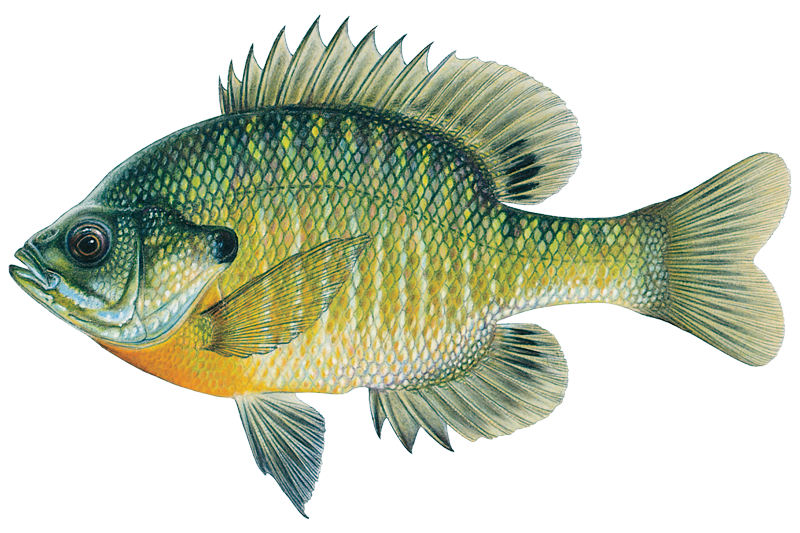
Introduced from North America in 1938 as a fodder fish for bass, bluegill are now firmly established across South Africa — particularly in the Western and Eastern Cape, KwaZulu-Natal, Mpumalanga, and the Free State.
They're a go-to target for light-tackle and fly anglers wanting fast action, and they've become a genuine pest species in many smaller waters where they outcompete indigenous barbs and redfins.
Scientific Name: Lepomis macrochirus
Also known as Blouwang Sonvis, Bream (informal American usage sometimes carried over)
- Deep, laterally compressed body with a distinctive blue or black opercular flap (the "ear") extending from the gill cover — the clearest ID feature.
- Bright blue edging on the gill rakes gives the fish its name; breeding males develop vivid orange-bronze on the belly and chest.
- Small mouth relative to body size — noticeably smaller than tilapia or bass of similar length.
- Typical fish run 100–300 g in South African waters; specimens above 1 kg are possible and represent a solid catch on light gear.
What to know
Habitat Distribution
- Not native to South Africa — introduced in 1938 as a forage species for largemouth, smallmouth, and spotted bass.
- Most abundant in the Western and Eastern Cape (including Howison's Poort Dam), with established populations in KwaZulu-Natal, Mpumalanga, and the Free State.
- Thrive in warm, weedy dams, lakes, and slow-flowing rivers with sand, mud, or gravel bottoms and good aquatic vegetation.
- Tend to do best in the cooler, wetter southern Cape climate; populations thin out in hotter, drier regions north of Pretoria.
Key Locations
- Howison's Poort Dam, Eastern Cape — subject of recent research on the invasive population; fish present in numbers.
- Durnacol Dam and Chelmsford Dam, KwaZulu-Natal — historical bank-angling records show fish to just over 1 kg from these waters.
- Midmar Dam and Albert Falls Dam, KwaZulu-Natal — both appear in SAFBAF bank-angling records for the species.
- Western and Southern Cape dams generally — the region where bluegill are most abundant and where they're commonly encountered as a bycatch when fishing for bass or kurper.
Specific Spots
- Weed edges and submerged vegetation — bluegill use plant cover both to ambush small invertebrates and to avoid larger predators like bass.
- Dock pilings, fallen timber, and any hard structure near the bank; they rarely stray far from cover throughout their lives.
- Shallow, protected bays during summer spawning — males fan circular nests in sand or gravel and hold tight to them, making them easy to locate and target.
- Shaded banks under overhanging trees, especially during midday when light levels are high and fish push into shadow.
Bluegill Sunfish FAQ
Answers from onWater's species guide.
What are the best lures and bait for Bluegill Sunfish?
Small inline spinners and tiny spinnerbaits (1/16 oz and under), the flash and vibration draw strikes even in slightly coloured water. Micro jigs (1/32 oz, black or dark colours) and small soft-plastic grubs fished under a float or on a slow retrieve near structure.
What flies work for Bluegill Sunfish?
Small nymphs are the backbone of bluegill fly fishing: Pheasant Tail Nymphs and Hare's Ears imitate mayfly and midge larvae and work year-round on a dead-drift (letting the fly drift naturally with no added movement) or a slow hand-twist retrieve.
When is the best time to fish for Bluegill Sunfish?
Summer (November–February), peak activity; fish are shallow, spawning males are aggressive and easy to locate on the beds. Autumn (March–April), fish remain active and feed heavily as water begins to cool; good all-round fishing before winter.
How do you catch Bluegill Sunfish?
Most South African anglers encounter bluegill from the bank while fishing light tackle for bass or kurper, though a growing number target them deliberately on 3–4 weight fly gear.
What do Bluegill Sunfish eat?
Primarily aquatic insects, insect larvae, and small invertebrates, match this with small nymphs like a Pheasant Tail (PTN) or Hare's Ear, which imitate mayfly and midge larvae.
See it in the app
Most maps show you water.
onWater shows you Bluegill Sunfish.



- 01 · Species map filter
Map every Bluegill Sunfish water
Pick Bluegill Sunfish and the map zeroes in on the waters they call home. No more guessing which lake holds them.
- 02 · Waterbody species
Tap any water. See what lives there.
Species, behavior and seasonal patterns for every lake, river and pond, before you leave the driveway.
- 03 · Angler Intelligence
Ask how to catch Bluegill Sunfish
Tactics, gear and timing from onWater's AI fishing guide, tuned to the species and the water you're on.
Stop guessing where Bluegill Sunfish are.
Open the map, filter by Bluegill Sunfish, and head to water that holds them. Download onWater and plan your next trip in minutes.
- Species map filter
- Angler Intelligence
- Fishing journal
Explore other species
Trout, bass, salmon, panfish and everything in between. Each guide unpacks the behavior, seasons, and tactics that put fish in the net.
No species information available.

Smarter Fishing Starts in the App.
onWater Fish gives you everything you need to plan smarter, fish better, and own every trip from first cast to last.