Orangespotted Sunfish
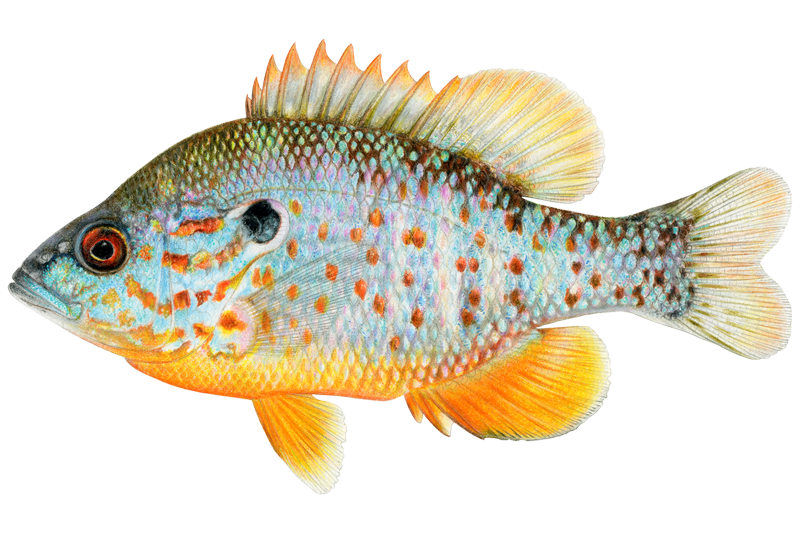
A thumb-sized centrarchid native to the Mississippi basin and Gulf Slope drainages, the orangespotted sunfish lives where most other sunfish can't — silty creeks, muddy ditches, turbid backwaters.
Breeding males wear electric-blue flanks dotted with glowing orange, making this small panfish a cult favorite among species hunters working a Lepomis life list.
Scientific Name: Lepomis humilis
Also known as Orangespot, Bream
- Greenish-silver back and sides scattered with reddish-orange spots; breeding males light up with iridescent blue-green sides and yellow-orange fins.
- Black ear flap edged in milky white and small — no larger than the eye — which separates this fish cleanly from longear sunfish.
- The only Lepomis with a pair of sensory pores in depressions between the eyes, a diagnostic mark separating it from every relative.
- Tiny by sunfish standards: most fish run 2.5–4 inches, with exceptional individuals reaching 5–6 inches.
What to know
Habitat Distribution
- Native across the Mississippi basin from Ohio to Louisiana and west to the Dakotas, plus Gulf Slope drainages from Mobile Bay to the Colorado River in Texas.
- Slow water is the rule: creeks, oxbows, sloughs, ponds, roadside ditches, and silty backwaters with sand or silt substrate.
- Tolerates turbidity, siltation, and low oxygen that knock other sunfishes out — agricultural runoff has actually expanded its range upstream in many Midwestern watersheds.
- Warmwater species comfortable from about 50–82°F; absent from cold, fast, clear upland streams where bluegill and longear dominate.
Specific Spots
- Quiet pools, backwaters, and overflow areas off the main current — especially silt-laden floodplain pools and slow margins along sand or fine substrate.
- Tight to scattered cover: fallen branches, brush piles, and submerged vegetation along weedlines, where the fish hold close and pick at small prey drifting by.
- Shallow shoreline flats in ankle-deep to a few feet of water during spawning, when colonial nesting males fan out silt over sand and gravel.
Orangespotted Sunfish FAQ
Answers from onWater's species guide.
What are the best lures and bait for Orangespotted Sunfish?
Live bait does the heavy lifting: a small piece of nightcrawler, a red wiggler, a waxworm, or a mealworm threaded on a size 14–18 hook is the most reliable presentation.
What flies work for Orangespotted Sunfish?
Small nymphs and bead-head soft hackles in sizes 14–18, patterns like Pheasant Tails and Hare's Ears imitate the midge larvae and small mayfly nymphs that make up most of the diet. Dead-drift or creep them slowly along weed edges.
What do Orangespotted Sunfish eat?
Eats small aquatic insects (water boatmen, midge larvae), zooplankton like Daphnia and copepods, and the occasional tiny fish, its small mouth limits prey size and makes it efficient on micro-forage. For bait, that translates to a pinch of worm, a waxworm, or a mealworm on a size 14–18 hook.
Where do Orangespotted Sunfish live?
Native across the Mississippi basin from Ohio to Louisiana and west to the Dakotas, plus Gulf Slope drainages from Mobile Bay to the Colorado River in Texas. Slow water is the rule: creeks, oxbows, sloughs, ponds, roadside ditches, and silty backwaters with sand or silt substrate.
See it in the app
Most maps show you water.
onWater shows you Orangespotted Sunfish.



- 01 · Species map filter
Map every Orangespotted Sunfish water
Pick Orangespotted Sunfish and the map zeroes in on the waters they call home. No more guessing which lake holds them.
- 02 · Waterbody species
Tap any water. See what lives there.
Species, behavior and seasonal patterns for every lake, river and pond, before you leave the driveway.
- 03 · Angler Intelligence
Ask how to catch Orangespotted Sunfish
Tactics, gear and timing from onWater's AI fishing guide, tuned to the species and the water you're on.
Stop guessing where Orangespotted Sunfish are.
Open the map, filter by Orangespotted Sunfish, and head to water that holds them. Download onWater and plan your next trip in minutes.
- Species map filter
- Angler Intelligence
- Fishing journal
Explore other species
Trout, bass, salmon, panfish and everything in between. Each guide unpacks the behavior, seasons, and tactics that put fish in the net.
No species information available.
Smarter Fishing Starts in the App.
onWater Fish gives you everything you need to plan smarter, fish better, and own every trip from first cast to last.