Brown Bullhead
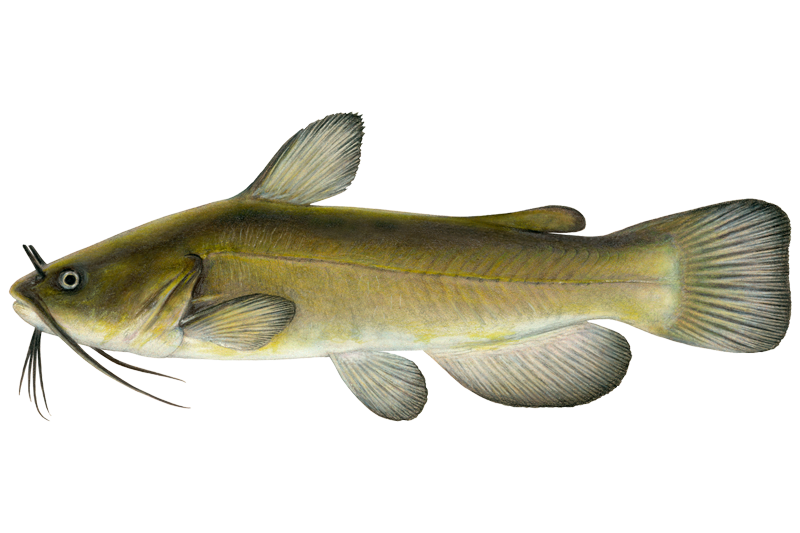
A scaleless, mottled-flank catfish of soft-bottomed lakes, ponds, and slow streams across most of the eastern half of the country, with introduced populations now widespread in the West.
Brown Bullhead are the quintessential warm-summer-night fish — a starter species for many anglers and a serious target in the Northeast, where 'hornpout' fishing remains a tradition.
Scientific Name: Ameiurus nebulosus
Also known as Hornpout, Horned Pout, Mud Pout, Mud Cat, Marbled Bullhead, Common Bullhead, Speckled Cat
- Olive to brown back with prominent dark mottling along the flanks fading to a yellow or white belly — the mottling is the key field mark separating it from the uniformly colored Black Bullhead.
- Chin barbels are dark brown to dusky black; this is the most reliable way to tell it from Yellow Bullhead (white chin barbels) and Black Bullhead (solid black, no pale base).
- Pectoral spines have 5–8 large saw-like serrations on the rear edge — you can feel them by running a finger along the spine. The corner-of-mouth barbel reaches well past the pectoral fin base.
- Most adults run 8–14 inches and a pound or so; a two-pound fish is a good one, and the IGFA all-tackle record stands at 7 lbs 6 oz.
What to know
Habitat Distribution
- Native to Atlantic and Gulf drainages from the Maritimes to Alabama, plus the St. Lawrence, Great Lakes, Hudson Bay, and Mississippi basins; introduced and well-established across much of the West, where it was among the first fish brought to the Pacific coast in the 1870s.
- Soft-bottomed lakes, ponds, reservoirs, and slow-moving streams are the core habitat — sand, mud, or silt substrate with submerged vegetation. Less common in fast or rocky water than other catfishes.
- One of the most pollution- and oxygen-tolerant freshwater fish in North America: survives water up to 97°F, dissolved oxygen as low as 0.2 ppm (gulping air through the swim bladder), and tolerates brackish tidal marshes.
Specific Spots
- Soft-bottomed coves and weedy shallows are the daytime forage flats once light fades — bullheads cruise these areas after dark, working the bottom by smell.
- Daytime hideouts: undercut banks, root tangles, submerged logs, rock overhangs, and any woody debris pile in pools or sluggish runs. Fish stage tight to this cover until dusk.
- In spring, look for pre-spawn schools moving into shallow vegetated bays and around any large bottom object — logs, rocks, even tires and concrete blocks — which become nest sites.
- Brown Bullhead tend to hold deeper and reach larger sizes than the other bullheads, so a slow drop-off into a soft-bottom basin is a good place to find better fish.
Brown Bullhead FAQ
Answers from onWater's species guide.
What are the best lures and bait for Brown Bullhead?
Nightcrawlers and earthworms are the bait, by a wide margin. Roughly two-thirds of trophy-class bullheads in tracked records come on worms, and pungent compost-pile worms outfish store-bought.
What do Brown Bullhead eat?
Bottom omnivores that locate food almost entirely by smell and the chemosensors in their barbels, this is why scented natural baits crush them and artificial lures rarely do. Anything pungent and sitting on the bottom is in play.
Where do Brown Bullhead live?
Native to Atlantic and Gulf drainages from the Maritimes to Alabama, plus the St. Lawrence, Great Lakes, Hudson Bay, and Mississippi basins; introduced and well-established across much of the West, where it was among the first fish brought to the Pacific coast in the 1870s.
See it in the app
Most maps show you water.
onWater shows you Brown Bullhead.



- 01 · Species map filter
Map every Brown Bullhead water
Pick Brown Bullhead and the map zeroes in on the waters they call home. No more guessing which lake holds them.
- 02 · Waterbody species
Tap any water. See what lives there.
Species, behavior and seasonal patterns for every lake, river and pond, before you leave the driveway.
- 03 · Angler Intelligence
Ask how to catch Brown Bullhead
Tactics, gear and timing from onWater's AI fishing guide, tuned to the species and the water you're on.
Stop guessing where Brown Bullhead are.
Open the map, filter by Brown Bullhead, and head to water that holds them. Download onWater and plan your next trip in minutes.
- Species map filter
- Angler Intelligence
- Fishing journal
Explore other species
Trout, bass, salmon, panfish and everything in between. Each guide unpacks the behavior, seasons, and tactics that put fish in the net.
No species information available.
Smarter Fishing Starts in the App.
onWater Fish gives you everything you need to plan smarter, fish better, and own every trip from first cast to last.