Sacramento Pikeminnow
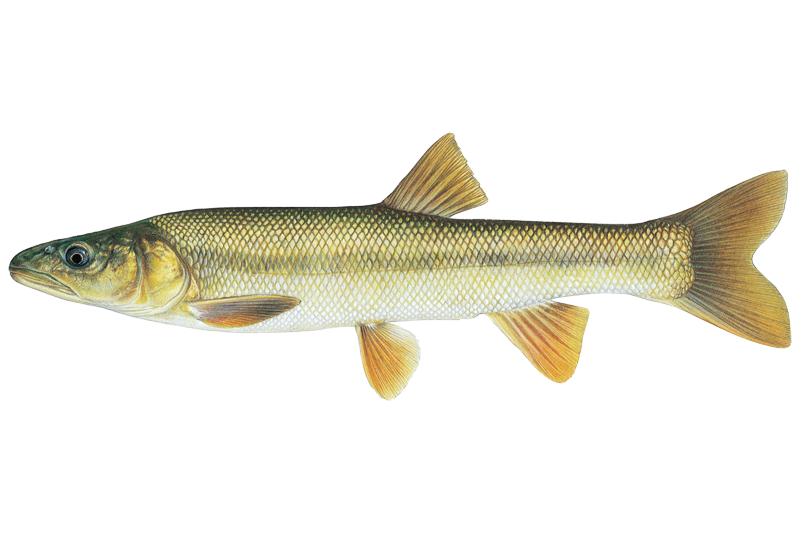
California's largest native minnow, the Sacramento Pikeminnow is a long, pike-profiled cyprinid endemic to the state's interior drainages.
Adults grow past two feet, switch to a fish-and-crayfish diet as they mature, and have become a legitimate summer fly-rod target now that anglers are getting past the old 'rough fish' label.
Scientific Name: Ptychocheilus grandis
Also known as Sacramento Squawfish, Pikeminnow
- Long, slender body with a flattened conical head and a large terminal mouth whose upper jaw extends back past the eye — the giveaway feature versus other big California cyprinids.
- Adults are dark brown to olive on the back fading to a golden-yellow belly, with a narrow caudal peduncle and a deeply forked tail; juveniles are silvery with a dark lateral band and a spot at the tail base.
- Spawning fish take on an orange-red flush in the tail and fins, and males develop breeding tubercles on the head.
- Most quality fish run around 24 inches and 5–10 lbs, with rare individuals pushing past 40 inches; the rod-and-reel record stands at 11 lb 7 oz, well below the species' biological ceiling.
What to know
Habitat Distribution
- Endemic to California — native across the Sacramento-San Joaquin system, Clear Lake basin, Russian River, Pajaro-Salinas drainages, and upper Pit River.
- Bait-bucket releases established the species in the Eel River around 1980, and it now occupies that whole system; aqueduct transfers have also seeded Chorro Creek and a few Southern California reservoirs.
- A warmwater fish at heart, comfortable from roughly 65–82°F and tolerating brief excursions near 100°F — it occupies mainstem reaches that go too warm for trout in summer.
- Tolerates salinity up to about 8 parts per thousand and occasionally turns up in tidal zones, though it's uncommon in the Delta and rare in Suisun Marsh.
Specific Spots
- Big adults sit in the deepest pools and slow runs through the heat of the day, tucked under cut banks, overhanging brush, and large woody debris where they can hunt out of cover.
- Dawn and dusk pull those same fish up onto riffles and riffle margins to feed — these low-light shallow windows are the prime shot for an angler.
- Smaller fish hold in backwaters and side pools to dodge predation (including cannibalism from larger pikeminnow), so juveniles are easier to find in soft, sheltered water.
- During spring spawning, expect concentrations on gravel riffles and pool tailouts, with lake and big-river fish running up tributaries to drop eggs.
Sacramento Pikeminnow FAQ
Answers from onWater's species guide.
What are the best lures and bait for Sacramento Pikeminnow?
Small spinners and spoons in silver or gold are reliable producers, and small swimbaits or minnow-profile crankbaits worked along current seams will draw strikes from actively hunting adults.
What flies work for Sacramento Pikeminnow?
Streamers carry the day for adult fish: articulated patterns, Clouser Minnows and Zonkers (both imitate baitfish), Woolly Buggers, and sculpin imitations fished across the full water column. Don't undersize, big pikeminnow are tuned to a baitfish profile.
What do Sacramento Pikeminnow eat?
Diet shifts hard with size: fish under 4 inches eat aquatic insect larvae and invertebrates, 4–8 inch fish add crayfish and small minnows, and adults over 8 inches feed almost entirely on fish and crayfish, which is why streamers and minnow-profile lures dominate for grown fish.
Where do Sacramento Pikeminnow live?
Endemic to California, native across the Sacramento-San Joaquin system, Clear Lake basin, Russian River, Pajaro-Salinas drainages, and upper Pit River.
See it in the app
Most maps show you water.
onWater shows you Sacramento Pikeminnow.



- 01 · Species map filter
Map every Sacramento Pikeminnow water
Pick Sacramento Pikeminnow and the map zeroes in on the waters they call home. No more guessing which lake holds them.
- 02 · Waterbody species
Tap any water. See what lives there.
Species, behavior and seasonal patterns for every lake, river and pond, before you leave the driveway.
- 03 · Angler Intelligence
Ask how to catch Sacramento Pikeminnow
Tactics, gear and timing from onWater's AI fishing guide, tuned to the species and the water you're on.
Stop guessing where Sacramento Pikeminnow are.
Open the map, filter by Sacramento Pikeminnow, and head to water that holds them. Download onWater and plan your next trip in minutes.
- Species map filter
- Angler Intelligence
- Fishing journal
Explore other species
Trout, bass, salmon, panfish and everything in between. Each guide unpacks the behavior, seasons, and tactics that put fish in the net.
No species information available.
Smarter Fishing Starts in the App.
onWater Fish gives you everything you need to plan smarter, fish better, and own every trip from first cast to last.