Alligator Gar
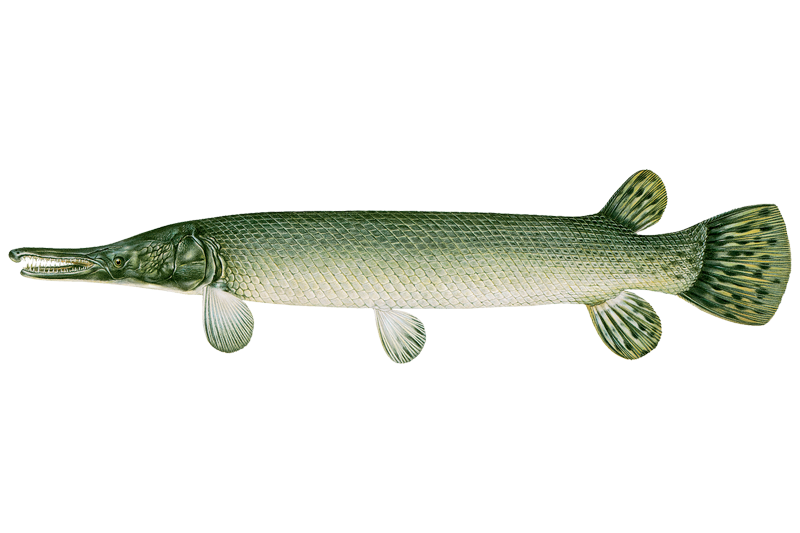
A living relic of the Gulf Coastal Plain, the alligator gar is the largest of North America's gars and one of the largest freshwater fish on the continent — a heavily armored, air-breathing predator that can exceed nine feet and live past a hundred years.
Anglers chase them in slow rivers, oxbows, bayous, and brackish coastal bays for the sheer scale and prehistoric character of the fight.
Scientific Name: Atractosteus spatula
Also known as Gator Gar, Greater Gar, Mississippi Alligator Gar, Garpike, Garfish, Catán, Pejelagarto
- Two rows of large, canine-like teeth on the upper jaw — visible even when the mouth is closed, and the surest way to separate it from every other US gar species.
- Broad, short, alligator-like snout viewed from above, unlike the long thin bill of a longnose gar or the spotted shorter snout of spotted and Florida gars.
- Torpedo-shaped body sheathed in hard, interlocking diamond-shaped ganoid scales — bony armor often described as chain mail. Olive to brown above, fading to a pale belly; juveniles wear a light stripe from snout to tail.
- Trophy-class size routine for the species: 4–6 feet and 100–160 pounds, with documented fish over 9 feet and 300+ pounds. The IGFA-class record stands at 327 pounds from Mississippi.
What to know
Habitat Distribution
- A Gulf Coastal Plain native, historically ranging from the Florida Panhandle west to Veracruz and up the Mississippi basin into the lower Ohio and Missouri rivers. The current stronghold is the western Gulf Coast, with the largest remaining populations in Texas river systems.
- Extirpated from much of its northern range — gone from Illinois by the 1960s and last verified in Kentucky in 1977 — though hatchery restoration is now active across at least six mid-range states.
- Big, slow water is the rule: large rivers, oxbow lakes, bayous, swamps, reservoirs, and coastal bays. The most salinity-tolerant gar, it moves freely between fresh and brackish water and forages well into Gulf estuaries.
- A vascularized swim bladder lets it gulp air at the surface, so it persists in stagnant, low-oxygen backwaters where other large predators can't survive. Successful spawning, however, depends on seasonal floodplain inundation — the habitat bottleneck across most of its range.
Specific Spots
- Deep pools, river bends, and slow main-channel margins next to heavy structure — submerged timber, root wads, fallen trees, bridge pilings, and riprap — where adults lie motionless before striking.
- In warm months, fish work the upper water column and surface-roll near floating debris, logs, and overhanging vegetation. Audible gulping at the surface is the primary cue for sight-fishing.
- Deep cuts with mud or clay bottoms in rivers and bayous hold fish year-round; flooded vegetation pulls them shallow during the spring spawn.
- In coastal bays and tidal creeks, look in estuarine channels and back bays where the diet shifts to include blue crabs alongside baitfish.
Alligator Gar FAQ
Answers from onWater's species guide.
What are the best lures and bait for Alligator Gar?
Cut bait carries the fishery: 4-inch chunks of carp, smallmouth buffalo, gizzard shad, mullet, or sucker on a 3/0 J-hook or treble, fished on bottom or under a big slip-float with little to no added weight.
What flies work for Alligator Gar?
Rope flies, a 6–9 inch length of frayed quarter-inch nylon rope on a swivel or shank, are the gar-specific pattern. Teeth tangle in the fibers and no hook-set is needed. Effective, but slow to remove, which is why some catch-and-release anglers avoid them.
What do Alligator Gar eat?
Adults eat fish, mostly rough species like gizzard shad, smallmouth buffalo, common carp, and mullet, which is exactly why a fresh chunk of carp, buffalo, or shad on a heavy hook is the standard bait.
Where do Alligator Gar live?
A Gulf Coastal Plain native, historically ranging from the Florida Panhandle west to Veracruz and up the Mississippi basin into the lower Ohio and Missouri rivers. The current stronghold is the western Gulf Coast, with the largest remaining populations in Texas river systems.
See it in the app
Most maps show you water.
onWater shows you Alligator Gar.



- 01 · Species map filter
Map every Alligator Gar water
Pick Alligator Gar and the map zeroes in on the waters they call home. No more guessing which lake holds them.
- 02 · Waterbody species
Tap any water. See what lives there.
Species, behavior and seasonal patterns for every lake, river and pond, before you leave the driveway.
- 03 · Angler Intelligence
Ask how to catch Alligator Gar
Tactics, gear and timing from onWater's AI fishing guide, tuned to the species and the water you're on.
Stop guessing where Alligator Gar are.
Open the map, filter by Alligator Gar, and head to water that holds them. Download onWater and plan your next trip in minutes.
- Species map filter
- Angler Intelligence
- Fishing journal
Explore other species
Trout, bass, salmon, panfish and everything in between. Each guide unpacks the behavior, seasons, and tactics that put fish in the net.
No species information available.

Smarter Fishing Starts in the App.
onWater Fish gives you everything you need to plan smarter, fish better, and own every trip from first cast to last.