Striped Bass
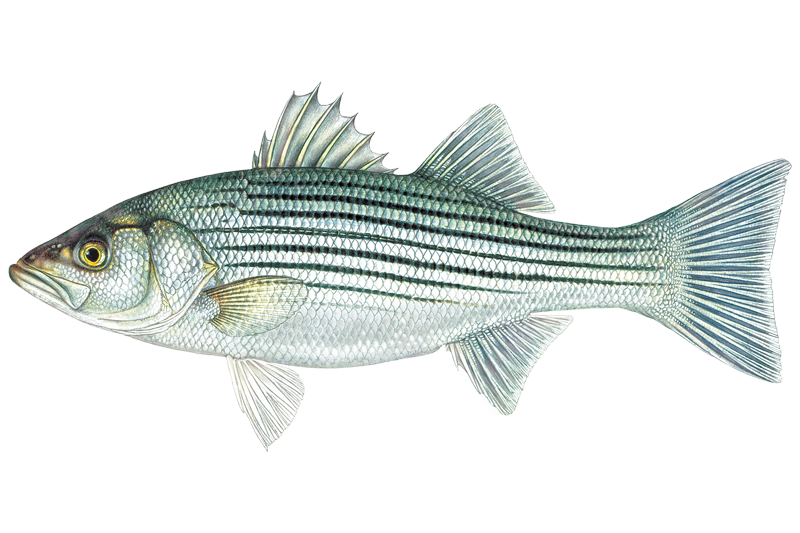
An anadromous coastal heavyweight native to the Atlantic seaboard and Gulf drainages, introduced to the Pacific in the 1880s, and stocked into reservoirs from the Southeast to the desert Southwest.
Stripers grow large, travel with the bait, and have built a fishing culture around themselves — surf, jetty, boat, and night tides on the coast; downrigger work and shad blitzes inland.
Scientific Name: Morone saxatilis
Also known as Striper, Rockfish, Linesider, Rock, Gulf Coast Striped Bass
- Streamlined silver body with 7–8 unbroken dark stripes running gill-to-tail; back shades olive-green to steel blue, belly white.
- Two distinctly separate parallel tooth patches on the base of the tongue — the cleanest separator from white bass (one patch) and hybrid wipers (joined patches).
- Stripes are continuous and uninterrupted; broken or wavy stripes mean it's a hybrid striped bass, not a true striper.
- Typical adults run 5–20 lb and 20–35 inches; coastal fish commonly reach 20–40 lb, with the rod-and-reel record at 81 lb 14 oz.
What to know
Habitat Distribution
- Native along the Atlantic from the St. Lawrence south to Florida and across Gulf drainages to Louisiana; introduced to the Pacific Coast and now established from San Diego to Vancouver Island.
- Stocked widely in interior reservoirs and tailraces; most inland populations aren't self-sustaining because spawning needs 30+ miles of free-flowing river to keep drifting eggs oxygenated.
- A temperate-water fish that does best between 64–70°F; landlocked stripers in summer get squeezed into a thin band of cool, oxygenated water just above the thermocline.
- Euryhaline by nature — adults move freely between ocean, estuary, and freshwater, with some river systems holding fully resident, non-migratory populations.
Specific Spots
- Coastal fish set up on current-swept structure — tidal rips, rocky points, jetties, inlet mouths, depth changes — anywhere moving water funnels bait into a predictable lane.
- In summer reservoirs, the fish stack in the narrow thermal-oxygen window just above the thermocline; sonar and downriggers usually beat blind casting.
- Spring and fall move them shallow — windblown shorelines, points, humps, and drop-offs that tie into deeper water hold feeding fish.
- Spawning runs push fish miles up tidal rivers into turbulent flow over rock and gravel, sometimes 100+ km inland from saltwater.
Striped Bass FAQ
Answers from onWater's species guide.
What are the best lures and bait for Striped Bass?
Live and cut natural baits carry the trophy game, eels at night, fresh bunker chunks on the bottom, sandworms and bloodworms at dawn, and live shad or herring inland.
What flies work for Striped Bass?
Baitfish streamers do the heavy lifting, Clouser Minnows and Lefty's Deceivers (both imitate baitfish), Half-and-Halfs, flatwings, and slim sand eel patterns cover most coastal water.
What do Striped Bass eat?
Saltwater stripers live on Atlantic menhaden (bunker) above almost everything else, with bay anchovy, silversides, herring, sand eels, and squid filling in, which is why bunker imitations, sand eel flies, and big swimming plugs dominate coastal tackle boxes.
Where do Striped Bass live?
Native along the Atlantic from the St. Lawrence south to Florida and across Gulf drainages to Louisiana; introduced to the Pacific Coast and now established from San Diego to Vancouver Island.
See it in the app
Most maps show you water.
onWater shows you Striped Bass.



- 01 · Species map filter
Map every Striped Bass water
Pick Striped Bass and the map zeroes in on the waters they call home. No more guessing which lake holds them.
- 02 · Waterbody species
Tap any water. See what lives there.
Species, behavior and seasonal patterns for every lake, river and pond, before you leave the driveway.
- 03 · Angler Intelligence
Ask how to catch Striped Bass
Tactics, gear and timing from onWater's AI fishing guide, tuned to the species and the water you're on.
Stop guessing where Striped Bass are.
Open the map, filter by Striped Bass, and head to water that holds them. Download onWater and plan your next trip in minutes.
- Species map filter
- Angler Intelligence
- Fishing journal
Explore other species
Trout, bass, salmon, panfish and everything in between. Each guide unpacks the behavior, seasons, and tactics that put fish in the net.
No species information available.

Smarter Fishing Starts in the App.
onWater Fish gives you everything you need to plan smarter, fish better, and own every trip from first cast to last.