Pumpkinseed
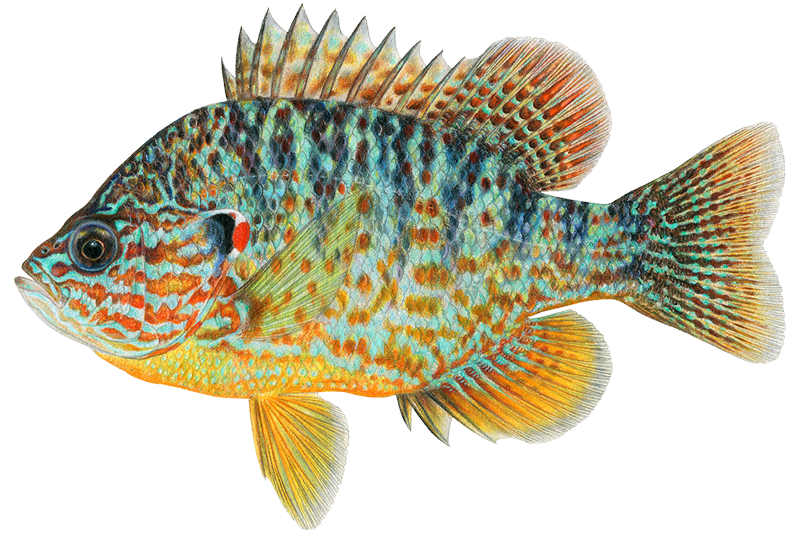
The most ornately colored sunfish in North American waters — olive flanks flecked with copper and orange, blue-green wavy lines across the cheeks, and a crimson half-moon on the ear flap.
Native across the Northeast, upper Midwest, and Great Lakes, and introduced into the Rockies and Pacific lowlands. A staple of vegetated ponds, weedy lake edges, and slow creek pools.
Scientific Name: Lepomis gibbosus
Also known as Sun perch, Sunny, Pond perch, Punkie, Kivver, Common sunfish, Yellow sunfish
- The crimson half-moon on the rear edge of the black ear flap is the giveaway — present in both sexes, brilliant on breeding males, and absent in bluegill.
- Wavy emerald and yellow bands across the cheek and gill cover, plus orange-and-gold spotting on the upper body, separate it from both bluegill and redear sunfish.
- Deep, saucer-shaped, laterally compressed body with a small terminal mouth and long, pointed pectorals that reach past the eye when bent forward.
- Typical adults run 4–6 inches; an 8-inch fish is a good one and 10 inches is genuine trophy size, with the all-tackle record at 1 pound 8 ounces.
What to know
Habitat Distribution
- Native across Atlantic Slope drainages from the Maritimes south to the Carolinas, plus the Great Lakes and upper Mississippi basin — the northernmost range of any Lepomis sunfish.
- Widely introduced and established in the Great Plains, Rocky Mountain states, and Pacific coastal lowlands, mostly through stocking as a panfish.
- A clear-water specialist tied to rooted aquatic vegetation. Optimal water sits around 70–75°F, but they handle cooler water better than other sunfish and tolerate low oxygen reasonably well.
- Sensitive to siltation and shoreline degradation — their disappearance from a lake is often an early signal of declining water quality.
Specific Spots
- Sits tight to vegetated shoreline in 6 inches to 6 feet of water, especially in wind-protected coves and back bays where weeds meet a sand or gravel bottom.
- Adults gang up under fallen timber, deadheads, and submerged logs at the waterline — the bigger fish in a school often hold one structure removed from the main pack.
- During the spawn, colonies of saucer-shaped nests sit in 6–12 inches of water over clean sand or gravel near vegetation, with males parked on the bed and visible from the bank.
- As water cools in fall, schools slide off shore toward drop-offs and deeper basin edges, which is where to look once shallow weed beds die back.
Pumpkinseed FAQ
Answers from onWater's species guide.
What are the best lures and bait for Pumpkinseed?
Live bait carries the day: a piece of nightcrawler, red wiggler, waxworm, cricket, or mealworm on a size 8–14 hook under a small float, set to suspend just above the weed tops. Micro jigs from 1/64 to 1/16 oz tipped with a small curly-tail grub or tube, fished slow along weed edges and woody cover.
What flies work for Pumpkinseed?
Small foam or cork poppers in size 10–12 are the classic warm-weather pattern. The 'pop-and-drop' rig, a popper up top with a small wet fly or bead-head nymph dropped 12–18 inches below, covers the surface and subsurface in one cast.
What do Pumpkinseed eat?
An invertebrate eater built around hard-shelled prey, molar-like throat teeth let pumpkinseeds crush snails and small mussels that other sunfish can't handle, and they actively browse weed stalks looking for them.
Where do Pumpkinseed live?
Native across Atlantic Slope drainages from the Maritimes south to the Carolinas, plus the Great Lakes and upper Mississippi basin, the northernmost range of any Lepomis sunfish.
See it in the app
Most maps show you water.
onWater shows you Pumpkinseed.



- 01 · Species map filter
Map every Pumpkinseed water
Pick Pumpkinseed and the map zeroes in on the waters they call home. No more guessing which lake holds them.
- 02 · Waterbody species
Tap any water. See what lives there.
Species, behavior and seasonal patterns for every lake, river and pond, before you leave the driveway.
- 03 · Angler Intelligence
Ask how to catch Pumpkinseed
Tactics, gear and timing from onWater's AI fishing guide, tuned to the species and the water you're on.
Stop guessing where Pumpkinseed are.
Open the map, filter by Pumpkinseed, and head to water that holds them. Download onWater and plan your next trip in minutes.
- Species map filter
- Angler Intelligence
- Fishing journal
Explore other species
Trout, bass, salmon, panfish and everything in between. Each guide unpacks the behavior, seasons, and tactics that put fish in the net.
No species information available.

Smarter Fishing Starts in the App.
onWater Fish gives you everything you need to plan smarter, fish better, and own every trip from first cast to last.