Lake Whitefish
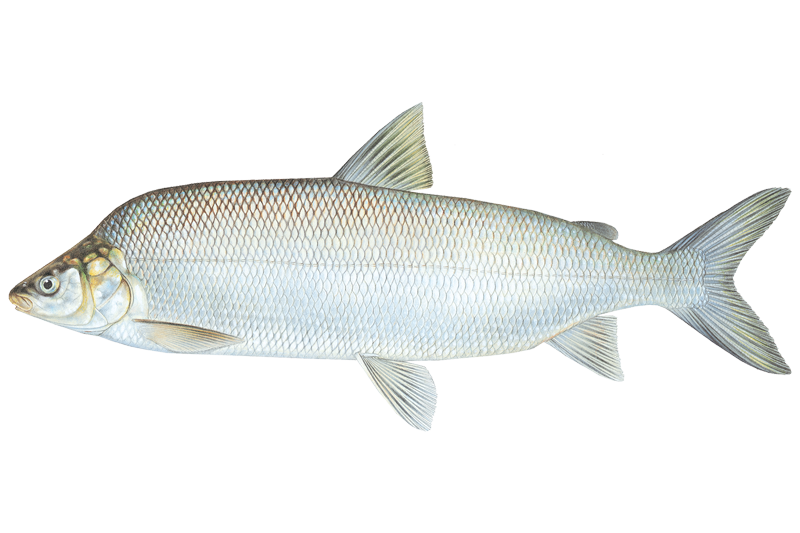
A deep, cold-water schooling salmonid native across Alaska, Canada, the Great Lakes basin, the upper Midwest, and northern New England, with introduced populations in parts of the Mountain West and Pacific Northwest.
Silvery, soft-mouthed, and bottom-oriented for most of the year, lake whitefish are best known to ice anglers and to a small but devoted group of fly fishers who catch them during spring midge and mayfly hatches.
The flesh is considered among the finest of any North American freshwater fish.
Scientific Name: Coregonus clupeaformis
Also known as Common Whitefish, Humpback Whitefish, Great Lakes Whitefish, Sault Whitefish, Otsego Bass, Inland Whitefish, Eastern Whitefish
- Silvery to satiny white sides with an olive to pale greenish-brown back; older fish develop a distinct hump behind the small head, the source of the 'humpback' nickname.
- Small, toothless, subterminal mouth — the snout overhangs the lower jaw, opening downward for feeding on bottom invertebrates. A small adipose fin sits between the dorsal and tail.
- Easiest IDs against lookalikes: cisco have the lower jaw projecting past the snout (opposite of whitefish); round whitefish have a single nostril flap rather than the lake whitefish's double flap and a more cylindrical body.
- Typical adults run 14–20 inches and 1–3 pounds; fish over 20 inches and 6 pounds are notable, the IGFA all-tackle record stands at 5 lbs 8 oz, and rare individuals push beyond 10 pounds.
What to know
Habitat Distribution
- Native through Alaska, Canada, the Great Lakes basin, the upper Mississippi drainage, and northern New England; introduced populations are established in parts of the Columbia River basin and several large Mountain West reservoirs and lakes.
- A cold-water obligate that holds in 46–57°F water with high dissolved oxygen — deep, clean lakes and large cool rivers, occasionally tolerating brackish water near coastal drainages.
- Climate-sensitive at the southern edge of its range. Warming surface temperatures, nutrient loading, and invasive dreissenid mussels (which strip out the zooplankton young whitefish need) all pressure populations.
Specific Spots
- In summer, schools push deep — typically 50–120 feet in most lakes, deeper still in the Great Lakes — chasing the cold, oxygenated layer and feeding along soft bottoms where chironomid larvae and amphipods concentrate.
- Through the ice, sand and gravel bars and the edges of points in 20–60 feet are the bread-and-butter zones; schools cruise rather than camp, so mobility and a flasher matter more than nailing one hole.
- Fall spawners stack on shoreline shoals, reefs, and around islands in less than 25–30 feet of water over gravel, rubble, or coarse sand, always with deeper water close by.
- In rivers — most relevant during fall and winter runs in western tailwaters — fish drop into soft side eddies in 6–15 feet over sand or fine gravel, never out in heavy current.
Lake Whitefish FAQ
Answers from onWater's species guide.
What are the best lures and bait for Lake Whitefish?
Through the ice, small jigging spoons (1/8–3/8 oz), Swedish Pimples, Kastmasters, Northland Buck-Shot Rattle Spoons, Williams Wablers, tipped with wax worms, maggots, or a minnow piece are the dominant approach.
What flies work for Lake Whitefish?
Small beadhead nymphs are the highest-percentage flies. A Prince Nymph in size 14–22 is widely considered the top producer; Pheasant Tails (which imitate mayfly nymphs) and Hare's Ears in the same sizes round out the box. Small is the entire point, anything bigger doesn't fit the mouth or match the natural forage.
What do Lake Whitefish eat?
The bread-and-butter forage is bottom invertebrates: amphipods (scuds), fingernail clams, snails, opossum shrimp, and chironomid (midge) larvae, the reason small beadhead nymphs and tiny tipped jigging spoons consistently outproduce larger offerings. Spring is the window when the diet leaves the bottom.
Where do Lake Whitefish live?
Native through Alaska, Canada, the Great Lakes basin, the upper Mississippi drainage, and northern New England; introduced populations are established in parts of the Columbia River basin and several large Mountain West reservoirs and lakes.
See it in the app
Most maps show you water.
onWater shows you Lake Whitefish.



- 01 · Species map filter
Map every Lake Whitefish water
Pick Lake Whitefish and the map zeroes in on the waters they call home. No more guessing which lake holds them.
- 02 · Waterbody species
Tap any water. See what lives there.
Species, behavior and seasonal patterns for every lake, river and pond, before you leave the driveway.
- 03 · Angler Intelligence
Ask how to catch Lake Whitefish
Tactics, gear and timing from onWater's AI fishing guide, tuned to the species and the water you're on.
Stop guessing where Lake Whitefish are.
Open the map, filter by Lake Whitefish, and head to water that holds them. Download onWater and plan your next trip in minutes.
- Species map filter
- Angler Intelligence
- Fishing journal
Explore other species
Trout, bass, salmon, panfish and everything in between. Each guide unpacks the behavior, seasons, and tactics that put fish in the net.
No species information available.
Smarter Fishing Starts in the App.
onWater Fish gives you everything you need to plan smarter, fish better, and own every trip from first cast to last.