Flathead Catfish
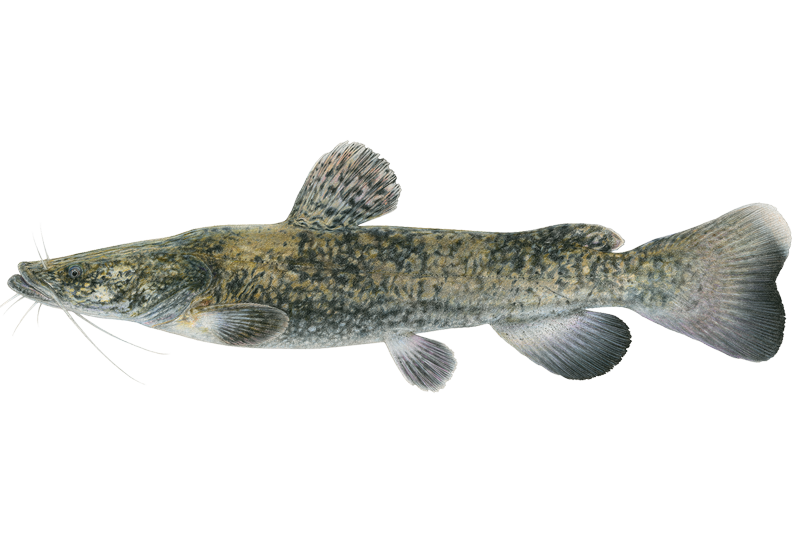
A heavy-bodied river catfish of the Mississippi, Missouri, and Ohio basins — and now established in dozens of drainages well beyond — the flathead is the deep-hole specialist of North American catfishing.
Solitary, nocturnal, and built around live prey, it's the second-largest catfish on the continent and routinely tops 50 pounds in mature waters.
Scientific Name: Pylodictis olivaris
Also known as Mudcat, Shovelhead Cat, Yellow Cat, Opelousas, Goujon, Johnnie Cat, Mississippi Cat
- Broad, distinctly flattened head between the eyes — the single most reliable feature separating flatheads from the rounder-headed channel and blue cats.
- Olive to pale yellow-brown back and sides, heavily mottled with black and brown, fading to a pale yellow or off-white belly; coloration runs darker in clear-water and younger fish.
- Lower jaw juts out past the upper jaw, and the tail is only slightly notched or squared — never deeply forked. Most fish under trophy size carry a white tip on the upper tail lobe.
- Common adults run 15–45 inches; mature populations regularly produce 50-pound fish, with rod-and-reel trophies in the 30–70 lb class and a 123-lb all-tackle record.
What to know
Habitat Distribution
- Native to the Mississippi, Missouri, and Ohio river basins, ranging from the northern Plains and lower Great Lakes fringe south to the Gulf and into northeast Mexico, west across Texas into New Mexico.
- Now introduced — much of it from unauthorized angler stockings — into at least 34 states, including Atlantic-slope rivers like the James, Potomac, Susquehanna, Cape Fear, and Savannah, plus parts of the Columbia and Colorado basins.
- A warm-water, large-river fish at heart: medium-to-large rivers, major tributaries, and reservoirs with slow, stable current and turbid water suit them best. Tolerates a wide thermal range and even mildly brackish water.
- Feeding ramps up sharply above 66°F, peaks through the 70s and 80s, and shuts off entirely below 45°F — a hard line that defines the northern limit of practical fishing seasons.
Specific Spots
- Big adults claim a single deep, sluggish pool with heavy woody cover — sunken logs, root wads, brush piles, undercut banks — and rarely move more than a mile or two from it across an entire season.
- Vertical or undercut banks with a slight overhang and submerged timber at least 10 feet deep are textbook holding lies, especially where the structure breaks the main current.
- A daily depth shuttle is the rule: deeper water (>13 ft) by day, shallower (
- Tailwaters below dams concentrate fish where current, oxygen, and stunned baitfish all stack up — one of the most reliably productive zones for rod-and-reel anglers across the range.
Flathead Catfish FAQ
Answers from onWater's species guide.
What are the best lures and bait for Flathead Catfish?
Live bait is the whole game: 4–10 inch bluegill, sunfish, bullheads, suckers, shad, creek chubs, or small carp, hooked to keep them swimming hard. The more commotion the bait makes, the more interest it draws, a tired bait is a wasted bait.
What do Flathead Catfish eat?
Adults are almost exclusively fish-eaters that demand live prey, bluegill and other sunfish, bullheads, suckers, shad, creek chubs, and carp in the 4–10 inch range. The struggle of a hooked baitfish is the strike trigger; dead, cut, or prepared baits that work for channel cats are largely ignored.
Where do Flathead Catfish live?
Native to the Mississippi, Missouri, and Ohio river basins, ranging from the northern Plains and lower Great Lakes fringe south to the Gulf and into northeast Mexico, west across Texas into New Mexico.
See it in the app
Most maps show you water.
onWater shows you Flathead Catfish.



- 01 · Species map filter
Map every Flathead Catfish water
Pick Flathead Catfish and the map zeroes in on the waters they call home. No more guessing which lake holds them.
- 02 · Waterbody species
Tap any water. See what lives there.
Species, behavior and seasonal patterns for every lake, river and pond, before you leave the driveway.
- 03 · Angler Intelligence
Ask how to catch Flathead Catfish
Tactics, gear and timing from onWater's AI fishing guide, tuned to the species and the water you're on.
Stop guessing where Flathead Catfish are.
Open the map, filter by Flathead Catfish, and head to water that holds them. Download onWater and plan your next trip in minutes.
- Species map filter
- Angler Intelligence
- Fishing journal
Explore other species
Trout, bass, salmon, panfish and everything in between. Each guide unpacks the behavior, seasons, and tactics that put fish in the net.
No species information available.
Smarter Fishing Starts in the App.
onWater Fish gives you everything you need to plan smarter, fish better, and own every trip from first cast to last.