Coho Salmon
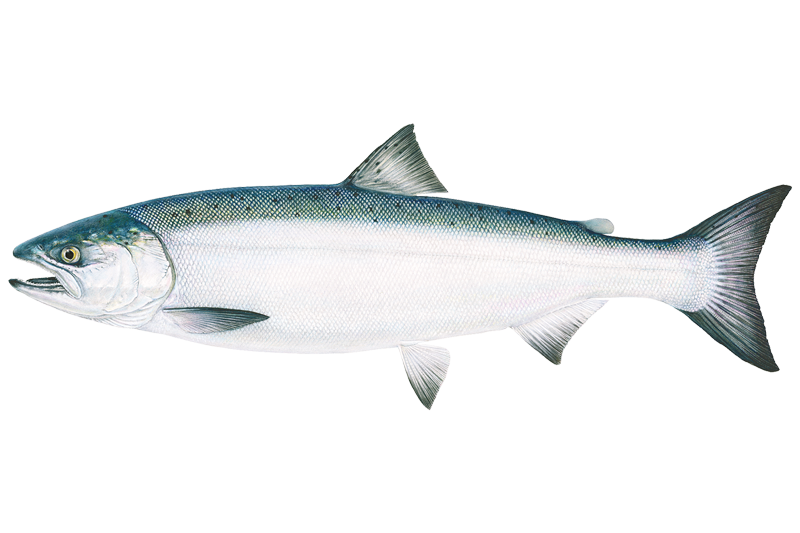
A Pacific salmon native to coastal streams from central California through Alaska, coho also support major stocked fisheries in all five Great Lakes.
Anglers chase them for their chrome-bright, football-shouldered build and willingness to chase down a fast-moving fly or lure. Of the Pacific salmon, they're the species most likely to crush a popper on the surface.
Scientific Name: Oncorhynchus kisutch
Also known as Silver Salmon, Silvers, Medium Red Salmon, Hoopid Salmon
- Ocean-phase fish are chrome-silver with a metallic blue-green back and small black spots only on the upper lobe of the tail — Chinook spot both lobes.
- White or light gumline on the lower jaw is the reliable in-hand separator from Chinook, which run black gums.
- Spawners turn deep maroon-red on the sides with a blue-green head; males develop a hooked kype and enlarged teeth, females less so.
- Typical adults run 20–28 inches and 8–12 lbs; Alaska and Great Lakes fish push into the high teens and 20+ lbs, with the all-tackle record at 33 lbs 4 oz.
What to know
Habitat Distribution
- Native to Pacific coast drainages from Monterey Bay north through Alaska and out the Aleutians, with historic inland runs hundreds of miles up the Columbia and Snake systems.
- Stocked into all five Great Lakes starting in the 1960s; that fishery is hatchery-dependent, with limited natural reproduction in tributaries.
- Anadromous life history — spawn and rear in cold, clean small streams and tributaries, then go to salt to grow before returning to natal water on a roughly 3-year cycle.
- Unlike Chinook, ocean-phase coho hug the nearshore zone rather than ranging the open Pacific, and they'll spawn in streams too small to support kings.
Specific Spots
- In rivers, look in the slow water — soft inside seams, back eddies, frog water, and lagoons — not the fast runs where steelhead and Chinook hold.
- Fresh fish often sit high in the water column in quiet pools, almost basking; once a run gets pressured, they drop deeper and require sink-tips or weighted presentations.
- Tidewater and the lowest river miles produce the best fishing — chrome fish, peak aggression, fish bunched on the move.
- Spawners cut redds at the heads of riffles in stable gravel; juveniles winter in side channels and off-channel sloughs that buffer them from flood scour.
Coho Salmon FAQ
Answers from onWater's species guide.
What are the best lures and bait for Coho Salmon?
Trolled spoons, hoochies (squid skirts), trolling flies, and cut-plug herring or anchovy rigs are the ocean and big-water staples; pink, orange, and chartreuse outfish everything else.
What flies work for Coho Salmon?
Bright, flashy streamers do most of the work: egg-sucking leeches, pink Starlight Leeches, Hareball Leeches, Dolly Llamas, and Intruder-style patterns in sizes 4 to 1/0, these trigger the reaction strikes that hunting fish can't ignore.
What do Coho Salmon eat?
At sea, adults eat small schooling baitfish, herring, sandlance, anchovies, sardines, plus squid, which is what chrome streamers like Dolly Llamas, Hareball Leeches, and Clouser-style baitfish patterns imitate.
Where do Coho Salmon live?
Native to Pacific coast drainages from Monterey Bay north through Alaska and out the Aleutians, with historic inland runs hundreds of miles up the Columbia and Snake systems. Stocked into all five Great Lakes starting in the 1960s; that fishery is hatchery-dependent, with limited natural reproduction in tributaries.
See it in the app
Most maps show you water.
onWater shows you Coho Salmon.



- 01 · Species map filter
Map every Coho Salmon water
Pick Coho Salmon and the map zeroes in on the waters they call home. No more guessing which lake holds them.
- 02 · Waterbody species
Tap any water. See what lives there.
Species, behavior and seasonal patterns for every lake, river and pond, before you leave the driveway.
- 03 · Angler Intelligence
Ask how to catch Coho Salmon
Tactics, gear and timing from onWater's AI fishing guide, tuned to the species and the water you're on.
Stop guessing where Coho Salmon are.
Open the map, filter by Coho Salmon, and head to water that holds them. Download onWater and plan your next trip in minutes.
- Species map filter
- Angler Intelligence
- Fishing journal
Explore other species
Trout, bass, salmon, panfish and everything in between. Each guide unpacks the behavior, seasons, and tactics that put fish in the net.
No species information available.

Smarter Fishing Starts in the App.
onWater Fish gives you everything you need to plan smarter, fish better, and own every trip from first cast to last.