Blue Catfish
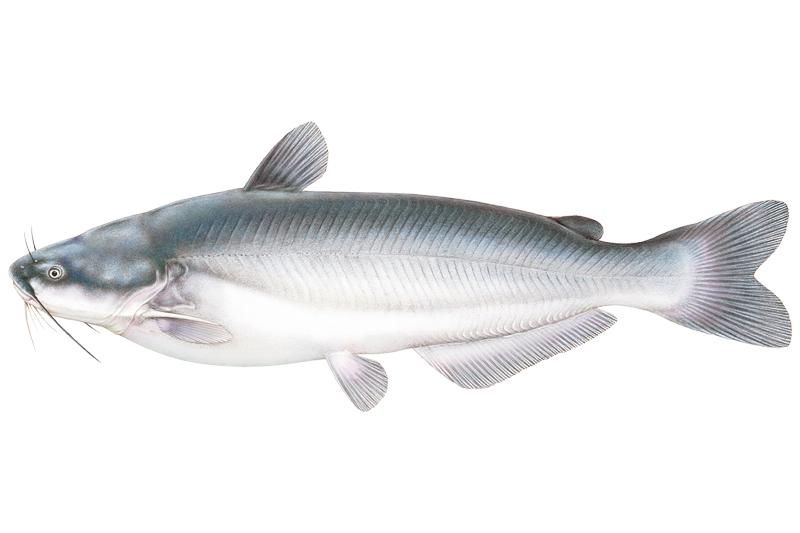
The largest catfish native to North America, blue catfish are big-river fish at heart — built for the deep channels and tailwaters of the Mississippi, Missouri, Ohio, and Rio Grande systems, with established introduced populations across the Chesapeake watershed and a handful of western reservoirs.
Mature fish in the 30–70 pound class are common where populations are healthy, and 100-pounders are a real possibility.
Scientific Name: Ictalurus furcatus
Also known as Blue cat, Humpback blue, Great blue catfish
- Heavy-bodied with a pronounced dorsal hump, slate blue-gray on the back fading to a chalky white belly. Breeding males darken to a deep blue.
- The straight, comb-edged anal fin with 30–36 rays is the cleanest field mark — channel cats have a rounded anal fin with 24–29 rays and dark body spots that blue cats lack.
- Deeply forked tail with rounded lobes, four pairs of barbels, stout serrated pectoral spines, and an upper jaw that protrudes slightly past the lower.
- Typical adults run 25–46 inches and 30–70 lbs; the IGFA all-tackle record is 143 lbs from Kerr Lake on the Virginia–North Carolina line.
What to know
Habitat Distribution
- Native to the Mississippi, Missouri, Ohio, Tennessee, and Arkansas basins, the Rio Grande drainage, and Gulf Coast rivers from Mobile Bay west into Texas.
- Stocked into nearly 20 states outside the native range — most consequentially the Atlantic-slope rivers of the Chesapeake watershed (introduced in the 1970s) and the Carolinas, where they're now classified as invasive.
- A big-river and big-reservoir fish: open main channels, deep backwaters, and tailwaters with current, usually over sand, gravel, or rock. Tolerates turbidity and salinity up to 15 ppt, which lets Chesapeake-system fish move between tidal rivers through brackish bay water.
- Highly mobile — one tagged fish moved more than 400 miles in a year, shifting upstream toward cooler water in summer and dropping back to deeper, warmer pools in winter.
Specific Spots
- Tailwaters below dams are the classic big-fish water — current concentrates stunned and injured baitfish in predictable lanes over hard bottom.
- Deep main-channel edges, ledges, and the lips of holes where current breaks against gravel, riprap, or boulder substrate.
- In reservoirs, schools will sit beneath open-water bait pods — including under feeding stripers — picking off cripples that sink out of the action.
- During the spawn, fish tuck into low-current pockets behind boulders, root wads, undercut banks, and depressions, where males stay on the nest guarding eggs and fry.
Blue Catfish FAQ
Answers from onWater's species guide.
What are the best lures and bait for Blue Catfish?
Fresh cut bait does the heavy lifting almost everywhere, gizzard shad first, then menhaden, herring, white perch, eel, and bluegill. Anglers chasing 60-lb-plus fish often switch to live bait of the same species.
What do Blue Catfish eat?
Smaller fish make up roughly half the diet, with cut shad, herring, and menhaden the dominant baits range-wide, gizzard shad in particular is the bait most experienced anglers reach for first.
Where do Blue Catfish live?
Native to the Mississippi, Missouri, Ohio, Tennessee, and Arkansas basins, the Rio Grande drainage, and Gulf Coast rivers from Mobile Bay west into Texas.
See it in the app
Most maps show you water.
onWater shows you Blue Catfish.



- 01 · Species map filter
Map every Blue Catfish water
Pick Blue Catfish and the map zeroes in on the waters they call home. No more guessing which lake holds them.
- 02 · Waterbody species
Tap any water. See what lives there.
Species, behavior and seasonal patterns for every lake, river and pond, before you leave the driveway.
- 03 · Angler Intelligence
Ask how to catch Blue Catfish
Tactics, gear and timing from onWater's AI fishing guide, tuned to the species and the water you're on.
Stop guessing where Blue Catfish are.
Open the map, filter by Blue Catfish, and head to water that holds them. Download onWater and plan your next trip in minutes.
- Species map filter
- Angler Intelligence
- Fishing journal
Explore other species
Trout, bass, salmon, panfish and everything in between. Each guide unpacks the behavior, seasons, and tactics that put fish in the net.
No species information available.
Smarter Fishing Starts in the App.
onWater Fish gives you everything you need to plan smarter, fish better, and own every trip from first cast to last.