Tiger Trout
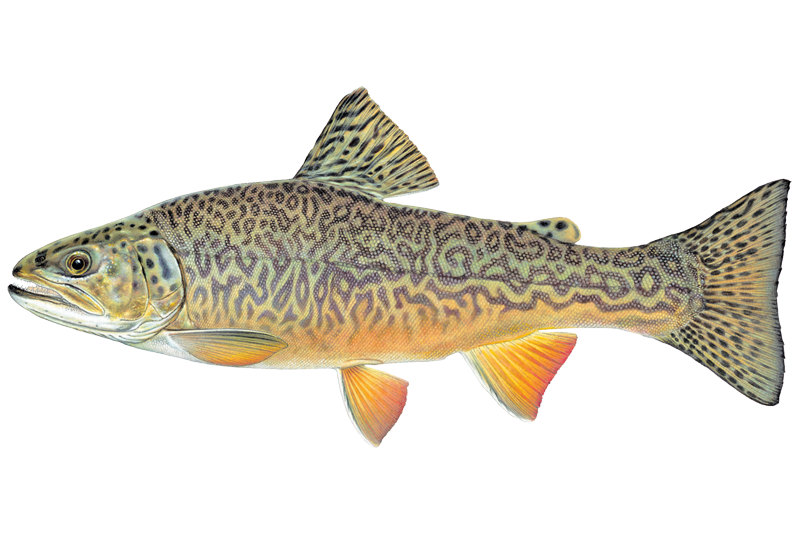
An entirely hatchery-made hybrid — female brown trout crossed with male brook trout — the tiger trout exists almost nowhere in nature because its parent species sit in different genera with mismatched chromosome counts.
Sterile, stocky, and famously aggressive, it's been adopted by stocking programs across the western and northeastern US, where it gives anglers a chance at a trout that grows fast, eats hard, and wears one of the most distinctive coat patterns in freshwater.
Also known as Frankenfish
- Bold, dark, maze-like vermiculations cover the sides and back — far heavier than the worm-tracks on a brook trout, and replacing the discrete spots of both parents entirely.
- Base color runs greenish-yellow to tan-brown with yellow-orange belly and lower fins; pectoral, pelvic, and anal fins often carry the white leading edge inherited from the brookie side.
- Stockier than either parent, with a body shape closer to a brown and a tail that falls between the brown's fork and the brookie's square. Mature males may show a slight kype.
- Typical stocked fish run 10–16 inches and 2–5 pounds; in forage-rich lakes 20-inch fish are routine and the IGFA all-tackle record stands at 27 lbs 6 oz.
What to know
Habitat Distribution
- No native range — every population is a stocking program. At least 14 states actively stock them, with the largest, most trophy-oriented fisheries in the western US and put-and-take stream and pond stockings common across the Northeast.
- Cold, clear, well-oxygenated water is non-negotiable: optimal feeding around 45°F, with a workable range of roughly 34–65°F. The brown trout side gives them slightly broader thermal tolerance than a pure brookie.
- Lakes and reservoirs hold the bulk of the fishery, especially mid- to high-elevation western waters. Streams and rivers see them where stocked, but stream fishing for tigers is usually incidental rather than the main event.
Specific Spots
- Cover-oriented hunters that hold tight to undercut banks, boulders, sunken wood, rocky breaks, and weed edges, then burst out to intercept passing prey.
- In spring after ice-out and again in fall, they cruise the upper column and shallows; summer heat pushes them onto thermoclines and inflows, with boat anglers working drop-offs in 15–20 feet.
- Shoreline patrols at dawn and dusk are reliable — fish parallel the bank in cool, low-light windows when surface temps drop and bait moves shallow.
- Inside turns where a flat falls into deeper water, points, and sharp contour changes concentrate fish, especially in lakes managed for chub or other rough-fish forage.
Tiger Trout FAQ
Answers from onWater's species guide.
What are the best lures and bait for Tiger Trout?
Spoons, in-line spinners, and minnow-imitating hard baits are the workhorse lures, they cover water and play directly to the baitfish-eating habits of mature fish. Kastmasters, Triple Teasers, Jake's Spin-a-lure, and Rapala-style plugs all have track records.
What flies work for Tiger Trout?
Streamers do the heavy lifting on adult fish, Woolly Buggers, leech patterns, sculpin imitations, and general baitfish streamers, all imitating the small fish and leeches tigers key on. Don't undersize, and vary your strip with pauses to trigger followers.
What do Tiger Trout eat?
Juveniles under about 12–14 inches feed like any small trout, mayfly and caddis nymphs, midges, scuds, and other aquatic insects, which is exactly what a Pheasant Tail, Hare's Ear, or small beadhead nymph imitates.
Where do Tiger Trout live?
No native range, every population is a stocking program. At least 14 states actively stock them, with the largest, most trophy-oriented fisheries in the western US and put-and-take stream and pond stockings common across the Northeast.
See it in the app
Most maps show you water.
onWater shows you Tiger Trout.



- 01 · Species map filter
Map every Tiger Trout water
Pick Tiger Trout and the map zeroes in on the waters they call home. No more guessing which lake holds them.
- 02 · Waterbody species
Tap any water. See what lives there.
Species, behavior and seasonal patterns for every lake, river and pond, before you leave the driveway.
- 03 · Angler Intelligence
Ask how to catch Tiger Trout
Tactics, gear and timing from onWater's AI fishing guide, tuned to the species and the water you're on.
Stop guessing where Tiger Trout are.
Open the map, filter by Tiger Trout, and head to water that holds them. Download onWater and plan your next trip in minutes.
- Species map filter
- Angler Intelligence
- Fishing journal
Explore other species
Trout, bass, salmon, panfish and everything in between. Each guide unpacks the behavior, seasons, and tactics that put fish in the net.

Find which waters have the species you want to catch

Redfish
Sciaenops ocellatus

Black Drum
Pogonias cromis

Spotted Seatrout
Cynoscion nebulosus

Weakfish
Cynoscion regalis

White Seabass
Atractoscion nobilis

Atlantic Croaker
Micropogonias undulatus

Spot
Leiostomus xanthurus

Northern Kingfish
Menticirrhus saxatilis

Southern Kingfish
Menticirrhus americanus

California Corbina
Menticirrhus undulatus

Whiting
Menticirrhus littoralis

Snook
Centropomus undecimalis

Tarpon
Megalops atlanticus

Ladyfish
Elops saurus

Bonefish
Albula vulpes

Mangrove Snapper
Lutjanus griseus

Red Snapper
Lutjanus campechanus

Lane Snapper
Lutjanus synagris

Mutton Snapper
Lutjanus analis

Yellowtail Snapper
Ocyurus chrysurus

Cubera Snapper
Lutjanus cyanopterus

Vermilion Snapper
Rhomboplites aurorubens

Gag Grouper
Mycteroperca microlepis

Red Grouper
Epinephelus morio

Black Grouper
Mycteroperca bonaci

Goliath Grouper
Epinephelus itajara

Scamp
Mycteroperca phenax

Snowy Grouper
Hyporthodus niveatus

Black Sea Bass
Centropristis striata

Kelp Bass
Paralabrax clathratus

Barred Sand Bass
Paralabrax nebulifer

Spotted Sand Bass
Paralabrax maculatofasciatus

Bluefish
Pomatomus saltatrix

Crevalle Jack
Caranx hippos

Permit
Trachinotus falcatus

Florida Pompano
Trachinotus carolinus

Greater Amberjack
Seriola dumerili

Almaco Jack
Seriola rivoliana

Yellowtail
Seriola lalandi

Blue Runner
Caranx crysos
Smarter Fishing Starts in the App.
onWater Fish gives you everything you need to plan smarter, fish better, and own every trip from first cast to last.