Northern Hogsucker
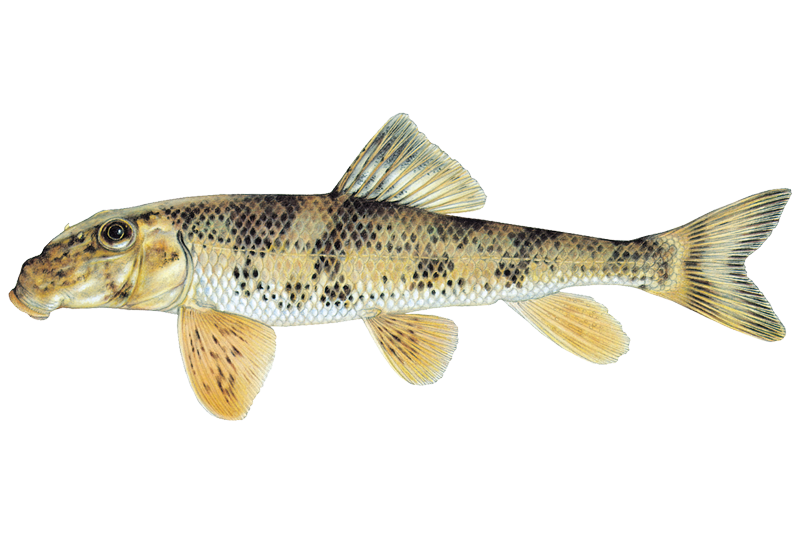
A clear-water stream fish of the eastern and central US, the northern hogsucker is built for life in fast riffles — a slender body behind a comically square, bony head it uses to flip stones and feed on whatever it dislodges.
Anglers most often see them while wading for smallmouth or trout, and their presence is a reliable sign of clean, healthy water.
Scientific Name: Hypentelium nigricans
Also known as Hogsucker, Hog Molly, Box Head, Northern Hog Sucker
- The square, bony head is concave between the eyes — the giveaway that separates this fish from every other sucker, and the tool it uses to overturn gravel.
- Mottled golden-brown back crossed by four dark saddle-shaped bars, with a pale belly. The pattern is near-perfect camouflage on a gravel streambed.
- Fleshy, papillae-covered protrusible lips ringed by a distinct black line — a marking unique to this species. Eyes sit far back on the head, closer to the gill cover than the snout.
- Most adults run 8–15 inches and under a pound. A two-pounder is a large fish; the IGFA all-tackle record stands at 3 lb 4 oz from the upper Mississippi.
What to know
Habitat Distribution
- Native across the Great Lakes, Mississippi, and Hudson Bay basins, plus Atlantic Slope rivers from the Mohawk-Hudson south to the Altamaha. Abundant through the Ozarks and southern Appalachians.
- A riffle specialist tied to clear, permanent streams with clean gravel, rubble, or cobble. Avoids silty, turbid, or sluggish water — its presence is a clean-water indicator.
- Preferred temperatures roughly 55–70°F, but tolerates everything from cold trout-stream headwaters to warmwater rivers. Occasional in reservoirs with strong inflow current; not a still-water fish.
- Range-edge populations along the western periphery and parts of the mid-Atlantic have thinned or fragmented from agricultural sedimentation, even where the species is common elsewhere.
Specific Spots
- Riffles and fast runs over exposed gravel and rubble — a reduced swim bladder and broad pectorals let them hold position in current without working for it.
- Pools that still have current flow are productive too, but anything silt-bottomed or stagnant is a dead zone for this species.
- Watch for trailing fish: shiners, dace, smallmouth, and longear sunfish often stack downstream of a feeding hogsucker to grab dislodged bugs.
- In northern waters, larger adults drop into deeper stream runs and lake margins outside spawning season, where pike and muskie pick them off.
Northern Hogsucker FAQ
Answers from onWater's species guide.
What are the best lures and bait for Northern Hogsucker?
Nightcrawlers and red worms on small hooks are the universal answer. A plump crawler bottom-rigged in a riffle, drifted into a fish's lane, is as close to a sure thing as this species offers. Small pieces of crayfish tail or clam meat will also draw takes.
What flies work for Northern Hogsucker?
Small weighted nymphs in sizes 12–16 imitating the aquatic insect larvae they're feeding on: bead-head Hare's Ear and Pheasant Tail (both imitate mayfly and general nymph larvae) and small caddis larva patterns are the go-to flies. Presentation matters more than pattern.
What do Northern Hogsucker eat?
Bottom-feeder eating midge, mayfly, and caddis larvae, snails, small crustaceans, algae, and detritus. The fly that matches this is a small weighted nymph, Hare's Ear or bead-head Pheasant Tail in sizes 12–16 imitates the larvae they're rooting up.
Where do Northern Hogsucker live?
Native across the Great Lakes, Mississippi, and Hudson Bay basins, plus Atlantic Slope rivers from the Mohawk-Hudson south to the Altamaha. Abundant through the Ozarks and southern Appalachians. A riffle specialist tied to clear, permanent streams with clean gravel, rubble, or cobble.
See it in the app
Most maps show you water.
onWater shows you Northern Hogsucker.



- 01 · Species map filter
Map every Northern Hogsucker water
Pick Northern Hogsucker and the map zeroes in on the waters they call home. No more guessing which lake holds them.
- 02 · Waterbody species
Tap any water. See what lives there.
Species, behavior and seasonal patterns for every lake, river and pond, before you leave the driveway.
- 03 · Angler Intelligence
Ask how to catch Northern Hogsucker
Tactics, gear and timing from onWater's AI fishing guide, tuned to the species and the water you're on.
Stop guessing where Northern Hogsucker are.
Open the map, filter by Northern Hogsucker, and head to water that holds them. Download onWater and plan your next trip in minutes.
- Species map filter
- Angler Intelligence
- Fishing journal
Explore other species
Trout, bass, salmon, panfish and everything in between. Each guide unpacks the behavior, seasons, and tactics that put fish in the net.
No species information available.

Smarter Fishing Starts in the App.
onWater Fish gives you everything you need to plan smarter, fish better, and own every trip from first cast to last.