Suwannee Bass
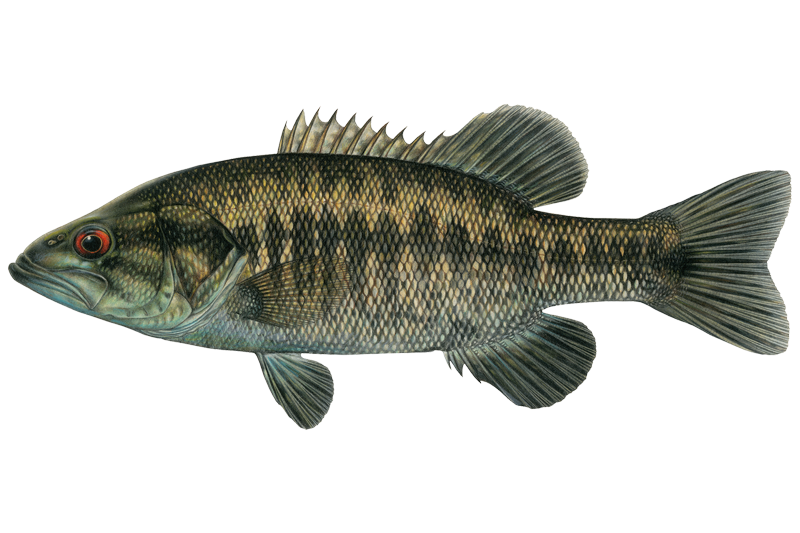
The smallest and most range-restricted of the black basses, Suwannee bass live only in a handful of limestone-bottomed rivers in north Florida and southern Georgia.
A two-pounder is a real fish, and a spawning male — turquoise across the cheeks, breast, and belly — looks almost tropical for a southern river bass. Anglers chasing the black-bass slam make the trip just for them.
Scientific Name: Micropterus notius
Also known as Suwannee River Smallmouth Bass
- Stocky brown body with about a dozen olive blotches along the sides that fuse into a lateral band on the tail wrist, plus a light-bordered caudal spot — sharpest on juveniles.
- Spawning males and mature adults flash bright turquoise on the cheeks, breast, and belly. Eyes go dark red on adults, brownish on younger fish.
- Upper jaw stops below the eye (not past it, like a largemouth), there's a small circular patch of teeth on the tongue, and the dorsal fins are only shallowly notched.
- Most fish run 8-12 inches and under two pounds; females outgrow males, reaching 16+ inches, while males rarely top 13. The IGFA record is 3 lb 14 oz from the Suwannee.
What to know
Habitat Distribution
- Has the smallest native range of any black bass — endemic to the Suwannee and Ochlockonee drainages of north Florida and adjacent southern Georgia, plus the Santa Fe, Ichetucknee, Withlacoochee, Alapaha, Wakulla, and a couple of introduced systems.
- A river fish through and through, tied to limestone shoals and springs fed by the Floridan Aquifer. Wants neutral-to-alkaline, well-oxygenated water and avoids the tannin-stained acidic reaches near the headwaters.
- Spring-fed tributaries like the Santa Fe and Ichetucknee — clear, cool, alkaline year-round — hold the densest populations. Georgia rivers run more tannic and turbid and generally hold fewer fish.
- Occasionally pushes into the brackish lower Suwannee, which is the only place in its range it eats blue crabs.
Specific Spots
- Limestone shoals, riffles, and the runs and pools immediately below them — the same fast, oxygenated current that concentrates crayfish and minnows is where these bass set up.
- Limestone outcroppings, boulders, cypress knees, and laydowns inside or right alongside moving water. Bigger fish lean on woody cover in deep sweeping bends much like a largemouth would.
- Spring boils and spring-run inflows pull fish in during summer when river temperatures climb; cool, clear water at the source acts as a thermal refuge.
- In the heat of summer, expect bigger fish to drop into deeper holes — sometimes 10 feet or more — adjacent to the shoals they feed on at first and last light.
Suwannee Bass FAQ
Answers from onWater's species guide.
What are the best lures and bait for Suwannee Bass?
Crayfish imitations come first: small crawfish crankbaits like the Rebel Wee Crawfish, brown-and-orange jigs, and Texas-rigged soft-plastic craws or brush hogs on a 1/4 oz bullet weight, dragged across limestone bottom.
What flies work for Suwannee Bass?
Weighted crayfish patterns, Crazi Craw-style or articulated crawfish flies, bounced along limestone bottom in current are the headline fly, mirroring the bass's primary forage.
What do Suwannee Bass eat?
Crayfish are the centerpiece of the diet at every adult life stage, so much so that biologists think crayfish density basically dictates Suwannee bass abundance. That's why crawfish-pattern crankbaits, brown/orange jigs, and soft-plastic craws bounced on the bottom outproduce nearly everything else.
Where do Suwannee Bass live?
Has the smallest native range of any black bass, endemic to the Suwannee and Ochlockonee drainages of north Florida and adjacent southern Georgia, plus the Santa Fe, Ichetucknee, Withlacoochee, Alapaha, Wakulla, and a couple of introduced systems.
See it in the app
Most maps show you water.
onWater shows you Suwannee Bass.



- 01 · Species map filter
Map every Suwannee Bass water
Pick Suwannee Bass and the map zeroes in on the waters they call home. No more guessing which lake holds them.
- 02 · Waterbody species
Tap any water. See what lives there.
Species, behavior and seasonal patterns for every lake, river and pond, before you leave the driveway.
- 03 · Angler Intelligence
Ask how to catch Suwannee Bass
Tactics, gear and timing from onWater's AI fishing guide, tuned to the species and the water you're on.
Stop guessing where Suwannee Bass are.
Open the map, filter by Suwannee Bass, and head to water that holds them. Download onWater and plan your next trip in minutes.
- Species map filter
- Angler Intelligence
- Fishing journal
Explore other species
Trout, bass, salmon, panfish and everything in between. Each guide unpacks the behavior, seasons, and tactics that put fish in the net.
No species information available.

Smarter Fishing Starts in the App.
onWater Fish gives you everything you need to plan smarter, fish better, and own every trip from first cast to last.