Spotted Sucker
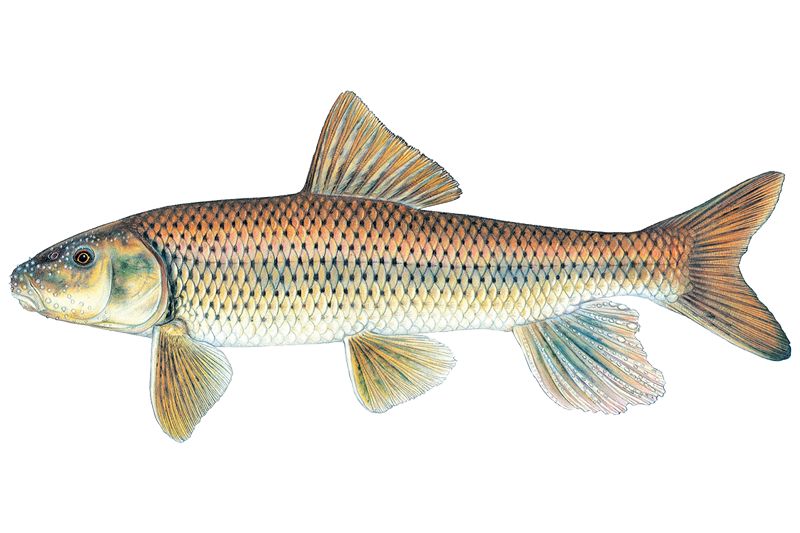
A clean-water sucker of the eastern and central US, the spotted sucker takes its name from the rows of dark spots that run lengthwise along its sides — a base-of-scale pattern unlike anything else in the family.
It lives across the Mississippi, Great Lakes, and Gulf and Atlantic slope drainages, favoring clear rivers and quiet backwaters where the bottom stays firm.
Scientific Name: Minytrema melanops
Also known as Corncob Sucker, Striped Sucker, Black Sucker, Winter Sucker, Speckled Sucker
- A dark spot at the base of every scale lines up into multiple parallel rows of small black-brown dots running the length of the body — the dead giveaway for this species.
- Lateral line is absent or very poorly developed, separating it from redhorses and most other suckers; chubsuckers also lack one but don't carry the scale-base spotting.
- Slender, fusiform shape with an olive to green-brown back, brassy silver sides, and white-cream belly. Lower fins often show a red tint; breeding males develop two dark stripes with a pink band between.
- Common length is 12-13 inches at around a pound; maximum runs to roughly 19-20 inches and 2.5 lbs. A 14-16 inch fish is a respectable catch.
What to know
Habitat Distribution
- Native across the lower Great Lakes, the entire Mississippi basin, and Gulf and Atlantic slope drainages from the Cape Fear west to the Colorado of Texas. Absent from most of peninsular Florida.
- A clean-water species that doesn't tolerate siltation or pollution well — its presence in a stream is treated as an indicator of decent water quality, and it's been lost from streams degraded by agricultural runoff.
- Substrate matters more than almost anything else: firm clay, sand, gravel, or rubble bottoms hold fish; soft silty bottoms generally don't, except in the swampy Deep South where it thrives in deltaic sloughs and oxbows.
- Range may be creeping northward in the Great Lakes region as habitat improves and waters warm, with documented expansion in eastern Lake Erie.
Specific Spots
- Adults hold in deep pools of small to medium rivers during the day, sliding onto shallow sandbars at first light and again at dusk to feed.
- Woody snags in main-channel and backwater habitat consistently produce — fish associate strongly with structure on firm bottoms.
- In southern swamp country, the best concentrations sit in overflow pools, oxbows, borrow pits, and slow deltaic sloughs rather than the river channel itself.
- During the spring spawning run, fish stack on shallow gravel or rubble riffles in moderate current in tributary streams — the one window when they're easy to find in numbers.
Spotted Sucker FAQ
Answers from onWater's species guide.
What are the best lures and bait for Spotted Sucker?
Nightcrawlers and red worms on a bottom rig, slip sinker (1/8-1/4 oz) or split shot above a small baitholder, circle, or Aberdeen hook. This is the program everywhere they swim. Leeches, small crayfish, and minnows produce too, but worms outfish everything else by a wide margin.
What flies work for Spotted Sucker?
Weighted nymphs that get to the bottom fast: beadhead Pheasant Tails and Hare's Ears (mayfly nymph imitations) and scud patterns cover the natural invertebrate diet.
What do Spotted Sucker eat?
A bottom feeder with a downturned suction mouth and no oral teeth, they vacuum up organic fragments, sand, diatoms, midge larvae, and tiny crustaceans (copepods, cladocerans). Whatever's seasonally abundant on the bottom is what they're eating.
Where do Spotted Sucker live?
Native across the lower Great Lakes, the entire Mississippi basin, and Gulf and Atlantic slope drainages from the Cape Fear west to the Colorado of Texas. Absent from most of peninsular Florida.
See it in the app
Most maps show you water.
onWater shows you Spotted Sucker.



- 01 · Species map filter
Map every Spotted Sucker water
Pick Spotted Sucker and the map zeroes in on the waters they call home. No more guessing which lake holds them.
- 02 · Waterbody species
Tap any water. See what lives there.
Species, behavior and seasonal patterns for every lake, river and pond, before you leave the driveway.
- 03 · Angler Intelligence
Ask how to catch Spotted Sucker
Tactics, gear and timing from onWater's AI fishing guide, tuned to the species and the water you're on.
Stop guessing where Spotted Sucker are.
Open the map, filter by Spotted Sucker, and head to water that holds them. Download onWater and plan your next trip in minutes.
- Species map filter
- Angler Intelligence
- Fishing journal
Explore other species
Trout, bass, salmon, panfish and everything in between. Each guide unpacks the behavior, seasons, and tactics that put fish in the net.
No species information available.

Smarter Fishing Starts in the App.
onWater Fish gives you everything you need to plan smarter, fish better, and own every trip from first cast to last.