Splake
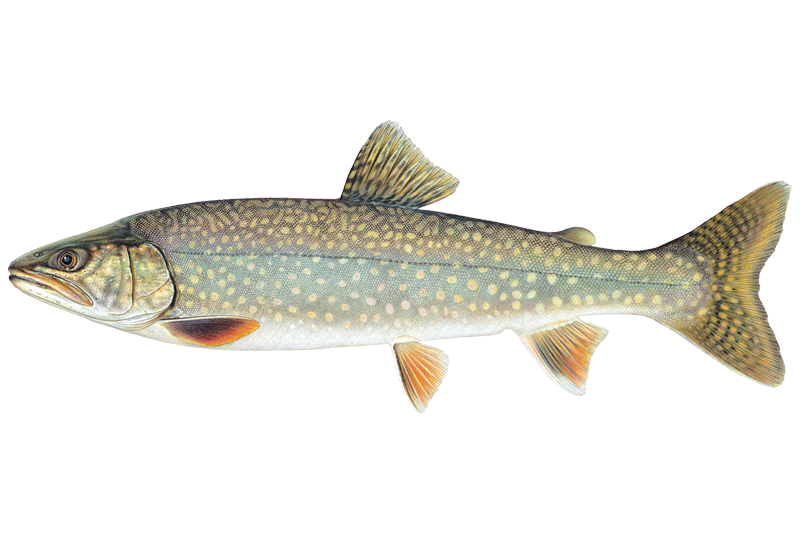
A hatchery-made char hybrid — female lake trout crossed with male brook trout — splake exist only because biologists put them there.
They're stocked across the Great Lakes region, the Northeast, and high-elevation lakes in the Rockies as a put-grow-and-take fishery, prized for hitting like a brookie while tolerating the cold, deeper water that defeats one.
Also known as Slake, Wendigo, Speckled lake trout
- Body shape splits the difference between the heavy-shouldered lake trout and the slimmer brook trout, with olive to dark gray backs, cream or light spots, and faint worm-like vermiculations near the dorsal fin.
- Tail is the most reliable field marker — moderately forked, less indented than a lake trout's lunate tail but more cut than a brookie's nearly square one. Tail shape alone isn't definitive, since the fork varies fish-to-fish.
- Tri-colored pelvic fins (white leading edge, black stripe, orange-red behind) carry over from the brook trout parent, though the white edges run less vivid than on a pure brookie.
- Average fish run 10–18 inches in smaller managed lakes; in productive big water they push past 25 inches and 10 pounds. The all-tackle record is 20 lbs 11 oz from Ontario.
What to know
Habitat Distribution
- No native population anywhere — every splake fishery in the US depends on continued hatchery stocking. Primary stocking range covers the Great Lakes region (especially Michigan's UP, plus Wisconsin and Minnesota), Maine and northern New York, and high-elevation lakes across Colorado, Wyoming, Idaho, and Utah.
- Cold-water obligate, with a sweet spot of roughly 40–50°F. Like both parents they need cold, well-oxygenated water and can't ride out warm summers without thermal refuge.
- Less tied to extreme depth than lake trout — splake rarely drop below about 50 feet, which makes them a workable target in smaller, shallower cold-water lakes where pure lakers wouldn't make it.
Specific Spots
- Rocky shoreline points and structure hold splake more reliably than open basins. Unlike lake trout drifting offshore, splake hug rock as long as the water stays cold enough to suit them.
- Spring and fall pull fish into nearshore shallows, gravel banks, and tributary mouths — a spawning instinct from both parents that congregates them on breaklines next to shallow flats, even though wild reproduction essentially fails.
- Once surface temps climb past 55–58°F, splake slide off protected bays toward the thermocline and stage along drop-offs, accessible to depth-adjusted trolling but rarely down where lakers live.
- Under ice they range broadly through the column. Shallow water inside 10 feet near transitions to deeper basins is the classic ice setup.
Splake FAQ
Answers from onWater's species guide.
What are the best lures and bait for Splake?
Small crankbaits and jerkbaits, Rapala stick baits and similar minnow profiles, are the go-to for casting and trolling along breaklines in spring and fall, run shallow when fish are up and deeper as summer pushes them down.
What flies work for Splake?
Streamers and baitfish patterns are the foundation, flashy weighted minnow imitations and leeches, fished slow with a strip-strike, mirror the lake trout playbook and are the right starting point in open water.
What do Splake eat?
Heavily fish-eating, and earlier in life than either parent, minnows, smelt, and small perch are the staples once they're past the fingerling stage.
Where do Splake live?
No native population anywhere, every splake fishery in the US depends on continued hatchery stocking. Primary stocking range covers the Great Lakes region (especially Michigan's UP, plus Wisconsin and Minnesota), Maine and northern New York, and high-elevation lakes across Colorado, Wyoming, Idaho, and Utah.
See it in the app
Most maps show you water.
onWater shows you Splake.



- 01 · Species map filter
Map every Splake water
Pick Splake and the map zeroes in on the waters they call home. No more guessing which lake holds them.
- 02 · Waterbody species
Tap any water. See what lives there.
Species, behavior and seasonal patterns for every lake, river and pond, before you leave the driveway.
- 03 · Angler Intelligence
Ask how to catch Splake
Tactics, gear and timing from onWater's AI fishing guide, tuned to the species and the water you're on.
Stop guessing where Splake are.
Open the map, filter by Splake, and head to water that holds them. Download onWater and plan your next trip in minutes.
- Species map filter
- Angler Intelligence
- Fishing journal
Explore other species
Trout, bass, salmon, panfish and everything in between. Each guide unpacks the behavior, seasons, and tactics that put fish in the net.

Find which waters have the species you want to catch

Redfish
Sciaenops ocellatus

Black Drum
Pogonias cromis

Spotted Seatrout
Cynoscion nebulosus

Weakfish
Cynoscion regalis

White Seabass
Atractoscion nobilis

Atlantic Croaker
Micropogonias undulatus

Spot
Leiostomus xanthurus

Northern Kingfish
Menticirrhus saxatilis

Southern Kingfish
Menticirrhus americanus

California Corbina
Menticirrhus undulatus

Whiting
Menticirrhus littoralis

Snook
Centropomus undecimalis

Tarpon
Megalops atlanticus

Ladyfish
Elops saurus

Bonefish
Albula vulpes

Mangrove Snapper
Lutjanus griseus

Red Snapper
Lutjanus campechanus

Lane Snapper
Lutjanus synagris

Mutton Snapper
Lutjanus analis

Yellowtail Snapper
Ocyurus chrysurus

Cubera Snapper
Lutjanus cyanopterus

Vermilion Snapper
Rhomboplites aurorubens

Gag Grouper
Mycteroperca microlepis

Red Grouper
Epinephelus morio

Black Grouper
Mycteroperca bonaci

Goliath Grouper
Epinephelus itajara

Scamp
Mycteroperca phenax

Snowy Grouper
Hyporthodus niveatus

Black Sea Bass
Centropristis striata

Kelp Bass
Paralabrax clathratus

Barred Sand Bass
Paralabrax nebulifer

Spotted Sand Bass
Paralabrax maculatofasciatus

Bluefish
Pomatomus saltatrix

Crevalle Jack
Caranx hippos

Permit
Trachinotus falcatus

Florida Pompano
Trachinotus carolinus

Greater Amberjack
Seriola dumerili

Almaco Jack
Seriola rivoliana

Yellowtail
Seriola lalandi

Blue Runner
Caranx crysos
Smarter Fishing Starts in the App.
onWater Fish gives you everything you need to plan smarter, fish better, and own every trip from first cast to last.