Spotted Bass
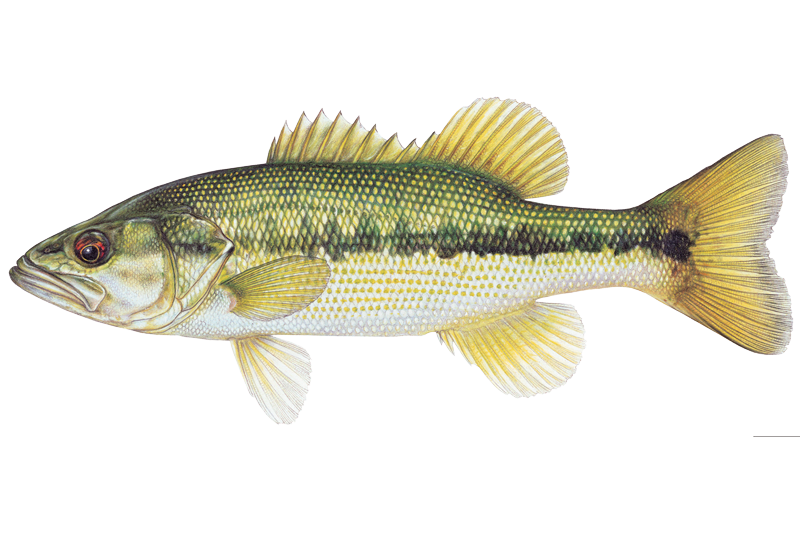
A native of the Mississippi basin and Gulf drainages, spotted bass slot ecologically between largemouth and smallmouth — at home in clearer, current-touched water that's too warm for one cousin and too cool or rocky for the other.
Introductions have pushed the species across roughly half the country, and in highland reservoirs from the Ozarks to the Sierra foothills, spots are now the dominant black bass.
Scientific Name: Micropterus punctulatus
Also known as Kentucky Bass, Spots, Spotty, Northern Spotted Bass
- Rows of dark spots below the lateral line — the namesake field mark, absent on both largemouth and smallmouth.
- Upper jaw stops near the middle of the eye when the mouth is closed; a largemouth's jaw clearly extends past the eye.
- A rough, sandpaper patch of teeth on the tongue is the quickest in-hand confirmation — largemouth and smallmouth don't have it.
- Native-range adults typically run 8–15 inches and 8 oz to 2 lb; introduced California reservoirs have produced fish over 10 lb, including the IGFA world record at 11 lb 4 oz.
What to know
Habitat Distribution
- Native across the Mississippi basin from southern Ohio and West Virginia south to the Gulf, plus Gulf Slope drainages from the Chattahoochee west to the Guadalupe.
- Introduced and established in roughly half of US states, reaching the Southwest and West Coast; absent from the coldest northern tier.
- An ecological middle child — clearer and cooler water than largemouth tolerate, warmer and more turbid than smallmouth prefer. Scarce in natural lakes; common in rivers and reservoirs.
- Especially dominant in clear highland reservoirs with rocky structure — Ozark, Appalachian, and Sierra Nevada foothill impoundments.
Specific Spots
- Long, gradually tapering main-lake and creek-mouth points are the prime reservoir address; schools often suspend 3–6 feet off the bottom in 10–60 feet of water.
- Bluff walls, riprap, and current seams below dam tailraces concentrate fish that ambush prey drifting past — a behavior more pronounced than in largemouth.
- In rivers, work rocky structure, gravel runs, and the slack edges of current seams much like you would for smallmouth.
- During the spring spawn, fish move shallow onto gravel or rock substrate near brush or laydowns, where males clear and guard nests.
Spotted Bass FAQ
Answers from onWater's species guide.
What are the best lures and bait for Spotted Bass?
Finesse soft plastics carry the load: shaky heads, drop shots, Ned rigs, and Senko-style stick baits worked slowly around deep points and rocky structure. Swimbaits, spoons, and the Float-N-Fly rig shine on suspended fish in clear deep reservoirs, particularly the bigger fish that rarely come shallow.
What flies work for Spotted Bass?
Crayfish patterns and weighted Clouser-style streamers (Clousers imitate baitfish; weighted crayfish flies imitate crawfish on rocky bottoms) are the workhorse subsurface choices, especially in rivers and tailwaters. Poppers, gurglers, and divers draw hard topwater eats during low light and through the warm months.
What do Spotted Bass eat?
Crayfish, small baitfish, and aquatic insects make up the bulk of the adult diet, which is why crayfish-imitating jigs and Ned rigs, small swimbaits, and streamers tied to suggest crawfish or shad consistently produce.
Where do Spotted Bass live?
Native across the Mississippi basin from southern Ohio and West Virginia south to the Gulf, plus Gulf Slope drainages from the Chattahoochee west to the Guadalupe. Introduced and established in roughly half of US states, reaching the Southwest and West Coast; absent from the coldest northern tier.
See it in the app
Most maps show you water.
onWater shows you Spotted Bass.



- 01 · Species map filter
Map every Spotted Bass water
Pick Spotted Bass and the map zeroes in on the waters they call home. No more guessing which lake holds them.
- 02 · Waterbody species
Tap any water. See what lives there.
Species, behavior and seasonal patterns for every lake, river and pond, before you leave the driveway.
- 03 · Angler Intelligence
Ask how to catch Spotted Bass
Tactics, gear and timing from onWater's AI fishing guide, tuned to the species and the water you're on.
Stop guessing where Spotted Bass are.
Open the map, filter by Spotted Bass, and head to water that holds them. Download onWater and plan your next trip in minutes.
- Species map filter
- Angler Intelligence
- Fishing journal
Explore other species
Trout, bass, salmon, panfish and everything in between. Each guide unpacks the behavior, seasons, and tactics that put fish in the net.
No species information available.
Smarter Fishing Starts in the App.
onWater Fish gives you everything you need to plan smarter, fish better, and own every trip from first cast to last.