Northern Snakehead
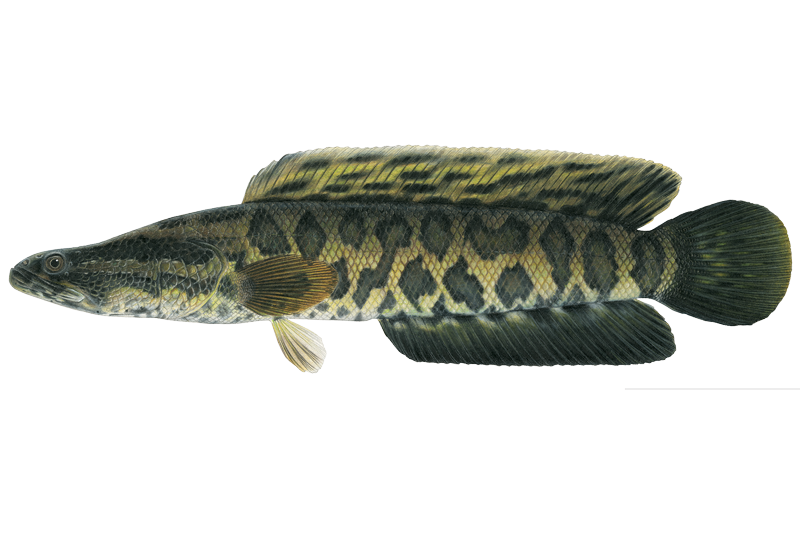
An invasive East Asian predator now established in the Mid-Atlantic Chesapeake watershed, parts of the Northeast, and the lower Mississippi basin.
Long, snake-headed, and reptilian in profile, the northern snakehead lives in the kind of weed-choked backwater most freshwater anglers reserve for largemouth — and hits topwaters hard enough that a growing fishery has built up around it.
Scientific Name: Channa argus
Also known as Amur Snakehead, Eastern Snakehead, Chesapeake Channa, Mudfish, Frankenfish
- Cylindrical, torpedo-shaped body with a single long dorsal fin running nearly the full length of the back, a long anal fin, and a flattened, anteriorly depressed head with eyes set high — a distinctly reptilian look.
- Golden tan to pale brown with irregular dark blotches along the sides and saddle-like markings across the back; coloration changes very little from juvenile to adult.
- Best separated from native bowfin by the rounded (not lunate) tail, longer anal fin, pelvic fins set far forward near the gills, and the absence of a bony gular plate under the jaw.
- Typical adults run 20–33 inches; introduced US fish reach about 36 inches and 18 pounds, with the IGFA all-tackle record at 21 pounds.
What to know
Habitat Distribution
- Entirely non-native. Established populations are concentrated in the Potomac River and broader Chesapeake Bay watershed, scattered through the Mid-Atlantic and NYC metro area, and in the lower Mississippi basin from a separate introduction.
- A shallow-water, weedy-margin specialist — stagnant or slow water under about 6 feet deep, mud bottom, heavy aquatic vegetation. Canals, tidal creeks, ponds, sloughs, and reservoirs all hold them.
- The most cold-tolerant fish in its family, with a functional range from near-freezing to 95°F, surviving under ice and tolerating brackish water to roughly 15 ppt — which is how it spread through tidal Chesapeake tributaries.
- An obligate air-breather using a primitive lung, so it thrives in oxygen-starved water where bass and other native predators struggle.
Specific Spots
- Lily pad fields, reed and cattail edges, and submerged grass beds in 1–3 feet of water — fish lie motionless inside the cover and strike outward into open lanes.
- Pocket openings inside heavy vegetation, dinner-plate-sized holes in the pads, and seams along the outside edge of grass — each one is potentially a single fish's lie.
- Backwater canals, dead-end sloughs, and roadside ditches connected to larger systems hold fish that get overlooked by anglers running main-channel water.
- During spawning in late spring and early summer, expect adults to push up the smallest creeks and into the shallowest vegetated flats, where pairs guard a circular floating nest in 2–3 feet of water.
Northern Snakehead FAQ
Answers from onWater's species guide.
What are the best lures and bait for Northern Snakehead?
Hollow-body topwater frogs are the defining snakehead lure, weedless enough to crawl through pads and reeds, and the strikes are genuinely violent. Black, white, and natural patterns all work.
What flies work for Northern Snakehead?
Topwater foam divers, waking frog and mouse patterns, and Dahlberg Diver-style flies (which push water and pop on the strip to imitate struggling surface prey) draw the explosive eats the species is known for, work them slowly with long pauses.
What do Northern Snakehead eat?
Adults are heavily fish-eaters, gut studies in the Potomac put fish at over 97% of stomach contents, mostly topminnows and small sunfish, which is exactly why baitfish-profile presentations like paddle-tail swimbaits, Game Changer streamers, and Clouser Minnows (weighted baitfish flies) produce so well.
Where do Northern Snakehead live?
Entirely non-native. Established populations are concentrated in the Potomac River and broader Chesapeake Bay watershed, scattered through the Mid-Atlantic and NYC metro area, and in the lower Mississippi basin from a separate introduction.
See it in the app
Most maps show you water.
onWater shows you Northern Snakehead.



- 01 · Species map filter
Map every Northern Snakehead water
Pick Northern Snakehead and the map zeroes in on the waters they call home. No more guessing which lake holds them.
- 02 · Waterbody species
Tap any water. See what lives there.
Species, behavior and seasonal patterns for every lake, river and pond, before you leave the driveway.
- 03 · Angler Intelligence
Ask how to catch Northern Snakehead
Tactics, gear and timing from onWater's AI fishing guide, tuned to the species and the water you're on.
Stop guessing where Northern Snakehead are.
Open the map, filter by Northern Snakehead, and head to water that holds them. Download onWater and plan your next trip in minutes.
- Species map filter
- Angler Intelligence
- Fishing journal
Explore other species
Trout, bass, salmon, panfish and everything in between. Each guide unpacks the behavior, seasons, and tactics that put fish in the net.
No species information available.
Smarter Fishing Starts in the App.
onWater Fish gives you everything you need to plan smarter, fish better, and own every trip from first cast to last.