Smallmouth Buffalo
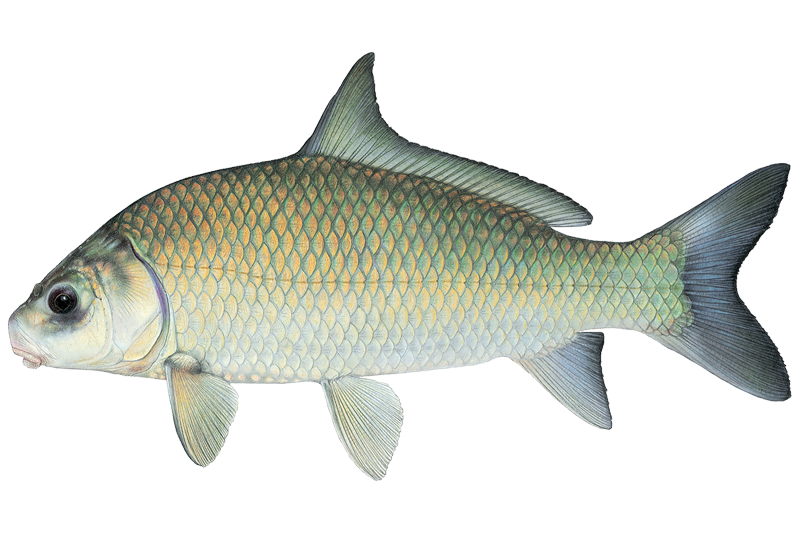
A native deep-bodied sucker of the Mississippi basin and Gulf drainages, smallmouth buffalo are the quiet giants of American rivers — fish that can live past 60 years, push 80 pounds, and get walked past daily by anglers chasing bass and carp.
They occupy a niche between bigmouth and black buffalo, holding in clearer, faster water than either, and are increasingly drawing the attention of carp anglers and fly sight-fishers.
Scientific Name: Ictiobus bubalus
Also known as Buffalofish, Buffalo, Razorback Buffalo
- Deep, strongly compressed body with a keeled hump rising from the back of the head — body depth roughly a third of standard length, noticeably thinner and taller than other buffalo species.
- Small, ventral, downward-facing sucker mouth with thick grooved lips — the front of the upper lip sits well below the eye, separating it from the forward-facing terminal mouth of bigmouth buffalo.
- Bronze to slate-olive back fading to bronze sides, slate-brown fins, and a long sickle-shaped dorsal fin with 26–31 rays. Eyes are notably larger than those of black buffalo.
- No barbels — the dead giveaway separating any buffalo from a common carp. Typical adults run 16–24 inches; the IGFA all-tackle record is 82 lb 3 oz from Texas, with 60–80 lb river fish documented.
What to know
Habitat Distribution
- Native through the Mississippi River basin and Gulf Slope drainages from Alabama to the Rio Grande, plus the Lake Michigan drainage; introduced and established in parts of the Carolinas and Arizona, with scattered stockings elsewhere.
- A clear-to-moderately-stained-water fish that pushes farther into current than its congeners — at home in big rivers, large streams, oxbows, and Ozark-style reservoirs over mixed sand, gravel, and silt.
- Tolerates hard water with pH 6.5–8.5 and prefers stretches with dense aquatic vegetation; most abundant in the large rivers of the Midwest and Central Plains.
Specific Spots
- Deep pools, large-river backwaters, tributary mouths, and oxbows with moderate current — particularly where rocky bottom or log drifts and deadfalls break the flow.
- Slack water behind rip-rap and scour holes around wing dams, plus the slower water on the outside of bends, where bottom forage settles into reach of a head-down feeder.
- In low, clear summer water, schools push into shallow runs and flats where they can be spotted feeding — the basis for the species' growing reputation as a sight-fishing target.
- During spawn, fish gather over submerged gravel and sand bars in 4–20 feet of water adjacent to the main channel, often where submerged vegetation is present.
Smallmouth Buffalo FAQ
Answers from onWater's species guide.
What are the best lures and bait for Smallmouth Buffalo?
Doughballs, including cottonseed-meal mixes and packbait, and whole or pop-up corn are the most consistent producers across the species' range, and pre-baiting a spot for several days noticeably improves catch rates.
What flies work for Smallmouth Buffalo?
Small weighted nymphs and egg flies dead-drifted along the bottom are the workhorses, they imitate the insect larvae and drifting organic matter buffalo actually eat. Small crayfish patterns shine when sight-fishing schools on flats, the same way they do for carp in similar water.
What do Smallmouth Buffalo eat?
Bottom feeders that vacuum up detritus, algae scraped from rocks, zooplankton, insect larvae, mollusk larvae, and small crustaceans, non-food sediment is ejected through the gills, not the mouth like a carp does.
Where do Smallmouth Buffalo live?
Native through the Mississippi River basin and Gulf Slope drainages from Alabama to the Rio Grande, plus the Lake Michigan drainage; introduced and established in parts of the Carolinas and Arizona, with scattered stockings elsewhere.
See it in the app
Most maps show you water.
onWater shows you Smallmouth Buffalo.



- 01 · Species map filter
Map every Smallmouth Buffalo water
Pick Smallmouth Buffalo and the map zeroes in on the waters they call home. No more guessing which lake holds them.
- 02 · Waterbody species
Tap any water. See what lives there.
Species, behavior and seasonal patterns for every lake, river and pond, before you leave the driveway.
- 03 · Angler Intelligence
Ask how to catch Smallmouth Buffalo
Tactics, gear and timing from onWater's AI fishing guide, tuned to the species and the water you're on.
Stop guessing where Smallmouth Buffalo are.
Open the map, filter by Smallmouth Buffalo, and head to water that holds them. Download onWater and plan your next trip in minutes.
- Species map filter
- Angler Intelligence
- Fishing journal
Explore other species
Trout, bass, salmon, panfish and everything in between. Each guide unpacks the behavior, seasons, and tactics that put fish in the net.
No species information available.
Smarter Fishing Starts in the App.
onWater Fish gives you everything you need to plan smarter, fish better, and own every trip from first cast to last.