Roanoke Bass
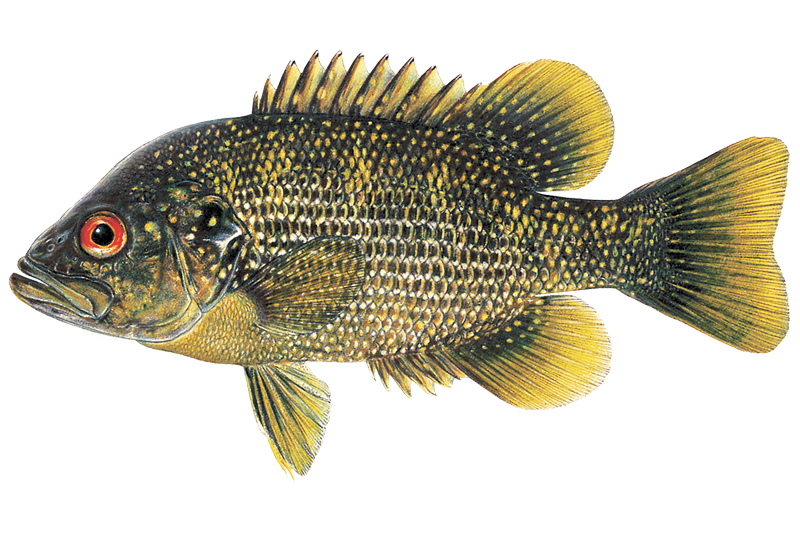
A small-bodied native sunfish endemic to a handful of river drainages in Virginia and North Carolina, the Roanoke bass is a fish of clear piedmont creeks and tannin-stained coastal rivers.
Anglers often catch them by accident while chasing smallmouth or panfish, and just as often misidentify them as rock bass. Knowing where to look — and how to tell the two apart — is most of the game.
Scientific Name: Ambloplites cavifrons
Also known as Redeye, Rock bass (misidentification)
- Robust, laterally compressed body with a large terminal mouth, a slightly concave forehead, and cheeks that are nearly scaleless — the key separator from the very similar rock bass.
- Dark olive-green to olive-brown above, fading to grayish flanks and a white belly, with small pale whitish or yellowish spots scattered across the upper body.
- Prominent red eye against the dark face, a dark-margined anal fin, rounded pectorals, and a slightly forked tail.
- A pound is a real fish; the IGFA all-tackle record stands at 1 lb 6 oz, and maximum recorded length is about 14 inches.
What to know
Habitat Distribution
- Native and endemic to just a handful of Atlantic Slope drainages — the Chowan, Roanoke, Tar, Neuse, and Cape Fear systems — in Virginia and North Carolina, with no established populations outside this two-state footprint.
- A creek and small-river fish at heart: large creeks, streams, and small to medium rivers with moderate flow and rocky substrate hold the strongest populations.
- Clear water is the default, but they tolerate the tea-colored, swamp-influenced reaches of coastal-plain rivers like the Nottoway and Blackwater. Heavy sedimentation is what they can't handle.
Specific Spots
- Rocky and sandy pools in creeks and small rivers — pools with hard bottom adjacent to current seams are the core holding water for adults.
- Edges of deeper rocky pockets where slack water meets moving water; cover and rock structure provide the ambush angle this fish relies on.
- In spring, shift attention to gravel flats in two feet of water or less — males build and guard nests there once water hits the low 70s.
- Nearshore vegetation matters early in the season, since fry hide in and around plants right after hatching.
Roanoke Bass FAQ
Answers from onWater's species guide.
What are the best lures and bait for Roanoke Bass?
Small inline spinners, 1/16–1/8 oz jigs (marabou or soft-plastic), small minnow-style crankbaits, and small spoons all produce. Doll flies, small bucktail or chenille jigs, are a regional staple worth carrying.
What flies work for Roanoke Bass?
Small streamers, Woolly Buggers, bucktail-style patterns, and size 6–10 Clouser Minnows, imitate the small fish that make up much of the adult diet and are the most consistent fly category for this species.
What do Roanoke Bass eat?
Crayfish and small fish dominate adult stomachs, match that with small crankbaits and minnow imitators in the 1.5–2.5 inch range, soft-plastic craws on light jigheads, or live minnows and crayfish drifted through pool tailouts.
Where do Roanoke Bass live?
Native and endemic to just a handful of Atlantic Slope drainages, the Chowan, Roanoke, Tar, Neuse, and Cape Fear systems, in Virginia and North Carolina, with no established populations outside this two-state footprint.
See it in the app
Most maps show you water.
onWater shows you Roanoke Bass.



- 01 · Species map filter
Map every Roanoke Bass water
Pick Roanoke Bass and the map zeroes in on the waters they call home. No more guessing which lake holds them.
- 02 · Waterbody species
Tap any water. See what lives there.
Species, behavior and seasonal patterns for every lake, river and pond, before you leave the driveway.
- 03 · Angler Intelligence
Ask how to catch Roanoke Bass
Tactics, gear and timing from onWater's AI fishing guide, tuned to the species and the water you're on.
Stop guessing where Roanoke Bass are.
Open the map, filter by Roanoke Bass, and head to water that holds them. Download onWater and plan your next trip in minutes.
- Species map filter
- Angler Intelligence
- Fishing journal
Explore other species
Trout, bass, salmon, panfish and everything in between. Each guide unpacks the behavior, seasons, and tactics that put fish in the net.

Find which waters have the species you want to catch

Redfish
Sciaenops ocellatus

Black Drum
Pogonias cromis

Spotted Seatrout
Cynoscion nebulosus

Weakfish
Cynoscion regalis

White Seabass
Atractoscion nobilis

Atlantic Croaker
Micropogonias undulatus

Spot
Leiostomus xanthurus

Northern Kingfish
Menticirrhus saxatilis

Southern Kingfish
Menticirrhus americanus

California Corbina
Menticirrhus undulatus

Whiting
Menticirrhus littoralis

Snook
Centropomus undecimalis

Tarpon
Megalops atlanticus

Ladyfish
Elops saurus

Bonefish
Albula vulpes

Mangrove Snapper
Lutjanus griseus

Red Snapper
Lutjanus campechanus

Lane Snapper
Lutjanus synagris

Mutton Snapper
Lutjanus analis

Yellowtail Snapper
Ocyurus chrysurus

Cubera Snapper
Lutjanus cyanopterus

Vermilion Snapper
Rhomboplites aurorubens

Gag Grouper
Mycteroperca microlepis

Red Grouper
Epinephelus morio

Black Grouper
Mycteroperca bonaci

Goliath Grouper
Epinephelus itajara

Scamp
Mycteroperca phenax

Snowy Grouper
Hyporthodus niveatus

Black Sea Bass
Centropristis striata

Kelp Bass
Paralabrax clathratus

Barred Sand Bass
Paralabrax nebulifer

Spotted Sand Bass
Paralabrax maculatofasciatus

Bluefish
Pomatomus saltatrix

Crevalle Jack
Caranx hippos

Permit
Trachinotus falcatus

Florida Pompano
Trachinotus carolinus

Greater Amberjack
Seriola dumerili

Almaco Jack
Seriola rivoliana

Yellowtail
Seriola lalandi

Blue Runner
Caranx crysos
Smarter Fishing Starts in the App.
onWater Fish gives you everything you need to plan smarter, fish better, and own every trip from first cast to last.