Quillback
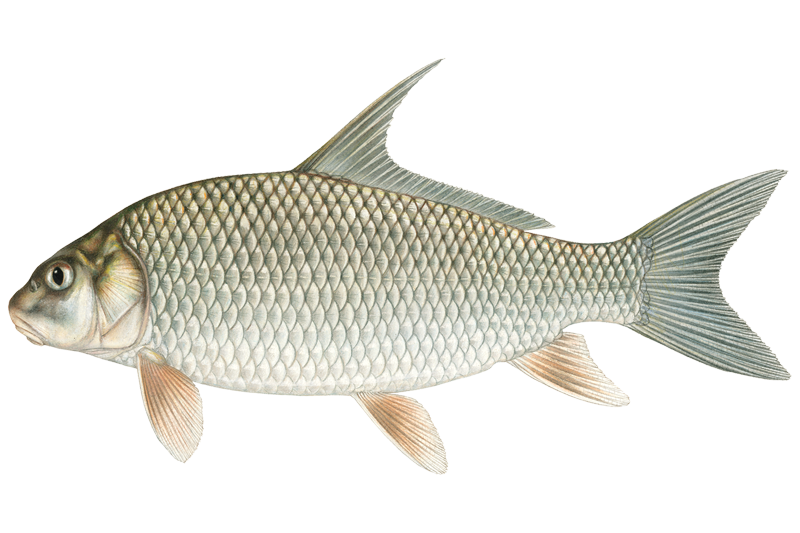
Most anglers meet a quillback by accident — pulling up a deep-bodied, slab-sided fish with a single long dorsal ray sticking up like a flagpole and spending a moment trying to figure out what they've got.
Native to central and eastern North America, from the Great Lakes and Mississippi drainages down through Atlantic and Gulf Slope rivers, the quillback is the most turbidity-sensitive of the carpsuckers and tends to signal clean, productive water.
Its vacuum-like bottom feeding and occasional midwater sipping make it a more behaviorally interesting catch than its reputation implies.
Also known as Quillback Sucker, Quillback Carpsucker
- That single elongated first dorsal ray — the namesake 'quill' — protrudes well above the rest of the fin even when folded down, reaching only about halfway along the fin's length. No other carpsucker has this feature as pronounced.
- Deep, laterally compressed body with large silvery scales; sides carry a golden-bronze tinge and the lower fins are whitish to faintly orange.
- Mouth positioned on the underside of the snout, no barbels, and no nipple-like projection on the lower lip — that last detail separates it from closely related carpsuckers like the Highfin. Hybridization between the two is common and can blur these ID marks.
- Most fish run 12–20 inches and 1–4 lbs; large individuals push 24 inches, and exceptional specimens have exceeded 6 lbs.
What to know
Habitat Distribution
- The quillback's range spans the Great Lakes–St. Lawrence, Hudson Bay, and Mississippi River drainages, plus Atlantic and Gulf Slope rivers from the Delaware south to the Pearl — a broad swath of central and eastern North America.
- Among the carpsuckers, it's the one most tied to clean water: more sensitive to suspended sediment than its relatives, and most at home in productive rivers, large streams, and reservoirs with stable gravel or rubble bottoms.
- Pool-riffle structure matters — quillbacks need large, permanent pools for day-to-day holding and access to gravelly riffles for spawning.
Specific Spots
- Deep, quiet pools are the day-to-day holding water — schools settle into slower current where bottom invertebrates and detritus accumulate, with riffles reserved for spawning runs.
- Tailwaters below locks and dams concentrate schools, particularly where current breaks create slack water adjacent to faster flow.
- Gravel and rubble substrate patches in moderate-depth runs hold actively feeding fish, since stable bottom supports the insect larvae and invertebrates they root for.
Quillback FAQ
Answers from onWater's species guide.
What are the best lures and bait for Quillback?
Small pieces of worm fished on a light bottom rig are the most reliable intentional approach, they match the insect larvae and invertebrates quillbacks root for and can be presented right on the substrate where fish feed.
What do Quillback eat?
Gravel and silt get worked over for aquatic insect larvae, midges, mayfly nymphs, along with snails, small clams, algae, and organic detritus. Small jigs or worm rigs fished right on the substrate match this feeding mode best.
Where do Quillback live?
The quillback's range spans the Great Lakes–St. Lawrence, Hudson Bay, and Mississippi River drainages, plus Atlantic and Gulf Slope rivers from the Delaware south to the Pearl, a broad swath of central and eastern North America.
See it in the app
Most maps show you water.
onWater shows you Quillback.



- 01 · Species map filter
Map every Quillback water
Pick Quillback and the map zeroes in on the waters they call home. No more guessing which lake holds them.
- 02 · Waterbody species
Tap any water. See what lives there.
Species, behavior and seasonal patterns for every lake, river and pond, before you leave the driveway.
- 03 · Angler Intelligence
Ask how to catch Quillback
Tactics, gear and timing from onWater's AI fishing guide, tuned to the species and the water you're on.
Stop guessing where Quillback are.
Open the map, filter by Quillback, and head to water that holds them. Download onWater and plan your next trip in minutes.
- Species map filter
- Angler Intelligence
- Fishing journal
Explore other species
Trout, bass, salmon, panfish and everything in between. Each guide unpacks the behavior, seasons, and tactics that put fish in the net.

Find which waters have the species you want to catch

Redfish
Sciaenops ocellatus

Black Drum
Pogonias cromis

Spotted Seatrout
Cynoscion nebulosus

Weakfish
Cynoscion regalis

White Seabass
Atractoscion nobilis

Atlantic Croaker
Micropogonias undulatus

Spot
Leiostomus xanthurus

Northern Kingfish
Menticirrhus saxatilis

Southern Kingfish
Menticirrhus americanus

California Corbina
Menticirrhus undulatus

Whiting
Menticirrhus littoralis

Snook
Centropomus undecimalis

Tarpon
Megalops atlanticus

Ladyfish
Elops saurus

Bonefish
Albula vulpes

Mangrove Snapper
Lutjanus griseus

Red Snapper
Lutjanus campechanus

Lane Snapper
Lutjanus synagris

Mutton Snapper
Lutjanus analis

Yellowtail Snapper
Ocyurus chrysurus

Cubera Snapper
Lutjanus cyanopterus

Vermilion Snapper
Rhomboplites aurorubens

Gag Grouper
Mycteroperca microlepis

Red Grouper
Epinephelus morio

Black Grouper
Mycteroperca bonaci

Goliath Grouper
Epinephelus itajara

Scamp
Mycteroperca phenax

Snowy Grouper
Hyporthodus niveatus

Black Sea Bass
Centropristis striata

Kelp Bass
Paralabrax clathratus

Barred Sand Bass
Paralabrax nebulifer

Spotted Sand Bass
Paralabrax maculatofasciatus

Bluefish
Pomatomus saltatrix

Crevalle Jack
Caranx hippos

Permit
Trachinotus falcatus

Florida Pompano
Trachinotus carolinus

Greater Amberjack
Seriola dumerili

Almaco Jack
Seriola rivoliana

Yellowtail
Seriola lalandi

Blue Runner
Caranx crysos
Smarter Fishing Starts in the App.
onWater Fish gives you everything you need to plan smarter, fish better, and own every trip from first cast to last.