Highfin Carpsucker
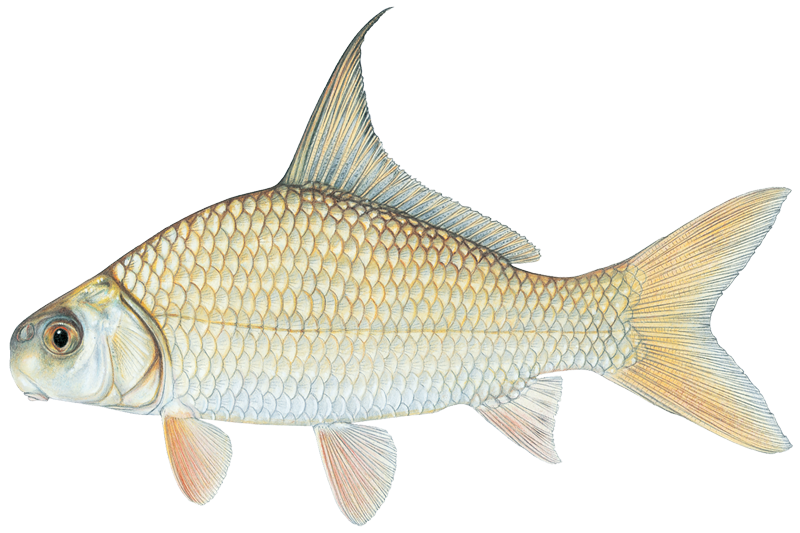
The smallest of the three Carpiodes carpsuckers, named for a first dorsal ray so elongated it gives the fish a sailfish silhouette.
You'll often spot one before you catch one — dorsal fin slicing the surface of a clean Mississippi-basin river, the back briefly exposed, then a clear jump. Where this fish still lives, the water is still good.
Scientific Name: Carpiodes velifer
- That sail-like first dorsal ray is the entire ID — laid back, it nearly reaches the end of the dorsal fin base, a profile no other Mississippi-basin sucker shares.
- Body is deep, thick, and laterally compressed; silvery to light bronze with dark-edged scales, brown-gray back, milk-white belly, and whitish to faintly orange lower fins.
- A small nipple-like bump on the front edge of the lower lip separates it from the lookalike quillback (which has none); the steeper forehead seals the call.
- Most adults run 9-12 inches and well under a pound. Top out around 14 inches in most rivers, with a documented maximum near 20.
What to know
Habitat Distribution
- A Mississippi-basin and Lake Michigan-drainage fish at its core, with disjunct populations on Gulf Slope rivers from the Choctawhatchee to the Pearl, and a few Atlantic Slope holdouts in the Cape Fear and Santee systems.
- Of all three carpsuckers, this is the one that quits the river first when the water turns. Siltation, agricultural runoff, and impoundment have erased it from waters where it was once the most common Carpiodes — its absence is itself a water-quality signal.
- Wants medium to large rivers with moderate to swift current and a firm sand or gravel bottom. Holds in pools and backwaters, occasionally drops into oxbows or overflow ponds, and rarely shows up in reservoirs.
Specific Spots
- Look for surface-skimming fish — dorsal fin and back exposed, sometimes a clean jump. That cruising behavior is unusual among suckers and tells you exactly where to drift a small bait.
- Mid-water cruisers, typically 3-10 feet down, but bottom matters more than depth. Clean sand and gravel hold them; heavy silt pushes them out, no matter the depth.
- Closer to the bank than to the heavy thalweg of bigger rivers — the main current thread isn't where you'll find them.
- Slack water below locks, dams, and riffle tailouts can produce, but expect quillback and river carpsucker to dominate those tailwater aggregations; highfin show up there less reliably.
Highfin Carpsucker FAQ
Answers from onWater's species guide.
What are the best lures and bait for Highfin Carpsucker?
A 1-2 inch piece of garden worm or nightcrawler on a small hook is the most consistent presentation, small bait, small mouth, better hook-up rate. Dough and pack baits made from bread, oats, flour, or corn double as hook bait and slow-dissolving chum, pulling fish into the area on scent.
What do Highfin Carpsucker eat?
Those fleshy, protrusile lips are built for one thing: vacuuming microinvertebrates off clean substrate. Snails, crayfish, small crustaceans, midge and mayfly larvae, protozoa, and filamentous algae all go in through a tiny downward-facing mouth. That biology dictates bait size more than anything.
Where do Highfin Carpsucker live?
A Mississippi-basin and Lake Michigan-drainage fish at its core, with disjunct populations on Gulf Slope rivers from the Choctawhatchee to the Pearl, and a few Atlantic Slope holdouts in the Cape Fear and Santee systems. Of all three carpsuckers, this is the one that quits the river first when the water turns.
See it in the app
Most maps show you water.
onWater shows you Highfin Carpsucker.



- 01 · Species map filter
Map every Highfin Carpsucker water
Pick Highfin Carpsucker and the map zeroes in on the waters they call home. No more guessing which lake holds them.
- 02 · Waterbody species
Tap any water. See what lives there.
Species, behavior and seasonal patterns for every lake, river and pond, before you leave the driveway.
- 03 · Angler Intelligence
Ask how to catch Highfin Carpsucker
Tactics, gear and timing from onWater's AI fishing guide, tuned to the species and the water you're on.
Stop guessing where Highfin Carpsucker are.
Open the map, filter by Highfin Carpsucker, and head to water that holds them. Download onWater and plan your next trip in minutes.
- Species map filter
- Angler Intelligence
- Fishing journal
Explore other species
Trout, bass, salmon, panfish and everything in between. Each guide unpacks the behavior, seasons, and tactics that put fish in the net.
No species information available.

Smarter Fishing Starts in the App.
onWater Fish gives you everything you need to plan smarter, fish better, and own every trip from first cast to last.