Atlantic Salmon
The fish that essentially invented fly fishing as a discipline.
In US waters, Atlantic salmon now exist in two practical forms: a tiny remnant of wild sea-run fish in eastern Maine that's federally endangered and closed to angling, and a much more accessible landlocked form fished across New England, the Adirondacks, the Finger Lakes, and parts of the Great Lakes basin.
Scientific Name: Salmo salar
Also known as Landlocked salmon, Sebago salmon, Ouananiche, Grilse, Kelt, King of Fish
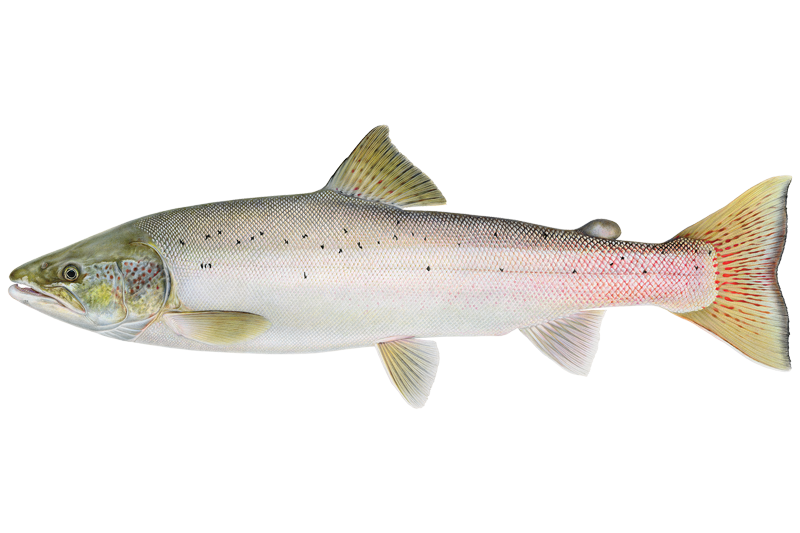
- Fresh sea-run fish are torpedo-shaped and chrome-bright, with a blue-green back, silver flanks, and sparse dark X-shaped spots scattered along the back and lateral line — few or none on the head or gill covers.
- The caudal peduncle (the wrist ahead of the tail) is unusually slender — narrow enough to grip with one hand — separating Atlantic salmon from Pacific salmon and most trout.
- Two reliable diagnostics: fewer than 13 rays in the anal fin (vs. Pacific salmon), and an upper jaw that doesn't extend past the rear edge of the eye (vs. brown trout, where it does).
- Sea-run adults that have spent two winters at sea average 28-30 inches and 8-12 lb; landlocked fish typically run 2-6 lb with 10-pounders possible in prime water.
What to know
Habitat Distribution
- Native sea-run fish once filled coastal rivers from the Hudson north through Maine; today the only remaining wild anadromous US population is a federally endangered cluster in central and eastern Maine, closed to all fishing.
- The landlocked form is the practical US fishery — native to four Maine watersheds and now stocked widely across New England, New York's Adirondacks and Finger Lakes, Lake Champlain tributaries, and parts of the Great Lakes basin.
- A cold-water obligate through every life stage: needs water in the 39-54°F range to thrive, struggles above 64°F, and cannot survive prolonged exposure above 70°F. Clean gravel for spawning and high dissolved oxygen are non-negotiable.
Specific Spots
- River fish hold in classic salmon lies — the heads of pools where current slackens into depth, boulder gardens that break flow, undercut banks in low water, and tail-outs when fish are active.
- Through summer, adults stack in shaded pools, spring seeps, and groundwater-fed runs, waiting for water to drop into the 60s before pushing toward spawning gravel.
- In lakes, landlocked fish chase smelt in the shallows during early spring, then drop to the thermocline through summer stratification and return shallow as water cools in fall.
- Spawning happens on clean, well-oxygenated riffles and runs over cobble and gravel; juveniles need complex in-stream structure — woody debris, deep pockets, coarse substrate — for the 2-4 years they spend in freshwater before smolting.
Atlantic Salmon FAQ
Answers from onWater's species guide.
What are the best lures and bait for Atlantic Salmon?
Spoons (Dardevle, Thomas Buoyant) and small floating plugs, black-and-silver Rapalas above all, are the trolling staples for landlocked salmon, fished shallow in early spring near smelt schools and deeper as the season progresses.
What flies work for Atlantic Salmon?
For sea-run fish, the wet-fly swing is the universal technique, quartering downstream, fly tensioned across the current to provoke a reaction.
What do Atlantic Salmon eat?
The angling-critical fact: sea-run adults stop feeding the moment they enter freshwater and live off ocean-built fat reserves for months.
Where do Atlantic Salmon live?
Native sea-run fish once filled coastal rivers from the Hudson north through Maine; today the only remaining wild anadromous US population is a federally endangered cluster in central and eastern Maine, closed to all fishing.
See it in the app
Most maps show you water.
onWater shows you Atlantic Salmon.



- 01 · Species map filter
Map every Atlantic Salmon water
Pick Atlantic Salmon and the map zeroes in on the waters they call home. No more guessing which lake holds them.
- 02 · Waterbody species
Tap any water. See what lives there.
Species, behavior and seasonal patterns for every lake, river and pond, before you leave the driveway.
- 03 · Angler Intelligence
Ask how to catch Atlantic Salmon
Tactics, gear and timing from onWater's AI fishing guide, tuned to the species and the water you're on.
Stop guessing where Atlantic Salmon are.
Open the map, filter by Atlantic Salmon, and head to water that holds them. Download onWater and plan your next trip in minutes.
- Species map filter
- Angler Intelligence
- Fishing journal
Explore other species
Trout, bass, salmon, panfish and everything in between. Each guide unpacks the behavior, seasons, and tactics that put fish in the net.
No species information available.

Smarter Fishing Starts in the App.
onWater Fish gives you everything you need to plan smarter, fish better, and own every trip from first cast to last.