Yellow Perch
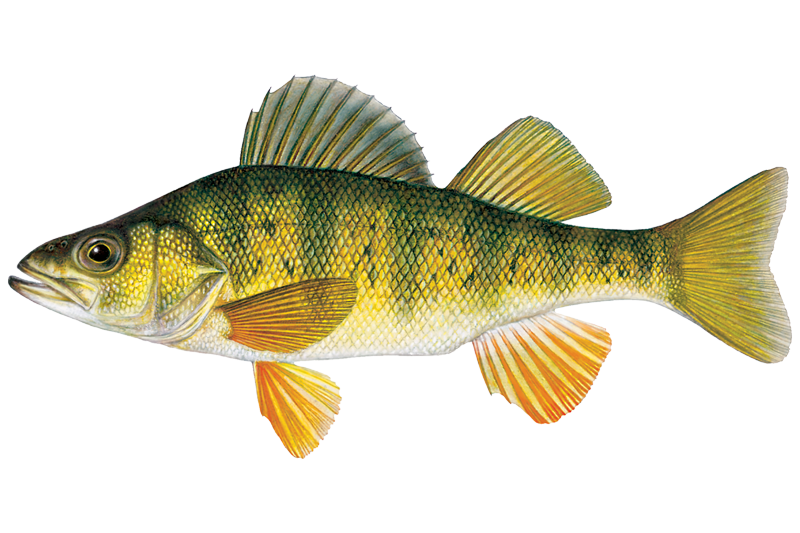
A native of the northeastern US, Great Lakes, and Mississippi drainages, now stocked across most of the country, the yellow perch is the panfish that most defines lake fishing for a huge chunk of America.
Built like a stockier cousin of the walleye, dressed in gold with bold black bars and orange fins, perch run in tight schools and reward the angler who finds them. Many consider their firm, sweet fillets the best eating in fresh water.
Scientific Name: Perca flavescens
Also known as Striped Perch, Ring Perch, Ringed Perch, Lake Perch, Raccoon Perch, American Perch, Ring-tail Perch, Preacher
- Golden-yellow flanks crossed by 6–8 broad dark olive-green vertical bars that extend from the back to just above the white belly — near-diagnostic among freshwater fish.
- Lower fins (pelvic, pectoral, anal) tinged orange to red, brightest on spawning males. Two separated dorsal fins with a deep notch between them; the spiny first dorsal carries a black blotch on the rear membrane.
- Most adults run 4–10 inches; a 12-inch fish is a good one and 14–17 inches earns the "jumbo" label. The world record (4 lb 3 oz, set in 1865) has stood untouched for over 150 years.
- Easy to separate from walleye and sauger — same family, but perch are far smaller, stockier, and the bold barring is absent on those cousins.
What to know
Habitat Distribution
- Native across the Northeast, Great Lakes, and St. Lawrence–Mississippi drainages from the Atlantic west to the eastern Great Plains, and now established in nearly every state through stocking and bait-bucket transfers. In the Pacific Northwest they're a non-native problem fish that competes with trout.
- A clear-water, weed-loving species of ponds, lakes, and slow-river backwaters; they avoid heavy current and silty water but tolerate low oxygen better than most lake fish, which lets them dominate many fertile small lakes.
- Equally at home in fresh and brackish tidal water — the Chesapeake system holds them in both freshwater rivers and salt-tinged tributaries, with seasonal runs between the two.
Specific Spots
- Schools roam shoreline cover — reeds, cabbage and coontail beds, dock pilings, and submerged wood — where they can shadow minnows and pick off invertebrates.
- Steep drop-offs that fall directly out of weed flats are reliable, because perch shuttle between shallow feeding zones and deeper thermal refuge as conditions change.
- Unlike bass, perch don't lock to one piece of cover. They cruise in wolf packs over sand, gravel, and weed flats, so once you contact a school, work the area thoroughly before moving.
- In summer, larger fish slide deep while smaller perch stay shallow; the inverse happens through spring and fall as the whole population follows comfortable temperatures back toward shore.
Yellow Perch FAQ
Answers from onWater's species guide.
What are the best lures and bait for Yellow Perch?
Small jigs from 1/32 to 1/8 oz, marabou, curly-tail grubs, tubes, split-tail plastics, are the most versatile perch lure in existence. Yellow, white, and chartreuse for stained water and prospecting; natural brown and green for crayfish and scud-eaters.
What flies work for Yellow Perch?
Small streamers and wets are the workhorses: Woolly Buggers (a leech and general-baitfish imitator), Clouser Minnows (which imitate baitfish), marabou streamers, and zonkers in white, olive, chartreuse, yellow, or natural minnow tones, sizes #6–#10.
What do Yellow Perch eat?
Insect larvae, scuds, and small crayfish carry most adult perch, with small baitfish (shiners, fathead minnows, young perch) becoming a bigger share once a fish tops about a pound.
Where do Yellow Perch live?
Native across the Northeast, Great Lakes, and St. Lawrence–Mississippi drainages from the Atlantic west to the eastern Great Plains, and now established in nearly every state through stocking and bait-bucket transfers. In the Pacific Northwest they're a non-native problem fish that competes with trout.
See it in the app
Most maps show you water.
onWater shows you Yellow Perch.



- 01 · Species map filter
Map every Yellow Perch water
Pick Yellow Perch and the map zeroes in on the waters they call home. No more guessing which lake holds them.
- 02 · Waterbody species
Tap any water. See what lives there.
Species, behavior and seasonal patterns for every lake, river and pond, before you leave the driveway.
- 03 · Angler Intelligence
Ask how to catch Yellow Perch
Tactics, gear and timing from onWater's AI fishing guide, tuned to the species and the water you're on.
Stop guessing where Yellow Perch are.
Open the map, filter by Yellow Perch, and head to water that holds them. Download onWater and plan your next trip in minutes.
- Species map filter
- Angler Intelligence
- Fishing journal
Explore other species
Trout, bass, salmon, panfish and everything in between. Each guide unpacks the behavior, seasons, and tactics that put fish in the net.
No species information available.

Smarter Fishing Starts in the App.
onWater Fish gives you everything you need to plan smarter, fish better, and own every trip from first cast to last.