Cutthroat Trout
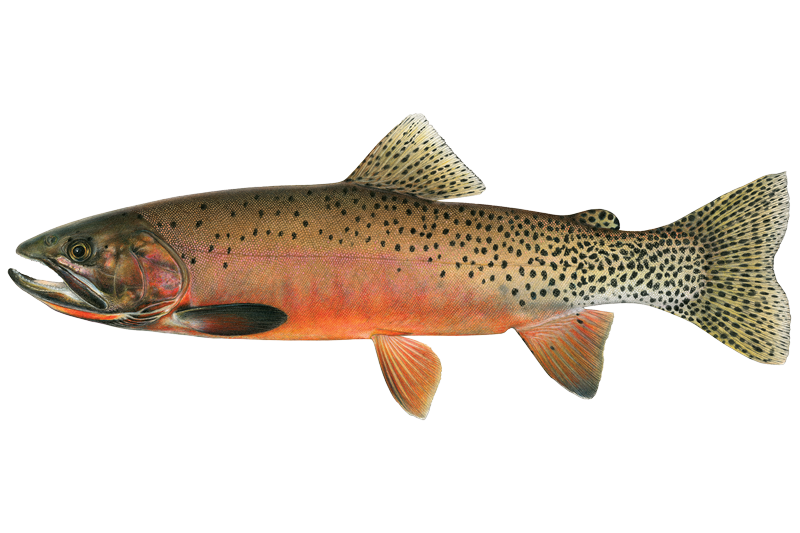
The cutthroat is the West's native trout — a complex of roughly fourteen subspecies marked by the red or orange slash beneath the lower jaw.
The same species name covers a 5-lb sea-run fish chasing salmon smolts in a Pacific estuary and a 20-lb Lahontan eating tui chubs in a desert lake, plus every alpine creek fish in between.
Scientific Name: Oncorhynchus clarkii
Also known as Cutty, Cutties, Blue-back, Sea trout, Harvest trout, Clark's trout, Red-throated trout
- The red, orange, or yellow slash in each skin fold under the lower jaw is the giveaway, but it can fade or wash out — pair it with the basibranchial teeth at the base of the tongue, the most reliable separator from rainbow trout.
- Color and spotting are wildly subspecies-dependent: silvery coastal fish spotted top to bottom, brassy-bronze Yellowstones with rounded spots clustered toward the tail, gold-and-orange Colorado River fish, rose-flanked Rio Grandes.
- Sea-run coastal fish in salt look almost different species — bluish-silver, muted black spotting, slash marks barely visible — and darken back to resident colors as they re-enter freshwater.
- Hybridization with rainbows produces cutbows that blur the picture, sometimes carrying a partial slash; the slash plus tongue teeth together is the only ID combination you can really trust.
What to know
Habitat Distribution
- Native across the second-largest historic range of any North American trout: Pacific drainages from Prince William Sound to northern California's Eel River, plus interior populations through the Rockies, Great Basin, and Mississippi-drainage headwaters of the Missouri, Yellowstone, Platte, Arkansas, and Rio Grande.
- Cold, clean, well-oxygenated water is the universal requirement — gravel-bottom streams or moderately deep lakes with vegetated shorelines. Siltation and warming push them out, which is why so many populations are now confined to upstream of barriers.
- Several subspecies have lost most of their water. Westslope cutthroat are down 76% rangewide and over 95% east of the Continental Divide, hanging on in isolated headwaters that non-native trout can't reach.
- Lahontans are the strange exception — they tolerate alkaline lake water that kills other trout, which is why they thrive in desert basins where no other native trout could.
Specific Spots
- Stream fish wedge into the shadow of log jams, root wads, and undercut banks, then shoot into the seam between fast and slow water to grab whatever drifts past — that current edge is the single most productive lie in cutthroat country.
- Once summer pushes stream temps up, fish slide into faster, more oxygenated runs or drop into deeper holes; alpine lakes above warm-water tributaries stay cooperative when lower elevations shut off.
- Sea-run coastal fish stack in tidewater and estuaries against sunken wood and brushy banks, working the last of the incoming and first of the outgoing tide at low light.
- Pyramid Lake Lahontans cruise the shoreline drop-off in casting range from the bank — the reason anglers there fish from stepladders set in the surf line.
Cutthroat Trout FAQ
Answers from onWater's species guide.
What are the best lures and bait for Cutthroat Trout?
Hardware works across the range, small spoons in 1/8–1/4 oz and in-line spinners in #2–#3, with presentation mattering more than color choice. Cover water by casting upstream and across, letting the lure swing through likely lies.
What flies work for Cutthroat Trout?
The dry-dropper is the most productive single rig in cutthroat country, a buoyant attractor like a Stimulator (stonefly), Chubby Chernobyl (hopper/general food), Elk Hair Caddis, or Parachute Adams up top, with a Pheasant Tail or Hare's Ear (mayfly nymphs) trailing 18–24 inches behind.
What do Cutthroat Trout eat?
On stream-resident fish, mayfly and caddis nymphs, stoneflies, and drifting adults make up the staples, with grasshoppers becoming a meaningful summer protein from July on.
Where do Cutthroat Trout live?
Native across the second-largest historic range of any North American trout: Pacific drainages from Prince William Sound to northern California's Eel River, plus interior populations through the Rockies, Great Basin, and Mississippi-drainage headwaters of the Missouri, Yellowstone, Platte, Arkansas, and Rio Grande.
See it in the app
Most maps show you water.
onWater shows you Cutthroat Trout.



- 01 · Species map filter
Map every Cutthroat Trout water
Pick Cutthroat Trout and the map zeroes in on the waters they call home. No more guessing which lake holds them.
- 02 · Waterbody species
Tap any water. See what lives there.
Species, behavior and seasonal patterns for every lake, river and pond, before you leave the driveway.
- 03 · Angler Intelligence
Ask how to catch Cutthroat Trout
Tactics, gear and timing from onWater's AI fishing guide, tuned to the species and the water you're on.
Stop guessing where Cutthroat Trout are.
Open the map, filter by Cutthroat Trout, and head to water that holds them. Download onWater and plan your next trip in minutes.
- Species map filter
- Angler Intelligence
- Fishing journal
Explore other species
Trout, bass, salmon, panfish and everything in between. Each guide unpacks the behavior, seasons, and tactics that put fish in the net.
No species information available.

Smarter Fishing Starts in the App.
onWater Fish gives you everything you need to plan smarter, fish better, and own every trip from first cast to last.