Bluegill Sunfish
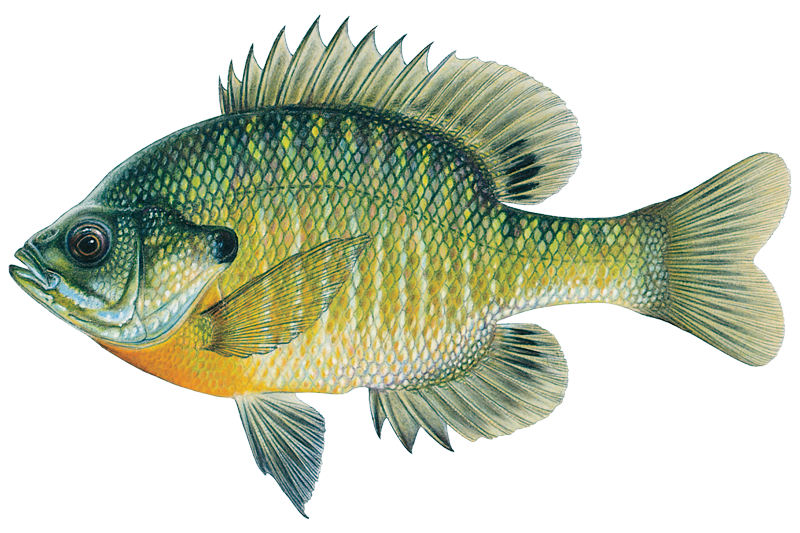
The slab-sided sunfish that introduces more Americans to fishing than any other species.
Native east of the Rockies and now stocked into ponds, lakes, and slow rivers in all 48 contiguous states, the bluegill thrives wherever water is warm, vegetated, and at least somewhat still.
Common at hand-sized, but a true 'bull' over a pound fights with surprising torque on light tackle.
Scientific Name: Lepomis macrochirus
Also known as Bream, Brim, Sunny, Sunnies, Copper Nose, Panfish, Slabs
- Deep, strongly compressed oval body with a small terminal mouth that doesn't reach past the front of the eye, and long pointed pectoral fins that fold forward past the eye.
- Solid black ear flap with no light border — the quickest way to separate bluegill from pumpkinseed (red spot on the flap) or redbreast sunfish (long, narrow flap).
- Olive to dark green back fading into lavender, copper, or orange flanks with 5–9 faint vertical bars and a distinctive black blotch at the rear base of the soft dorsal fin; breeding males turn yellow to bright orange-red on the breast.
- Most adults run 4–7 inches and under a pound; 1-pounders are big anywhere, 2 pounds is trophy class, and the IGFA all-tackle record of 4 lb 12 oz from Alabama in 1950 still stands.
What to know
Habitat Distribution
- Native to the Great Lakes, St. Lawrence, and Mississippi basins, plus Atlantic and Gulf drainages from the Cape Fear south to the Rio Grande; introduced everywhere else in the lower 48 as a sport fish and bass forage.
- Warm, quiet water is the rule: ponds, reservoirs, lake coves, and slow rivers with sand, mud, or gravel bottoms and aquatic vegetation. Comfortable from 65–80°F and able to tolerate water into the 90s.
- One of the most pollution- and low-oxygen-tolerant centrarchids, which is why they thrive in farm ponds and urban impoundments where pickier species disappear. Also unusually salt-tolerant — established in tidal river systems at salinities up to 18 ppt.
- The Coppernose subspecies native to the Deep South grows faster in warm water and produces most of the country's trophy-class fish; introduced western populations are well-established in warmwater impoundments.
Specific Spots
- The shaded, vegetated band along the shoreline — the littoral zone — is home base. Juveniles tuck inside the weeds while bigger fish patrol the outer edges where insects drift through.
- Anything that throws shade or breaks current: fallen timber, stumps, dock pilings, brush piles, rock piles, and overhanging banks. Midday, shade doubles as thermal cover.
- Spawning colonies in 1–3 feet of water on firm sand or gravel, often in protected coves — a cluster of saucer-shaped nests 6–12 inches across, frequently visible from above in clear water.
- In summer, don't ignore open water: adults will suspend just under the surface in the middle of a lake to pick off plankton and surface insects. In winter, schools drop into 15–20 feet near soft bottoms where midge larvae live.
Bluegill Sunfish FAQ
Answers from onWater's species guide.
What are the best lures and bait for Bluegill Sunfish?
Live bait is hard to beat: garden worms, red wigglers, nightcrawlers, and crickets are universal; mealworms and wax worms are the standards through the ice. Small soft-plastic jigs in 1/32 to 1/16 oz with a 1-inch grub, paddle tail, or spider body are the single most productive artificial across the country.
What flies work for Bluegill Sunfish?
Surface poppers and foam/sponge rubber-legged spiders, black, green, or brown, are the canonical bluegill flies and the most fun way to catch them. Twitch, pause, twitch again.
What do Bluegill Sunfish eat?
An insect specialist first and foremost, midge larvae alone can make up half the diet. Small nymphs, soft-hackle wets, and 1-inch soft plastics on a 1/32–1/16 oz jighead all imitate this core food source. Adults expand the menu to crayfish, snails, small minnows, and a heavy seasonal share of terrestrials.
Where do Bluegill Sunfish live?
Native to the Great Lakes, St. Lawrence, and Mississippi basins, plus Atlantic and Gulf drainages from the Cape Fear south to the Rio Grande; introduced everywhere else in the lower 48 as a sport fish and bass forage.
See it in the app
Most maps show you water.
onWater shows you Bluegill Sunfish.



- 01 · Species map filter
Map every Bluegill Sunfish water
Pick Bluegill Sunfish and the map zeroes in on the waters they call home. No more guessing which lake holds them.
- 02 · Waterbody species
Tap any water. See what lives there.
Species, behavior and seasonal patterns for every lake, river and pond, before you leave the driveway.
- 03 · Angler Intelligence
Ask how to catch Bluegill Sunfish
Tactics, gear and timing from onWater's AI fishing guide, tuned to the species and the water you're on.
Stop guessing where Bluegill Sunfish are.
Open the map, filter by Bluegill Sunfish, and head to water that holds them. Download onWater and plan your next trip in minutes.
- Species map filter
- Angler Intelligence
- Fishing journal
Explore other species
Trout, bass, salmon, panfish and everything in between. Each guide unpacks the behavior, seasons, and tactics that put fish in the net.
No species information available.

Smarter Fishing Starts in the App.
onWater Fish gives you everything you need to plan smarter, fish better, and own every trip from first cast to last.