Spotted Sunfish
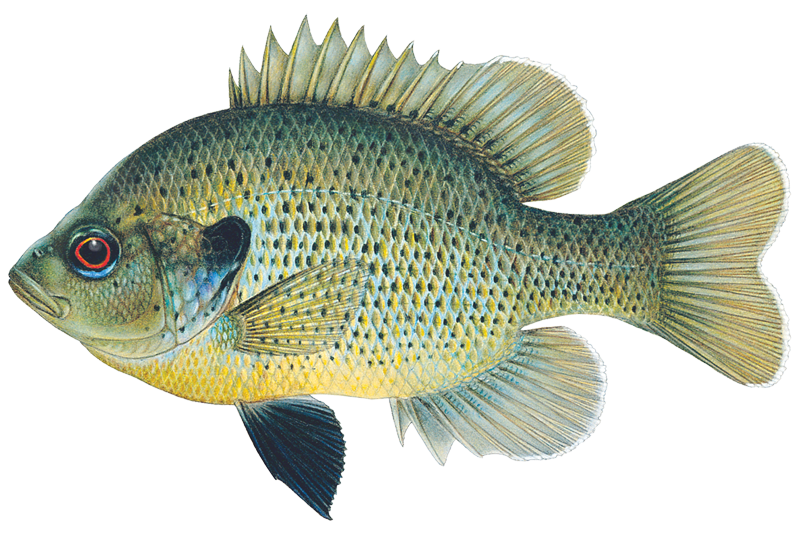
The stumpknocker is the small, scrappy native of Southeast blackwater rivers, spring runs, and coastal-plain swamps from the Carolinas through Florida and west along the Gulf slope.
Tidy rows of dark spots run the flanks and a blue iridescent crescent sits under the eye. Anglers tangle with them while working shoreline wood for bream and find a fish that punches above its size on ultralight or fly tackle.
Scientific Name: Lepomis punctatus
Also known as Stumpknocker, Bream
- Olive-green to brown body with a black or reddish spot at the base of nearly every scale, lining up into the neat rows that give the species its name (punctatus = spotted).
- An iridescent blue crescent or 'bowl' under the eye is the field mark that separates spotted sunfish from the nearly identical redspotted sunfish, which lacks that blue eye-shine.
- Pale, rosy, or silvery margins on the dorsal and tail fins sharpen with age; spawning males flush red-orange across the breast and through the soft fins.
- A small fish — most run 3 to 5 inches, an 8-incher is exceptional, and the Florida state record is just 0.83 lbs.
What to know
Habitat Distribution
- Native only — no introduced populations anywhere — to Atlantic and Gulf coastal-plain drainages from the Cape Fear south through Florida and west along the Gulf slope, with a northern outlier in southeastern Tennessee.
- Below the Fall Line is the line: abundant in coastal-plain rivers and absent from piedmont and mountain water. Florida holds the densest populations, particularly in panhandle rivers and spring-fed systems.
- Warmwater, slow-current habitat — heavily vegetated ponds, swamps, sloughs, and small to medium rivers over mud or sand. Tolerates brackish water up to about 12.5 ppt at the heads of estuaries.
- Where its range meets the redspotted sunfish around the Apalachicola–Perdido systems and upper Coosa, the two hybridize and individual fish can be impossible to tell apart without gill-raker measurements.
Specific Spots
- Wood is the whole game — sunken logs, cypress knees, and undercut roots are where the foraging happens, and a fish rarely sits more than a rod-length from the cover it knocks bugs off of.
- Submerged grass beds — pondweed, hydrilla, and similar mats — over sand, gravel, or limestone in less than three feet of water hold fish through the day.
- This species fishes better in moving water than in lakes; in rivers, look for slow seams just brisk enough to drift a fly past a snag, especially where current bends around woody structure.
- Adults shift through the day, sliding into open water during daylight and tight to the banks after dark, so dawn and dusk along structured shorelines stack the odds.
Spotted Sunfish FAQ
Answers from onWater's species guide.
What are the best lures and bait for Spotted Sunfish?
Grass shrimp, red worms, crickets, and freshwater clam meat under a small float are the classic stumpknocker baits, drift them past wood and weed edges and let the float do the work.
What flies work for Spotted Sunfish?
Tiny nymphs are the most reliable category, midge patterns, chironomids, and soft-hackles in sizes 12–16 drifted along logs and undercut banks line up directly with their bug-heavy diet.
What do Spotted Sunfish eat?
Insectivorous from fry to adult, midge larvae and other immature aquatic insects pulled off the bottom and off woody debris are the bulk of what they eat, which is the niche a small soft-hackle, midge nymph, or Hare's Ear fills.
Where do Spotted Sunfish live?
Native only, no introduced populations anywhere, to Atlantic and Gulf coastal-plain drainages from the Cape Fear south through Florida and west along the Gulf slope, with a northern outlier in southeastern Tennessee.
See it in the app
Most maps show you water.
onWater shows you Spotted Sunfish.



- 01 · Species map filter
Map every Spotted Sunfish water
Pick Spotted Sunfish and the map zeroes in on the waters they call home. No more guessing which lake holds them.
- 02 · Waterbody species
Tap any water. See what lives there.
Species, behavior and seasonal patterns for every lake, river and pond, before you leave the driveway.
- 03 · Angler Intelligence
Ask how to catch Spotted Sunfish
Tactics, gear and timing from onWater's AI fishing guide, tuned to the species and the water you're on.
Stop guessing where Spotted Sunfish are.
Open the map, filter by Spotted Sunfish, and head to water that holds them. Download onWater and plan your next trip in minutes.
- Species map filter
- Angler Intelligence
- Fishing journal
Explore other species
Trout, bass, salmon, panfish and everything in between. Each guide unpacks the behavior, seasons, and tactics that put fish in the net.
No species information available.
Smarter Fishing Starts in the App.
onWater Fish gives you everything you need to plan smarter, fish better, and own every trip from first cast to last.