Sauger
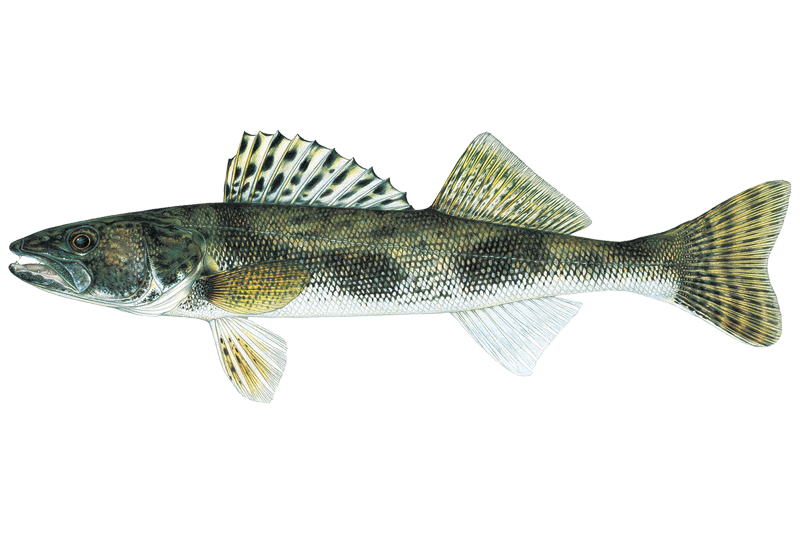
Walleye's smaller, river-savvy cousin, sauger are fish of big, turbid, current-driven water — Mississippi, Ohio, Missouri, Tennessee, and the dam tailraces that punctuate them.
They rarely top 15 inches but stack by the hundreds below navigation dams in fall and winter, when most other species have shut down. Anglers who target them seriously argue they out-eat walleye on the table.
Scientific Name: Sander canadensis
Also known as Sand Pickerel, Sand Pike, Pike Perch, River Pike, Gray Pike
- Bronze-to-brown or golden-olive back and sides with a mottled pattern of four dark saddle marks expanding into oblong blotches — never the uniform gold of walleye.
- Spiny dorsal fin carries at least three rows of distinct round black spots — the single most reliable way to tell sauger from walleye (faint streaks only) or saugeye (spots plus bars).
- No white tip on the lower lobe of the tail — at most a faint yellowish edge, where walleye carry an obvious white splotch. Cheeks are rough-scaled, not smooth.
- Typical adult runs 12–15 inches and 1–2 lbs; a 20-incher is exceptional anywhere in the range, with a documented maximum near 30 inches and just under 9 lbs.
What to know
Habitat Distribution
- Native across the St. Lawrence–Great Lakes, Hudson Bay, and Mississippi basins, reaching south into the Tennessee drainage and west to the high rivers of Wyoming and Oklahoma; introduced into several Atlantic and Gulf slope drainages.
- A river fish first and foremost — large, turbid, slow-gradient warm-water rivers are the heart of the range, with sauger thriving precisely where walleye struggle thanks to a more developed tapetum lucidum for low-light vision.
- Range has contracted sharply from historical levels: extirpated from Lakes Erie and Ontario, fragile or absent across much of the upper Allegheny, and dependent throughout on long unblocked river corridors for spawning migrations.
- Will hold in large shallow lakes and reservoir tailraces with sufficient current and turbidity, but clear lakes and reservoirs rarely produce the kind of fishing the species is known for.
Specific Spots
- Tailraces below navigation and hydro dams are the defining sauger structure — oxygenated current, turbidity, deep holding water, and stacked baitfish all in one place.
- Wing dams, bridge pilings, lock walls, and barge-cut holes all hold fish for the same reason: a current break with deep adjacent water lets sauger rest on the bottom and ambush bait drifting past.
- Eddies, current seams behind points, inside bends, and deep pools with sand-to-rubble transitions — sauger sit on the soft side of the seam, facing the food line.
- Quiet backwaters near tributary mouths over sand, mud, or bedrock pick up fish outside the spring and fall migration windows.
Sauger FAQ
Answers from onWater's species guide.
What are the best lures and bait for Sauger?
Jig and minnow is the workhorse, a 1/8 to 2 oz leadhead (sized to current and depth) tipped with a live or dead shiner, fathead, or even just a minnow head. Chartreuse and other bright colors consistently beat naturals in turbid water.
What do Sauger eat?
Adults are almost entirely fish-eaters, gizzard shad, emerald shiners, young perch, trout-perch, white bass, and small sunfishes all show up in stomach content studies. Shad dominate the diet from fall through midwinter.
Where do Sauger live?
Native across the St. Lawrence–Great Lakes, Hudson Bay, and Mississippi basins, reaching south into the Tennessee drainage and west to the high rivers of Wyoming and Oklahoma; introduced into several Atlantic and Gulf slope drainages.
See it in the app
Most maps show you water.
onWater shows you Sauger.



- 01 · Species map filter
Map every Sauger water
Pick Sauger and the map zeroes in on the waters they call home. No more guessing which lake holds them.
- 02 · Waterbody species
Tap any water. See what lives there.
Species, behavior and seasonal patterns for every lake, river and pond, before you leave the driveway.
- 03 · Angler Intelligence
Ask how to catch Sauger
Tactics, gear and timing from onWater's AI fishing guide, tuned to the species and the water you're on.
Stop guessing where Sauger are.
Open the map, filter by Sauger, and head to water that holds them. Download onWater and plan your next trip in minutes.
- Species map filter
- Angler Intelligence
- Fishing journal
Explore other species
Trout, bass, salmon, panfish and everything in between. Each guide unpacks the behavior, seasons, and tactics that put fish in the net.
No species information available.
Smarter Fishing Starts in the App.
onWater Fish gives you everything you need to plan smarter, fish better, and own every trip from first cast to last.