Blue Sucker
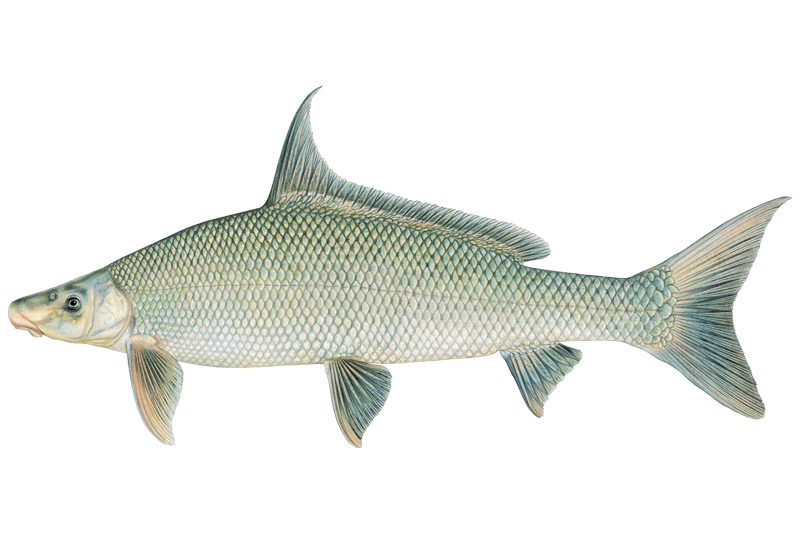
A native specialist of big rivers, the Blue Sucker lives only where long stretches of clean, fast water still flow over gravel and rock.
It ranges from the Mississippi basin and Missouri drainage south through Gulf Slope rivers to the Rio Grande, but is rare nearly everywhere it occurs — a fish whose presence signals genuinely intact river habitat.
Scientific Name: Cycleptus elongatus
Also known as Blackhorse, Razor Back, Missouri Sucker, Sweet Sucker, Gourd Seed Sucker
- Slate-blue to dark olive back fading to a white belly, with coloration ranging from light steel-gray to nearly jet black in spring spawning fish.
- The standout feature is a tall, sickle-shaped (falcate) dorsal fin with 24–35 rays — the front rays much longer than the rear, giving a pointed, tapered profile no other US sucker shares.
- Long, slender body with a small head tapering to a fleshy snout; inferior, subterminal mouth set up for vacuuming the riverbed.
- Adults typically run 30 inches and 4–7 pounds; fish past 9 pounds are exceptional, and individuals can live 40+ years.
What to know
Habitat Distribution
- Native and never introduced; range covers the Mississippi basin from the upper Midwest south to Louisiana, the Missouri drainage into the northern Plains, and Gulf Slope rivers from Mobile Bay west to the Rio Grande.
- A strict large-river fish, restricted to the deep main channels and chutes of medium-to-large rivers over bedrock, sand, and gravel.
- Intolerant of pollution and degraded flow — needs well-oxygenated, unpolluted water and the riffle-and-run hydrology that dams and channelization tend to erase.
- Widespread on paper but genuinely rare in practice; populations have collapsed across much of the historic range and persist mainly in the longest free-flowing reaches.
Specific Spots
- Adults hold in the thalweg — the deepest, fastest part of the channel — in 3 to 8 feet of heavy current over rock and gravel.
- Capture probability climbs around woody snags and where surface velocity is highest, so current seams along submerged timber in the main channel are prime water.
- Below natural rock dams and at the heads and tails of large-river riffles, where bottom-dwelling invertebrates concentrate in the broken flow.
- Juveniles separate from adults, sliding into slacker water in tributaries and backwaters rather than fighting the main channel.
Blue Sucker FAQ
Answers from onWater's species guide.
What are the best lures and bait for Blue Sucker?
Natural bait fished dead on the bottom is the only consistent approach, small pieces of nightcrawler or garden worm on a baitkeeper hook is the standard.
What do Blue Sucker eat?
A bottom feeder through and through, that downturned mouth vacuums aquatic insect larvae, small crustaceans, algae, and bits of plant material directly off the substrate.
Where do Blue Sucker live?
Native and never introduced; range covers the Mississippi basin from the upper Midwest south to Louisiana, the Missouri drainage into the northern Plains, and Gulf Slope rivers from Mobile Bay west to the Rio Grande.
See it in the app
Most maps show you water.
onWater shows you Blue Sucker.



- 01 · Species map filter
Map every Blue Sucker water
Pick Blue Sucker and the map zeroes in on the waters they call home. No more guessing which lake holds them.
- 02 · Waterbody species
Tap any water. See what lives there.
Species, behavior and seasonal patterns for every lake, river and pond, before you leave the driveway.
- 03 · Angler Intelligence
Ask how to catch Blue Sucker
Tactics, gear and timing from onWater's AI fishing guide, tuned to the species and the water you're on.
Stop guessing where Blue Sucker are.
Open the map, filter by Blue Sucker, and head to water that holds them. Download onWater and plan your next trip in minutes.
- Species map filter
- Angler Intelligence
- Fishing journal
Explore other species
Trout, bass, salmon, panfish and everything in between. Each guide unpacks the behavior, seasons, and tactics that put fish in the net.
No species information available.
Smarter Fishing Starts in the App.
onWater Fish gives you everything you need to plan smarter, fish better, and own every trip from first cast to last.