Bigmouth Buffalo
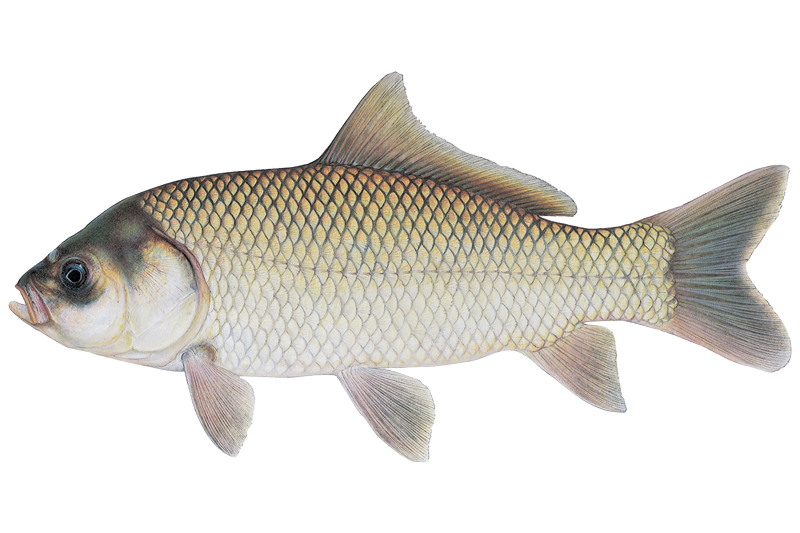
The largest sucker in North America and one of the most curious giants in freshwater — a deep-bodied, plankton-straining filter feeder that can live well past a century and grow north of 70 pounds.
Native to the Mississippi and Hudson Bay drainages and Lake Erie, with introduced populations in parts of the Southwest and West.
Scientific Name: Ictiobus cyprinellus
Also known as Redmouth Buffalo, Marblehead, Roundhead, Bernard Buffalo, Buffalofish, Buffalo, Gourd Head
- Forward-facing, oblique mouth with thin lips sitting nearly level with the eye — unique among suckers and the cleanest way to separate it from the downward-facing mouth of smallmouth buffalo.
- Deep, laterally compressed body with a long sickle-shaped dorsal fin running from midback nearly to the tail, and no fin spines anywhere — common carp have a serrated dorsal spine and barbels; buffalo have neither.
- Brownish-olive or coppery sides with dusky fins and a white belly; older fish often pick up black or orange spots, and rare individuals show white-edged fins.
- Typical hook-and-line catch runs 15–27 inches and 2–14 pounds, with 30-pounders not unusual; the all-tackle world record is 76.5 pounds at 49.5 inches.
What to know
Habitat Distribution
- Native through the Mississippi River drainage from southern Canada to the Gulf, plus the Lake Erie and Hudson Bay drainages; introduced stockings established it in parts of the Southwest, and reproducing populations now hold in Lake Erie with colonizers in Michigan and Ontario.
- A standing-water and slow-current specialist — main channels, backwaters, oxbows, natural lowland lakes, and reservoirs all hold fish, with a strong preference for water under about 16 feet deep.
- Tolerates turbidity better than its buffalo cousins (often thriving above 100 ppm), handles low dissolved oxygen and warm summer temperatures, and does best in pH 6.5–8.5.
- Northern populations (the Dakotas, Minnesota, the prairie provinces) have contracted since the 1970s; the mid-South and Mississippi corridor still support robust numbers.
Specific Spots
- Deeper pools of large rivers and lowland lakes are the daytime anchor — schools hold midwater or near bottom in slow, soft water.
- In summer, fish push into warm shallow bays and the upper arms of reservoirs to filter-feed on plankton blooms; they slide back to depth as water cools in fall.
- Spring spawners stack on freshly flooded vegetation — inundated marsh edges, flooded lake margins, floodplain grass — sometimes moving a mile or more off the main channel to reach it.
- In skinny, calm water these fish are jumpy and easily put down; quiet approaches and long casts matter more than they would for carp.
Bigmouth Buffalo FAQ
Answers from onWater's species guide.
What are the best lures and bait for Bigmouth Buffalo?
Scented dough balls and pack baits do most of the work. Cornmeal pack bait sweetened with molasses or sugar and scented with garlic, anise, or vanilla, squeezed around the hook, dissolves into a chum cloud that pulls fish onto the bait.
What do Bigmouth Buffalo eat?
The only sucker that mainly filter-feeds in open water, straining zooplankton, water fleas and copepods, through 60-plus fine gill rakers per arch. Because they don't chase prey, conventional lures almost never work; you're trying to put scented food where their suction-feeding pulls it in.
Where do Bigmouth Buffalo live?
Native through the Mississippi River drainage from southern Canada to the Gulf, plus the Lake Erie and Hudson Bay drainages; introduced stockings established it in parts of the Southwest, and reproducing populations now hold in Lake Erie with colonizers in Michigan and Ontario.
See it in the app
Most maps show you water.
onWater shows you Bigmouth Buffalo.



- 01 · Species map filter
Map every Bigmouth Buffalo water
Pick Bigmouth Buffalo and the map zeroes in on the waters they call home. No more guessing which lake holds them.
- 02 · Waterbody species
Tap any water. See what lives there.
Species, behavior and seasonal patterns for every lake, river and pond, before you leave the driveway.
- 03 · Angler Intelligence
Ask how to catch Bigmouth Buffalo
Tactics, gear and timing from onWater's AI fishing guide, tuned to the species and the water you're on.
Stop guessing where Bigmouth Buffalo are.
Open the map, filter by Bigmouth Buffalo, and head to water that holds them. Download onWater and plan your next trip in minutes.
- Species map filter
- Angler Intelligence
- Fishing journal
Explore other species
Trout, bass, salmon, panfish and everything in between. Each guide unpacks the behavior, seasons, and tactics that put fish in the net.
No species information available.

Smarter Fishing Starts in the App.
onWater Fish gives you everything you need to plan smarter, fish better, and own every trip from first cast to last.