White Sucker
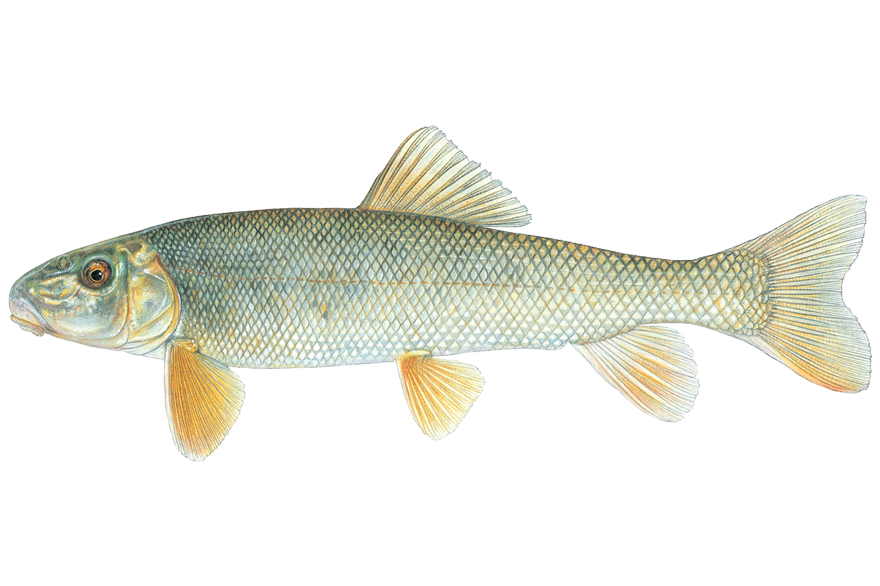
A widespread native sucker found across most of the eastern and midwestern US, the white sucker is the fish that marks the end of winter for northern anglers — appearing in riffles by the thousands at ice-out, well before most gamefish stir.
Light-tackle conventional anglers chase the spring run for its dogged fight, while fly anglers prize the spawn for the trout-feeding frenzy it triggers.
Scientific Name: Catostomus commersonii
Also known as Common Sucker, Brook Sucker, Bay Fish, Mullet, Black Mullet, June Sucker
- Long, nearly cylindrical torpedo-shaped body with olive-brown to black back, lighter or white belly, dusky or clear fins, and large prominent cycloid scales.
- Underslung, toothless sucking mouth with no barbels; lower lip roughly twice as thick as the upper and notched in the middle. The rounded snout barely projects beyond the upper lip.
- Fewer than 75 lateral line scales (typically 55–58) and a short snout separate it from the longnose sucker, which is the species most often confused with it.
- Typical adults run 12–20 inches and 2–6 pounds; the IGFA all-tackle record is 6 lb 8 oz. Spawning males flash gold backs and a red side stripe.
What to know
Habitat Distribution
- Native across the Atlantic, Arctic, Great Lakes, and Mississippi basins, the Atlantic Slope south to South Carolina, and the upper Rio Grande — present in over 40 states.
- Introduced in parts of the West (Colorado River and Rio Grande drainages) via bait-bucket releases and trout-stocking contamination, where it now displaces and hybridizes with native flannelmouth and bluehead suckers.
- Most at home in small cold, clear creeks and small to medium rivers, plus shallow lakes and shallow bays of larger lakes. Preferred temperature range is roughly 53–69°F.
- Remarkably tough: tolerates murky, polluted, and oxygen-poor water that would push other species out, which is why biologists use them as environmental monitors.
Specific Spots
- Deep pools below rapids and the slow-water pockets just above them — adults sit on gravel or mud bottoms studded with larger rocks and let current bring food to them.
- Shallow gravel riffles and shoals less than a foot deep during the spring run; suckers home to the same spawning sites year after year, so once you find a run it pays off annually.
- In lakes, nearshore zones after dark and offshore drop-offs by morning — they shuttle between the two daily as crepuscular and nocturnal feeders.
- Small tributaries far up from the main stem during spawning migrations; fish travel dozens of miles to reach them and stack up in numbers.
White Sucker FAQ
Answers from onWater's species guide.
What are the best lures and bait for White Sucker?
Nightcrawlers threaded so the barb is buried are the standard everywhere, with clam strips a strong second where legal. Cast out, let the sinker settle, and let current animate the bait.
What flies work for White Sucker?
The Sucker Spawn pattern, yarn loops tied to imitate a drifting cluster of sucker eggs, in light gold, yellow, or cream is the defining fly here. Fished heavily weighted on the bottom below or beside spawning fish, it's deadly on trout keyed to the egg drop.
What do White Sucker eat?
Strict bottom feeders that vacuum sediment with fleshy, underslung lips, taking midge larvae, scuds and other crustaceans, snails and small clams, worms, leeches, and algae. That's why dead-drifted nightcrawlers, leeches, and small natural-colored grubs along the bottom outproduce anything fished higher in the column.
Where do White Sucker live?
Native across the Atlantic, Arctic, Great Lakes, and Mississippi basins, the Atlantic Slope south to South Carolina, and the upper Rio Grande, present in over 40 states.
See it in the app
Most maps show you water.
onWater shows you White Sucker.



- 01 · Species map filter
Map every White Sucker water
Pick White Sucker and the map zeroes in on the waters they call home. No more guessing which lake holds them.
- 02 · Waterbody species
Tap any water. See what lives there.
Species, behavior and seasonal patterns for every lake, river and pond, before you leave the driveway.
- 03 · Angler Intelligence
Ask how to catch White Sucker
Tactics, gear and timing from onWater's AI fishing guide, tuned to the species and the water you're on.
Stop guessing where White Sucker are.
Open the map, filter by White Sucker, and head to water that holds them. Download onWater and plan your next trip in minutes.
- Species map filter
- Angler Intelligence
- Fishing journal
Explore other species
Trout, bass, salmon, panfish and everything in between. Each guide unpacks the behavior, seasons, and tactics that put fish in the net.
No species information available.
Smarter Fishing Starts in the App.
onWater Fish gives you everything you need to plan smarter, fish better, and own every trip from first cast to last.