Silver Redhorse
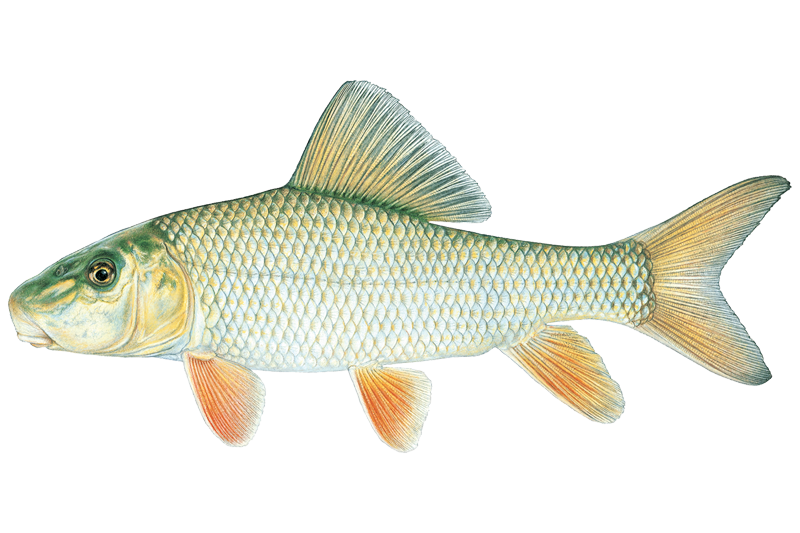
A deep-bodied native sucker of clean Eastern rivers, silver redhorse range across the Great Lakes, Mississippi, and Ohio basins south to the Tennessee system, with isolated populations on the Atlantic Slope.
Their presence is itself a sign the water is in good shape, and they're slowly catching on with anglers who've figured out how to fool a bottom-grubbing fish that won't chase a thing.
Scientific Name: Moxostoma anisurum
Also known as Redhorse, Sucker, March horse, Chevalier blanc
- Silver-sided with a dark gray-brown back and slate-gray tail; the dorsal fin's top edge is distinctly convex (rounded outward) with 14–17 soft rays — the cleanest ID mark.
- Sub-terminal mouth with thick, grooved lips; the rear edge of the lower lip forms a deep V. No teeth, no adipose fin.
- Deeper-bodied than golden or black redhorse, with large cycloid scales and a blunt white snout. Pale fins flush bright red when the fish is netted, which can throw off ID in hand.
- Typical fish run 18–24 inches and 2–5 pounds; trophies push past 10 pounds and 30 inches, and the species is the longest-lived redhorse known, with documented ages to 41 years.
What to know
Habitat Distribution
- Native across the Great Lakes, St. Lawrence, and Mississippi basins, south through the Ohio and Tennessee drainages to northern Alabama and northern Arkansas, with disjunct Atlantic Slope populations from the Roanoke south to the Altamaha.
- A coolwater specialist tied to clean, clear, well-oxygenated water — sensitive enough to pollution and siltation that finding them is a fair gauge of river health.
- Strongholds are medium to large rivers with gravel and bedrock substrate and no migratory barriers; occasionally found in lakes, especially Great Lakes tributaries that produce the biggest fish on record.
Specific Spots
- Outside the spawn, fish drop into the deeper pools just below or above riffles and grub the bottom for invertebrates — that pool-riffle seam is the search zone.
- Undercut banks, exposed root wads, and sand- or rock-bottomed runs all hold fish, particularly where moderate current keeps the substrate clean.
- During the spring run, the tops and tails of gravel riffles concentrate spawning fish — often visible in shallow, clear water if you approach quietly.
Silver Redhorse FAQ
Answers from onWater's species guide.
What are the best lures and bait for Silver Redhorse?
Natural baits run the show. Pieces of nightcrawler, leeches, cut clam, or a small live crayfish, dead-drifted or anchored on the bottom, outproduce everything else. Dough balls, bread or commercial dough, are a long-standing producer for sucker species and work well for redhorse.
What flies work for Silver Redhorse?
Small dark nymphs in size 10–12 are the bread and butter, generic Hare's Ears and Pheasant Tails imitate the mayfly and caddis larvae redhorse pick off the gravel.
What do Silver Redhorse eat?
A bottom feeder through and through, insect larvae, small crayfish, mollusks, and detritus picked off gravel and sand. The sub-terminal mouth means they don't chase; whatever you offer has to be ON the bottom and barely moving.
Where do Silver Redhorse live?
Native across the Great Lakes, St. Lawrence, and Mississippi basins, south through the Ohio and Tennessee drainages to northern Alabama and northern Arkansas, with disjunct Atlantic Slope populations from the Roanoke south to the Altamaha.
See it in the app
Most maps show you water.
onWater shows you Silver Redhorse.



- 01 · Species map filter
Map every Silver Redhorse water
Pick Silver Redhorse and the map zeroes in on the waters they call home. No more guessing which lake holds them.
- 02 · Waterbody species
Tap any water. See what lives there.
Species, behavior and seasonal patterns for every lake, river and pond, before you leave the driveway.
- 03 · Angler Intelligence
Ask how to catch Silver Redhorse
Tactics, gear and timing from onWater's AI fishing guide, tuned to the species and the water you're on.
Stop guessing where Silver Redhorse are.
Open the map, filter by Silver Redhorse, and head to water that holds them. Download onWater and plan your next trip in minutes.
- Species map filter
- Angler Intelligence
- Fishing journal
Explore other species
Trout, bass, salmon, panfish and everything in between. Each guide unpacks the behavior, seasons, and tactics that put fish in the net.
No species information available.

Smarter Fishing Starts in the App.
onWater Fish gives you everything you need to plan smarter, fish better, and own every trip from first cast to last.