Saugeye
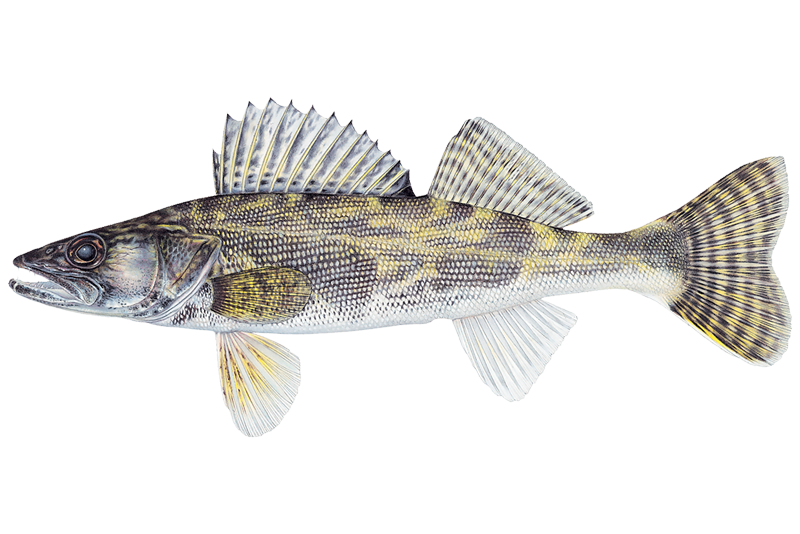
A first-generation cross between female walleye and male sauger, the saugeye carries the best traits of both parents: walleye-like growth and table quality with sauger's tolerance for muddy, wind-churned reservoir water.
Stocked widely across the Midwest and mid-South in impoundments where pure walleye fail, and occurring naturally in big-river systems where both parents share water.
Also known as Walleye × Sauger Hybrid, Sander canadensis × vitreus
- Bronze-silver to yellow-gold body with blotchy saddle markings down the sides — sauger-like patterning with walleye coloration mixed in.
- The spiny dorsal is the tell: walleye dorsals are clear, sauger dorsals carry rows of spots, saugeye show a messy mix of spots AND dark bars in the webbing.
- Cheeks are rough and scaled like a sauger rather than smooth like a walleye, and the white tail tip is partial or blurred rather than the sharp white spot of a pure walleye.
- Most caught fish run 12–18 inches and 1–2 pounds; anything over 20 inches is a quality fish, and the IGFA all-tackle record stands at 12 pounds, 13 ounces.
What to know
Habitat Distribution
- Naturally produced where walleye and sauger overlap — the Ohio, Missouri, and Illinois River systems and other large Midwestern river corridors, where wild hybridization runs around 2–4% of mixed populations.
- Stocked across reservoirs throughout the Midwest and mid-South, particularly in impoundments too turbid or structurally deficient to support self-sustaining walleye.
- A cool-water fish with a preferred range of 55–75°F, holding deep on main-lake structure through summer and using shoreline zones in low light.
- Tolerates silt, stain, and wind-driven turbidity better than pure walleye, which is exactly why management agencies favor them for stocking.
Specific Spots
- Rip-rap along dams, causeways, and bridge approaches concentrates fish in spring and again at night through the warm months — rocky banks hold both forage and current breaks.
- Main-lake humps and rapid depth transitions near windswept points hold fish through summer days, with the same fish moving shallow after dark.
- Tailwater zones below dams stack fish during periods of heavy flow, when current pins baitfish against structure.
- Creek channel mouths and spillways are reliable evening producers, especially where wind is pushing into the structure.
Saugeye FAQ
Answers from onWater's species guide.
What are the best lures and bait for Saugeye?
Jigs in 1/8 to 3/8 oz are the universal saugeye lure, paired with paddle-tail swimbaits, 2–4 inch curly-tail grubs, or live minnows. White, chartreuse, purple, and the white-with-black-flake "Monkey Milk" pattern are reliable starting colors.
What do Saugeye eat?
Gizzard shad, shiners, and yellow perch make up the bulk of the diet in reservoir systems, which is why shad-pattern crankbaits and minnow-tipped jigs cover most situations.
Where do Saugeye live?
Naturally produced where walleye and sauger overlap, the Ohio, Missouri, and Illinois River systems and other large Midwestern river corridors, where wild hybridization runs around 2–4% of mixed populations.
See it in the app
Most maps show you water.
onWater shows you Saugeye.



- 01 · Species map filter
Map every Saugeye water
Pick Saugeye and the map zeroes in on the waters they call home. No more guessing which lake holds them.
- 02 · Waterbody species
Tap any water. See what lives there.
Species, behavior and seasonal patterns for every lake, river and pond, before you leave the driveway.
- 03 · Angler Intelligence
Ask how to catch Saugeye
Tactics, gear and timing from onWater's AI fishing guide, tuned to the species and the water you're on.
Stop guessing where Saugeye are.
Open the map, filter by Saugeye, and head to water that holds them. Download onWater and plan your next trip in minutes.
- Species map filter
- Angler Intelligence
- Fishing journal
Explore other species
Trout, bass, salmon, panfish and everything in between. Each guide unpacks the behavior, seasons, and tactics that put fish in the net.
No species information available.

Smarter Fishing Starts in the App.
onWater Fish gives you everything you need to plan smarter, fish better, and own every trip from first cast to last.