Black Redhorse
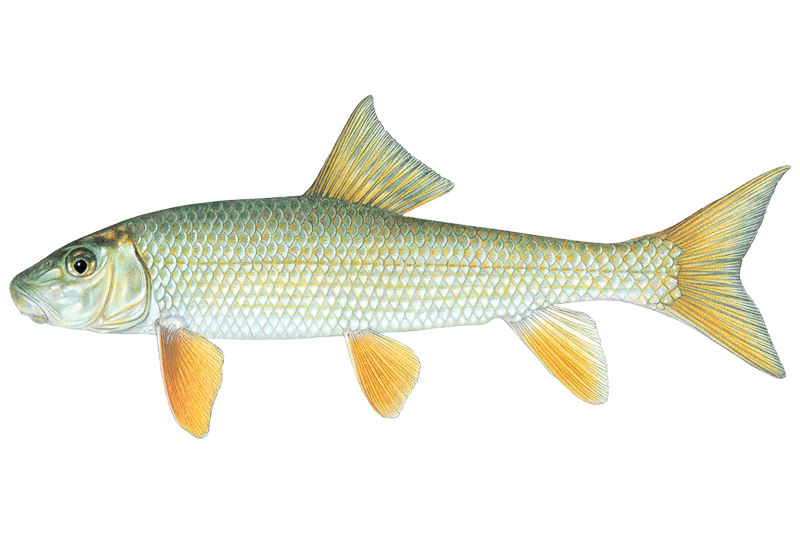
A slender, clean-water sucker of the eastern US, the black redhorse holds in moderate to fast reaches of medium and large rivers from the lower Great Lakes and upper Ohio drainage south through the Mississippi basin to the Mobile and Tennessee systems.
It's the redhorse of clear, gravel-bottomed water — intolerant of silt and far less common than its golden or shorthead cousins. Most anglers meet one by accident while drifting bait through a riffle for bass or trout.
Scientific Name: Moxostoma duquesnei
- Slate-gray caudal fin — the single most useful field mark, since other Moxostoma species in the same rivers carry red or orange tails.
- The only redhorse with 10 pelvic fin rays (others have 9); body is slender with a long, slim caudal peduncle and silvery-blue sides over a milky-white belly.
- Lips are plicate (folded, not pebbled) with a broadly V-shaped lower lip and an inferior, sucker-style mouth; lateral line carries 44–47 scales.
- Typical adults run 9–15 inches; a 2-pounder is record-class — the IGFA all-tackle stands at 2 lb 4 oz, with rare individuals reaching about 20 inches and 7 pounds at the northern edge of the range.
What to know
Habitat Distribution
- Native across the eastern half of the country, ranging from the Northeast and lower Great Lakes drainages west to the upper Mississippi and Ozark border, and south through the Tennessee and Mobile systems. Distribution is wide but patchy, with locally imperiled populations in several northern states.
- A clear-water specialist — restricted to medium and large warmwater rivers with moderate to fast flow, clean rubble-gravel-cobble-sand substrates, and low turbidity. Far less tolerant of siltation than golden or shorthead redhorse.
- Strictly riverine; rarely associated with vegetation and not a fish of lakes or impoundments. Some populations persist where groundwater seepage helps stabilize summer temperatures and water quality.
Specific Spots
- Schools stage in pools and runs immediately above and below riffles in summer, where invertebrate drift concentrates over clean gravel.
- Spawning fish key on the heads and tails of riffles in 12–24 inches of water, working fine-and-coarse gravel mixes — the same seams worth targeting in spring when water hits the mid-50s to upper 60s.
- By fall, fish drop into the deeper pools they'll overwinter in; juveniles slide upstream toward those wintering holes as water cools toward 40°F.
- Young-of-year hold along pool edges near emergent vegetation, separate from the adult schools out in the current.
Black Redhorse FAQ
Answers from onWater's species guide.
What are the best lures and bait for Black Redhorse?
Nightcrawlers and garden worms are the default bait, small pieces drifted along the bottom outproduce everything else, and most dedicated sucker anglers never use anything else.
What flies work for Black Redhorse?
Heavily weighted nymphs that match the natural prey: Hare's Ear and caddis-larva patterns (think Hydropsyche imitations) for caddis, classic stonefly nymphs, and scud or sowbug patterns for the crustaceans they pick out of the substrate.
What do Black Redhorse eat?
Adults work the bottom in schools, sucking up substrate and expelling silt to pick out aquatic insect larvae, caddis, mayflies, stoneflies, along with microcrustaceans, scuds, sowbugs, detritus, and algae.
Where do Black Redhorse live?
Native across the eastern half of the country, ranging from the Northeast and lower Great Lakes drainages west to the upper Mississippi and Ozark border, and south through the Tennessee and Mobile systems. Distribution is wide but patchy, with locally imperiled populations in several northern states.
See it in the app
Most maps show you water.
onWater shows you Black Redhorse.



- 01 · Species map filter
Map every Black Redhorse water
Pick Black Redhorse and the map zeroes in on the waters they call home. No more guessing which lake holds them.
- 02 · Waterbody species
Tap any water. See what lives there.
Species, behavior and seasonal patterns for every lake, river and pond, before you leave the driveway.
- 03 · Angler Intelligence
Ask how to catch Black Redhorse
Tactics, gear and timing from onWater's AI fishing guide, tuned to the species and the water you're on.
Stop guessing where Black Redhorse are.
Open the map, filter by Black Redhorse, and head to water that holds them. Download onWater and plan your next trip in minutes.
- Species map filter
- Angler Intelligence
- Fishing journal
Explore other species
Trout, bass, salmon, panfish and everything in between. Each guide unpacks the behavior, seasons, and tactics that put fish in the net.
No species information available.
Smarter Fishing Starts in the App.
onWater Fish gives you everything you need to plan smarter, fish better, and own every trip from first cast to last.