Mountain Whitefish
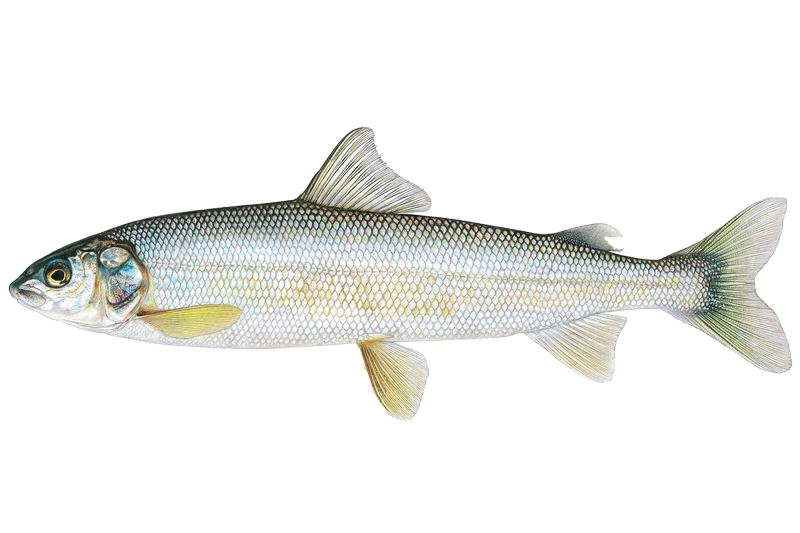
Native to the cold, clear rivers of the intermountain West and Pacific Northwest, mountain whitefish are the most abundant salmonid in many western drainages — often outnumbering trout 10-to-1.
A schooling, bottom-feeding cousin of trout and salmon with a small subterminal mouth and a glittery silver flank, they're the West's most underrated fly-rod target, especially in winter when trout fishing slows.
Scientific Name: Prosopium williamsoni
Also known as Rocky Mountain Whitefish, Williamson's Whitefish, Whitey, Mister White, Mountain Bonefish
- Slender, nearly cylindrical silver body with a dusky olive-green back and large scales (74–90 along the lateral line) that flash like a disco ball in clear water.
- Small subterminal mouth with the snout overhanging the lower jaw — the easiest field mark to separate them from trout, which have a terminal mouth.
- An adipose fin and axillary process confirm the salmonid lineage, ruling out chubs and dace; the round body shape separates them from the deeper, flat-sided lake whitefish.
- Most fish run 12–16 inches and 0.5–2 lbs; anything over 3 lbs or 20 inches qualifies as a trophy, and the world-record class sits near 5.5 lbs.
What to know
Habitat Distribution
- Native across the Pacific, Hudson Bay, and upper Missouri drainages of the northwestern US, with introduced populations established in a few Rocky Mountain rivers since the 1950s.
- A cold-water indicator species that needs water generally below 68°F and clean, well-oxygenated flows — populations thrive only where water quality holds up.
- Primarily a river fish but also lives in connected lakes and reservoirs, where it hugs the bottom in deeper water (typically 15–60 feet down).
- In some western rivers they're the only native salmonid, and densities can reach extraordinary levels — well over 1,000 fish per 100 meters in parts of the Snake River basin.
Specific Spots
- Deep pools at least a meter down with cobble or gravel bottoms — schools stack in the lower water column, especially in slower pool tailouts and seams.
- Riffle-pool transitions and foam-lined current seams, where invertebrate drift funnels right past fish working the substrate.
- In winter, slow deep holes during the warmest part of the day — schools pack in tightly and stay visible in low, clear flows.
- Cobble beds and undercut banks in summer, when fish disperse across a wider mix of riffles and runs to feed.
Mountain Whitefish FAQ
Answers from onWater's species guide.
What are the best lures and bait for Mountain Whitefish?
Natural baits drifted near the bottom on small hooks (size 6–10) are the most consistent producers, maggots, salmon eggs, mealworms, and small garden worms all work. Small spinners and spoons under 1/8 oz fished slow can pick up actively feeding fish, especially when whitefish are chasing fry.
What flies work for Mountain Whitefish?
Beadhead nymphs are the dominant fly category, Prince Nymph, Copper John, Pheasant Tail, Hare's Ear, and zebra midges in sizes 12–22 imitate the caddis, mayfly, and midge larvae they root for. Fish them as close to the bottom as you can get.
What do Mountain Whitefish eat?
Bottom-rooting insectivores, caddis, mayfly, stonefly, and midge larvae make up most of the diet, which is why a dead-drifted beadhead nymph (Prince, Pheasant Tail, Hare's Ear, zebra midge) bounced near the substrate is the single most reliable presentation.
Where do Mountain Whitefish live?
Native across the Pacific, Hudson Bay, and upper Missouri drainages of the northwestern US, with introduced populations established in a few Rocky Mountain rivers since the 1950s.
See it in the app
Most maps show you water.
onWater shows you Mountain Whitefish.



- 01 · Species map filter
Map every Mountain Whitefish water
Pick Mountain Whitefish and the map zeroes in on the waters they call home. No more guessing which lake holds them.
- 02 · Waterbody species
Tap any water. See what lives there.
Species, behavior and seasonal patterns for every lake, river and pond, before you leave the driveway.
- 03 · Angler Intelligence
Ask how to catch Mountain Whitefish
Tactics, gear and timing from onWater's AI fishing guide, tuned to the species and the water you're on.
Stop guessing where Mountain Whitefish are.
Open the map, filter by Mountain Whitefish, and head to water that holds them. Download onWater and plan your next trip in minutes.
- Species map filter
- Angler Intelligence
- Fishing journal
Explore other species
Trout, bass, salmon, panfish and everything in between. Each guide unpacks the behavior, seasons, and tactics that put fish in the net.
No species information available.

Smarter Fishing Starts in the App.
onWater Fish gives you everything you need to plan smarter, fish better, and own every trip from first cast to last.