River Carpsucker
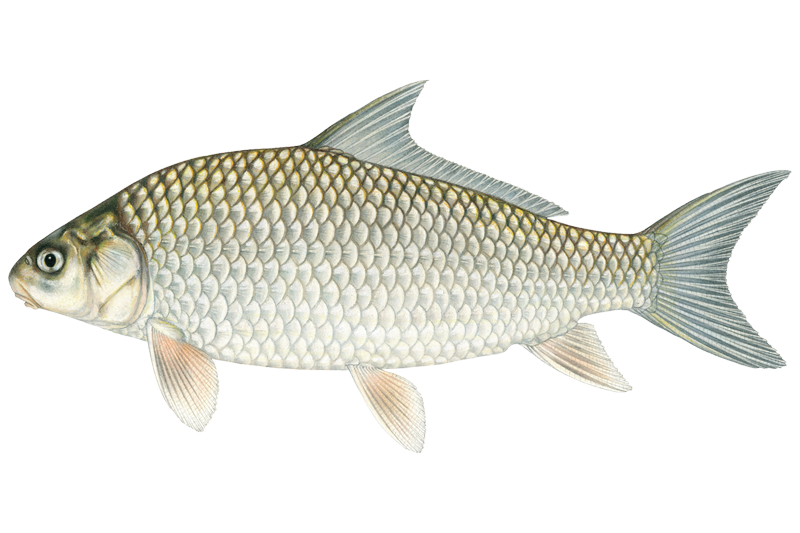
A schooling, deep-bodied native sucker of the Mississippi basin and Gulf Slope drainages, the river carpsucker is the silty-water specialist of the Carpiodes group — common in turbid main-channel pools, prairie rivers, and warm-water reservoirs from Montana down to the Rio Grande.
Anglers rarely target them, but they're a fascinating native fish that recent research shows can live 40 years or more.
Scientific Name: Carpiodes carpio
Also known as Carpsucker, White Carp, Northern Carpsucker, Cold Water Buffalo
- Stout, laterally compressed body with a slightly arched back; olive-brown above, silvery on the sides, white belly, and a long sickle-shaped dorsal fin.
- The giveaway ID feature is a small nipple-like bump at the midpoint of the lower lip — present here, absent on the closely related quillback.
- No barbels around the mouth, which separates carpsuckers from any non-native carp they get confused with; large scales cover the body, with 34–36 along the lateral line.
- Adults usually run 12–15 inches and 1–3 pounds; a true trophy pushes 25 inches, and the IGFA all-tackle record sits at 7 lbs 11 oz.
What to know
Habitat Distribution
- Native across the Mississippi basin from Pennsylvania west to Montana and south to Louisiana, plus Gulf Slope drainages from the Calcasieu over to the Rio Grande in Texas and New Mexico.
- Big, slow, warm-water rivers and reservoirs are the core habitat — sand or silt bottoms, low gradient, and turbidity they actually prefer over clear water.
- In clearer systems they drop out and get replaced by quillback and highfin carpsucker; juveniles use small tributaries while adults hold in main-channel reaches and impoundments.
Specific Spots
- Quiet silt-bottomed pools, oxbows, and backwaters off the main channel — slow, soft water where fine sediment and detritus settle.
- Schools work tight to the bottom and creep slowly upstream while feeding; spotting that slow upstream drift of silver-sided fish over silt is the visual cue.
- In reservoirs, shallow flats with high worm and chironomid biomass hold them, particularly stretches with low nutrient inputs and soft substrate.
River Carpsucker FAQ
Answers from onWater's species guide.
What are the best lures and bait for River Carpsucker?
Small natural baits laid stationary on the bottom: a piece of nightcrawler or a kernel or two of corn on a small hook, placed directly in the path of a feeding school. Pre-baiting the spot with loose corn or chopped worms can pull a school in and hold them long enough to present a hook bait.
What do River Carpsucker eat?
A bottom-grazing filter and suction feeder. They vacuum diatoms, filamentous algae, detritus, midge larvae, microcrustaceans, and the occasional snail or small clam from soft sediment, not chasing prey, just rooting through silt. That feeding mode is why they're nearly impossible to target with active lures or flies.
Where do River Carpsucker live?
Native across the Mississippi basin from Pennsylvania west to Montana and south to Louisiana, plus Gulf Slope drainages from the Calcasieu over to the Rio Grande in Texas and New Mexico.
See it in the app
Most maps show you water.
onWater shows you River Carpsucker.



- 01 · Species map filter
Map every River Carpsucker water
Pick River Carpsucker and the map zeroes in on the waters they call home. No more guessing which lake holds them.
- 02 · Waterbody species
Tap any water. See what lives there.
Species, behavior and seasonal patterns for every lake, river and pond, before you leave the driveway.
- 03 · Angler Intelligence
Ask how to catch River Carpsucker
Tactics, gear and timing from onWater's AI fishing guide, tuned to the species and the water you're on.
Stop guessing where River Carpsucker are.
Open the map, filter by River Carpsucker, and head to water that holds them. Download onWater and plan your next trip in minutes.
- Species map filter
- Angler Intelligence
- Fishing journal
Explore other species
Trout, bass, salmon, panfish and everything in between. Each guide unpacks the behavior, seasons, and tactics that put fish in the net.
No species information available.

Smarter Fishing Starts in the App.
onWater Fish gives you everything you need to plan smarter, fish better, and own every trip from first cast to last.