Ozark Bass
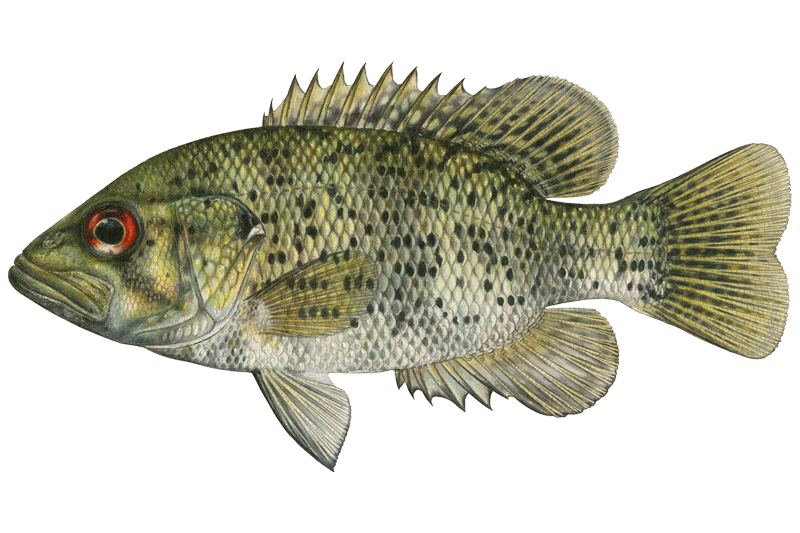
An Ozark endemic that lives nowhere else on earth — the Ozark bass occupies the upper White River drainage in the Highlands of Missouri and Arkansas, and that's the entire native range.
A close cousin to the rock bass, it holds tight to boulders and undercut banks in the same gin-clear gravel-bottom streams that produce smallmouth and trout, and most anglers catch them as scrappy bycatch on light tackle.
Scientific Name: Ambloplites constellatus
Also known as Goggle-eye
- Brownish-green with an irregular pattern of black speckling — a 'freckled' look that separates it from the parallel-row spotting of a northern rock bass.
- Oversized eyes with a red iris, the source of the local nickname 'goggle-eye'; eyes are noticeably larger and more prominent than on related sunfish.
- Slimmer body than other Ambloplites, with six anal-fin spines (vs. three on green sunfish and warmouth) confirming the genus.
- Common length around 5 inches, maximum reported around 11 inches; the IGFA all-tackle record is a one-pound tie. A six- to seven-incher is a good fish.
What to know
Habitat Distribution
- Native only to the upper White River system and its tributaries — the James, Sac, and Pomme de Terre — across the Ozark Highlands of two states. One of the most range-restricted game fish in the country.
- Clean, clear creeks and small to medium rivers with rocky or sandy bottoms, high dissolved oxygen, and low turbidity. Silt and degraded water push them out fast.
- Aquatic vegetation matters too, both as cover and as the engine for the insect life they feed on.
- Limited stocking history outside the native drainage (notably the Illinois drainage in northwest Arkansas) but no confirmed established populations beyond the natives.
Specific Spots
- Tight to the bank — boulders, submerged cedar tangles, and rocky pool margins. This is a structure-oriented fish, rarely caught in open water away from cover.
- Clear rocky pools adjacent to the bank, especially where a boulder or downed wood breaks current and gives an ambush angle.
- Spawning males hold over gravel and small stone in 1–5 feet of water, almost always within a yard of larger overhead or lateral cover.
- Strong site fidelity — tagged fish stay near the same pool year-round, so a productive lie this year will likely produce next year.
Ozark Bass FAQ
Answers from onWater's species guide.
What are the best lures and bait for Ozark Bass?
Small craw-imitating tube jigs and soft-plastic crayfish in 1/16–1/8 oz, in natural browns, oranges, and olives, direct match to the dominant forage in clear water.
What flies work for Ozark Bass?
Weighted crayfish patterns in sizes 6–10, a Whitlock NearNuff Crayfish or similar, fished dead-drifted (drifted naturally with the current) or short-stripped along rocky bottom is the most directly matched fly. Small sculpin patterns work the same job for the minnow side of the diet.
What do Ozark Bass eat?
Crayfish drive the menu in Ozark streams, which is why a small tube jig, soft-plastic craw, or a weighted crayfish fly like a NearNuff Crayfish in browns and olives consistently produces.
Where do Ozark Bass live?
Native only to the upper White River system and its tributaries, the James, Sac, and Pomme de Terre, across the Ozark Highlands of two states. One of the most range-restricted game fish in the country. Clean, clear creeks and small to medium rivers with rocky or sandy bottoms, high dissolved oxygen, and low turbidity.
See it in the app
Most maps show you water.
onWater shows you Ozark Bass.



- 01 · Species map filter
Map every Ozark Bass water
Pick Ozark Bass and the map zeroes in on the waters they call home. No more guessing which lake holds them.
- 02 · Waterbody species
Tap any water. See what lives there.
Species, behavior and seasonal patterns for every lake, river and pond, before you leave the driveway.
- 03 · Angler Intelligence
Ask how to catch Ozark Bass
Tactics, gear and timing from onWater's AI fishing guide, tuned to the species and the water you're on.
Stop guessing where Ozark Bass are.
Open the map, filter by Ozark Bass, and head to water that holds them. Download onWater and plan your next trip in minutes.
- Species map filter
- Angler Intelligence
- Fishing journal
Explore other species
Trout, bass, salmon, panfish and everything in between. Each guide unpacks the behavior, seasons, and tactics that put fish in the net.
No species information available.

Smarter Fishing Starts in the App.
onWater Fish gives you everything you need to plan smarter, fish better, and own every trip from first cast to last.