American Shad
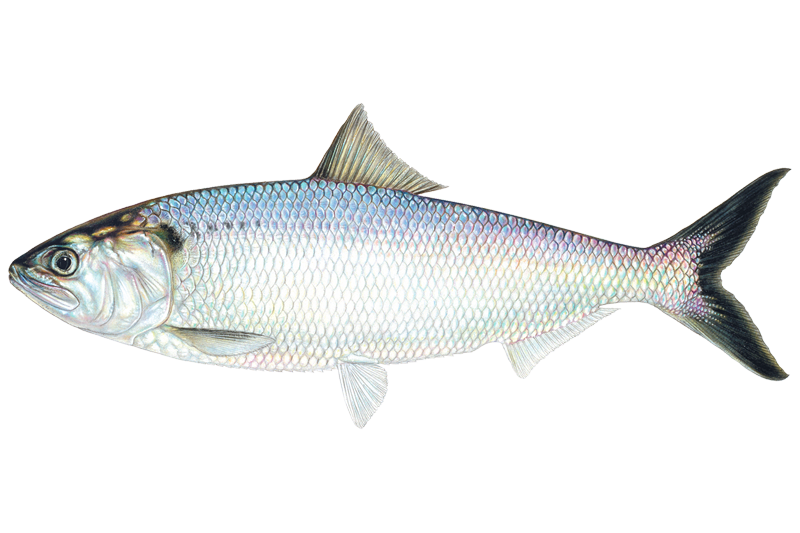
The largest member of the herring family in eastern US waters, American shad spend most of their lives in the open ocean and return to natal rivers each spring to spawn.
Native to the Atlantic from Newfoundland to Florida, they were introduced to the Sacramento River in 1871 and now run West Coast rivers from California to Alaska.
Anglers know them as the 'poor man's tarpon' — leaping, tail-walking fish that strike bright flies and darts despite not actively feeding during the run.
Scientific Name: Alosa sapidissima
Also known as White Shad, Atlantic Shad, Connecticut River Shad, Potomac Shad, Susquehanna Shad, Herring Jack
- Laterally compressed silver body with a blue-green metallic back, white belly, and a sharp saw-toothed scale keel running along the underside.
- A row of 4–6 dark spots sits on the shoulder behind the gill cover; colors darken noticeably once fish enter freshwater to spawn.
- Cheek patch is deeper than long and the upper and lower jaws meet evenly — the two most reliable marks separating American from hickory shad, which has a protruding lower jaw.
- Adults commonly run 3–8 lb and 20–24 inches, with females noticeably larger than males; the IGFA all-tackle record is 11 lb 4 oz from the Connecticut River.
What to know
Habitat Distribution
- Native to Atlantic coast rivers from Newfoundland to central Florida, where coastwide stocks are depleted and many historic runs have been blocked by dams; the Delaware holds the strongest unimpeded wild population.
- Introduced populations are well established along the entire Pacific coast, with the Columbia River now hosting the largest American shad run anywhere in the world — counts at Bonneville Dam routinely top several million fish.
- Anadromous: adults live in the open ocean at 55–64°F, then push into freshwater rivers when spring water temperatures reach 55–61°F. They avoid water with low dissolved oxygen and heavy turbidity.
Specific Spots
- Migrating fish stack below current obstructions — falls, heavy rapids, fish ladders, dam tailraces, and bridge pilings — where the upstream push concentrates them in catchable numbers.
- Long uniform flats with slow to moderate current, current seams, soft edges, and the mouths of tributary streams hold pods moving between resting water and pushing water.
- During midday heat, fish drop into deep, slow pools and river bends to wait out the sun before continuing upstream at dusk — a pattern that explains the morning and evening bite windows.
- Spawning shad release eggs over sandy or pebbly shallows from sundown to midnight, broadcast in open water rather than over a defined nest.
American Shad FAQ
Answers from onWater's species guide.
What are the best lures and bait for American Shad?
Shad darts (small lead-head jigs with a bucktail or feather collar) and small flutter or willow-leaf spoons are the traditional range-wide producers. Tandem rigs running a dart above a spoon on a dropper are widely used on both coasts.
What flies work for American Shad?
Shad-dart-style flies, bright chartreuse, pink, orange, or yellow rabbit or chenille bodies with a short white marabou wing and dumbbell or bead-chain eyes, directly mimic the conventional dart's shape and weighting and are the foundation pattern.
What do American Shad eat?
At sea, adults are plankton feeders, copepods, amphipods, mysid shrimp, and fish eggs make up most of the diet, with the occasional small fish. Here's the wrinkle that defines the fishery: adults stop eating entirely once they enter the river to spawn, yet they still strike artificial lures aggressively.
Where do American Shad live?
Native to Atlantic coast rivers from Newfoundland to central Florida, where coastwide stocks are depleted and many historic runs have been blocked by dams; the Delaware holds the strongest unimpeded wild population.
See it in the app
Most maps show you water.
onWater shows you American Shad.



- 01 · Species map filter
Map every American Shad water
Pick American Shad and the map zeroes in on the waters they call home. No more guessing which lake holds them.
- 02 · Waterbody species
Tap any water. See what lives there.
Species, behavior and seasonal patterns for every lake, river and pond, before you leave the driveway.
- 03 · Angler Intelligence
Ask how to catch American Shad
Tactics, gear and timing from onWater's AI fishing guide, tuned to the species and the water you're on.
Stop guessing where American Shad are.
Open the map, filter by American Shad, and head to water that holds them. Download onWater and plan your next trip in minutes.
- Species map filter
- Angler Intelligence
- Fishing journal
Explore other species
Trout, bass, salmon, panfish and everything in between. Each guide unpacks the behavior, seasons, and tactics that put fish in the net.
No species information available.
Smarter Fishing Starts in the App.
onWater Fish gives you everything you need to plan smarter, fish better, and own every trip from first cast to last.