Redspotted Sunfish
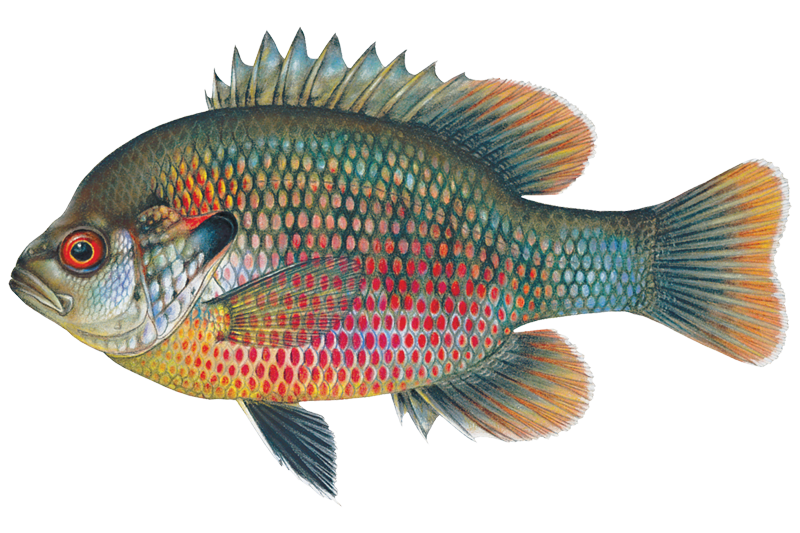
A swamp-and-bayou specialist of the lower Mississippi Valley and Gulf South, the redspotted sunfish — stumpknocker to most folks who fish for it — is a chunky little bream of cypress sloughs and oxbow backwaters.
It tops out around six inches but carries unusual thickness across the back, and breeding males flush brick-red from rows of square spots, one per scale.
Scientific Name: Lepomis miniatus
Also known as Stumpknocker, Western Spotted Sunfish
- Dark olive-brown back fading to a yellowish belly, with three dark lines fanning back from the eye and a stiff black ear flap edged narrowly in white or red.
- Breeding males turn brick-red on the lower body from rows of square red-to-purplish spots, one per scale; females wear yellow-orange spots confined to the belly and lower sides.
- An iridescent blue-turquoise crescent in the lower half of the eye — shared only with the spotted sunfish among all the lepomids and a quick tell against bluegill or longear.
- The cleanest separation from spotted sunfish: redspotted lacks the dark spots at the bases of its scales that form clear horizontal rows on punctatus. In the Florida panhandle and Mobile Basin contact zone, hybrids muddy that line.
What to know
Habitat Distribution
- Native through the Mississippi Valley up to the Illinois and Ohio Rivers, west across Gulf Coast drainages to Texas and the Red River, and east to the Chattahoochee.
- This is a swamp-country fish — oxbows, bayous, bottomland ponds, vegetated lake margins, and the slow pools of small to medium rivers — not a creature of clear streams or man-made farm ponds.
- Almost alone among Lepomis in handling brackish water, it pushes into tidal estuary backwaters and bayou mouths along the Gulf Coast that exclude bluegill and shellcracker.
- Wetland drainage has shrunk the species at its northern edge to a handful of refuges, while across the Gulf South it remains widespread and locally abundant.
Specific Spots
- Almost still water is the requirement — documented preference for current under half a centimeter per second — so eddies, sloughs, and the soft side of any flow are where to start, not the channel itself.
- Within those soft pockets, fish hold tight to woody cover (the name is literal) and to stems of water willow and lily pads, where invertebrates concentrate against the structure.
- Forages on or just above muddy and sandy bottoms, so a bait worked near the substrate near cover beats one drifted at mid-depth — drop the offering down rather than swim it past.
- In Gulf Coast tidal backwaters they use the same drowned wood and grass edges, but on the seaward side of the brackish line where most other bream can't follow.
Redspotted Sunfish FAQ
Answers from onWater's species guide.
What are the best lures and bait for Redspotted Sunfish?
Crickets, red worms, and grass shrimp under a small float are the go-to, drift one past every stump, root ball, and weed stem and you'll find the fish.
What flies work for Redspotted Sunfish?
Small nymphs are the most reliable patterns, Pheasant Tail (mayfly nymph), Hare's Ear (general bug), and beadhead midge or caddis patterns in sizes 12-16 fished near the bottom around vegetation and wood.
What do Redspotted Sunfish eat?
Midge larvae are the staple, pair them with caddis pupae, mayfly nymphs, amphipods, and tiny crustaceans pulled off the bottom, which is exactly why a small Pheasant Tail (mayfly nymph), Hare's Ear (general nymph), or zebra midge fished near cover catches them all day.
Where do Redspotted Sunfish live?
Native through the Mississippi Valley up to the Illinois and Ohio Rivers, west across Gulf Coast drainages to Texas and the Red River, and east to the Chattahoochee.
See it in the app
Most maps show you water.
onWater shows you Redspotted Sunfish.



- 01 · Species map filter
Map every Redspotted Sunfish water
Pick Redspotted Sunfish and the map zeroes in on the waters they call home. No more guessing which lake holds them.
- 02 · Waterbody species
Tap any water. See what lives there.
Species, behavior and seasonal patterns for every lake, river and pond, before you leave the driveway.
- 03 · Angler Intelligence
Ask how to catch Redspotted Sunfish
Tactics, gear and timing from onWater's AI fishing guide, tuned to the species and the water you're on.
Stop guessing where Redspotted Sunfish are.
Open the map, filter by Redspotted Sunfish, and head to water that holds them. Download onWater and plan your next trip in minutes.
- Species map filter
- Angler Intelligence
- Fishing journal
Explore other species
Trout, bass, salmon, panfish and everything in between. Each guide unpacks the behavior, seasons, and tactics that put fish in the net.
No species information available.

Smarter Fishing Starts in the App.
onWater Fish gives you everything you need to plan smarter, fish better, and own every trip from first cast to last.