Chain Pickerel
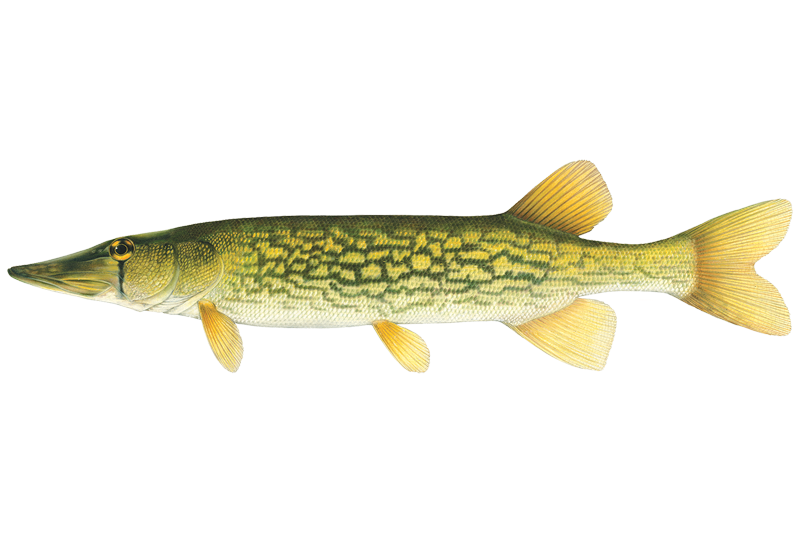
The most accessible member of the pike family, chain pickerel are the small-water Esox of the eastern US — a fish of weedy ponds, lily-padded coves, swampy backwaters, and tannin-stained bog ponds from Maine to Florida and west into eastern Texas.
They feed hard through cold weather when bass and panfish slow down, which has earned them a devoted following among anglers who fish through winter.
Scientific Name: Esox niger
Also known as Jack, Jackfish, Southern Pike, Eastern Pickerel, Grass Pike, Gunny, Slime Dart, Gatorfish
- The interlocking dark chain-link pattern along olive-green flanks is the giveaway — no other Esox in North America wears this reticulated marking on a creamy-yellow background.
- Cheeks and gill covers are fully scaled, separating them cleanly from northern pike (lower operculum scaleless) and muskie (dark markings on light, not the reverse).
- A vertical dark teardrop bar runs straight down from the eye — on the similar redfin and grass pickerels that bar curves backward, which is the fast field call between the three.
- Most caught fish run 14-18 inches at 1-2 pounds; a 22-incher around 5 pounds is a legitimate trophy, and the species rarely tops 31 inches.
What to know
Habitat Distribution
- Native along the Atlantic Slope from southwestern Maine through Florida, with the Gulf Coast range reaching west to the Sabine and Red River drainages of east Texas and north up the Mississippi basin into Kentucky and Missouri.
- Introduced populations sit in the lower Great Lakes drainages and as far west as Colorado, where management agencies treat them as invasive predators.
- Ponds, swamps, slow rivers, and lake backwaters with abundant aquatic vegetation hold the most fish; sluggish, clear, weedy water is the sweet spot.
- Remarkably acid-tolerant down to a pH of about 3.8 — which is why they thrive in tannin-stained bog ponds and cypress swamps — and tolerant enough of salt to push into brackish tidal reaches in winter, especially along the mid-Atlantic.
Specific Spots
- Lily pad fields and submerged weed edges are the primary address — the chain pattern breaks up their outline against the stems, and they sit motionless waiting for shiners or sunfish to drift past.
- Wood cover does the same job: laydowns, submerged brush, undercut banks. In rivers, backwaters, abandoned side channels, and floodplain wetlands hold them year-round.
- Most of the time they're in less than 10 feet of water; in the hottest stretch of summer adults slide out a bit deeper, then push back into the shallow weeds when temperatures ease.
- Time of day moves them around predictably — bright afternoons find them tucked under pad shade or shoreline trees, while overcast days, mornings, and evenings push them out onto shallow grassy flats.
Chain Pickerel FAQ
Answers from onWater's species guide.
What are the best lures and bait for Chain Pickerel?
In-line spinners, spinnerbaits, and weedless spoons are the workhorses, the flash and vibration trigger reaction strikes from fish parked in the weeds. Topwater plugs and soft-plastic jerkbaits (Slug-Go, Zoom Fluke fished weightless) get crushed in the shallows.
What flies work for Chain Pickerel?
Subsurface baitfish streamers carry most of the load: Clouser Minnows, Lefty's Deceivers, Pike Bunnies, Bendbacks, and articulated game-changers, all baitfish imitations, in white, chartreuse, and yellow. Flash in the pattern matters more than exact imitation.
What do Chain Pickerel eat?
Adults eat fish above all else, golden shiners turned up in nearly half the stomachs in one classic study, with crayfish in 42%, and brown bullheads and pumpkinseeds rounding it out, which is why flashy baitfish-profile lures (in-line spinners, spoons, jerkbaits) and white or chartreuse streamers like Clouser Minnows...
Where do Chain Pickerel live?
Native along the Atlantic Slope from southwestern Maine through Florida, with the Gulf Coast range reaching west to the Sabine and Red River drainages of east Texas and north up the Mississippi basin into Kentucky and Missouri.
See it in the app
Most maps show you water.
onWater shows you Chain Pickerel.



- 01 · Species map filter
Map every Chain Pickerel water
Pick Chain Pickerel and the map zeroes in on the waters they call home. No more guessing which lake holds them.
- 02 · Waterbody species
Tap any water. See what lives there.
Species, behavior and seasonal patterns for every lake, river and pond, before you leave the driveway.
- 03 · Angler Intelligence
Ask how to catch Chain Pickerel
Tactics, gear and timing from onWater's AI fishing guide, tuned to the species and the water you're on.
Stop guessing where Chain Pickerel are.
Open the map, filter by Chain Pickerel, and head to water that holds them. Download onWater and plan your next trip in minutes.
- Species map filter
- Angler Intelligence
- Fishing journal
Explore other species
Trout, bass, salmon, panfish and everything in between. Each guide unpacks the behavior, seasons, and tactics that put fish in the net.
No species information available.

Smarter Fishing Starts in the App.
onWater Fish gives you everything you need to plan smarter, fish better, and own every trip from first cast to last.