Kokanee Salmon
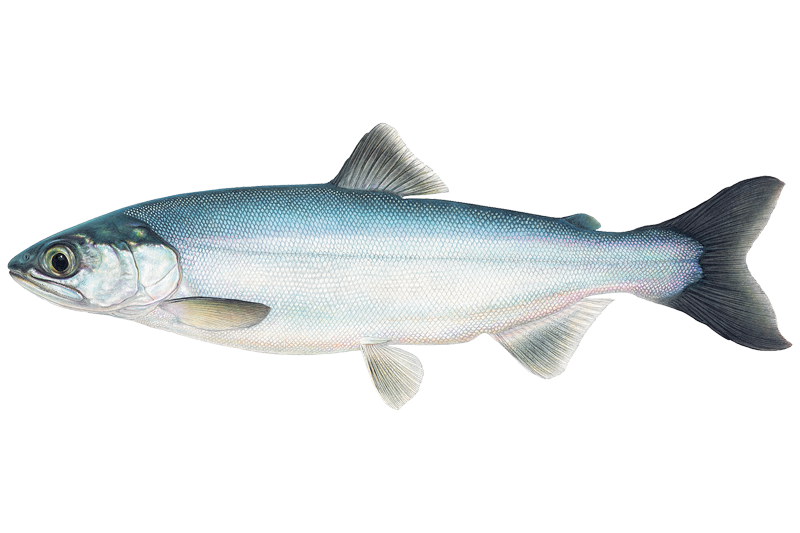
Kokanee are the landlocked, lake-dwelling form of sockeye salmon — same fish, different life history, isolated from the ocean since the last glacial retreat.
They live in cold, deep lakes across the Pacific Northwest and the Intermountain West, where anglers chase them in open water for their bright silver flanks, eating quality, and the dramatic red spawning run that turns mountain tributaries scarlet each fall.
Also known as Landlocked Salmon, Little Redfish, Silver Trout, Kokanee Trout, Kennerly's Salmon
- Bright silver sides with a blue-green back and — critically — no dark spots on the back, fins, or tail. That clean, unspotted look separates them from rainbows, browns, and cutthroat sharing the same lakes.
- Spawning fish go through a full Pacific salmon transformation: brilliant red body, olive-green head, humped back and hooked kype on males. Females flush red but more muted.
- Fine, closely spaced gill rakers (30–40 on the first arch) built for filtering zooplankton, paired with an anal fin base longer than the dorsal — both useful for separating kokanee from trout in hand.
- Most run 10–16 inches and under a pound; in productive water 18–20 inches and 3–5 pounds is realistic. The IGFA all-tackle record stands at 9 lb 10 oz from Wallowa Lake, Oregon.
What to know
Habitat Distribution
- Native to deep, cold lakes of Alaska, the Pacific Northwest, and northern California, where post-glacial drainage changes cut sockeye off from the sea roughly 15,000 years ago.
- Widely introduced across the Intermountain West — and stocked into reservoirs in the Mountain West and parts of the Northeast — with most of those fisheries maintained by hatchery programs because wild reproduction rarely sustains itself.
- An obligate cold-water fish: prefers 50–59°F with an optimum near 54°F, and needs lakes deep enough to hold a stable thermocline through summer. Warm or turbid water rules them out entirely.
- Spawning requires clean, oxygenated gravel — either in tributaries or on shoreline upwelling zones — where eggs incubate roughly 110 days at 43°F before fry drop into the lake.
Specific Spots
- Open midwater is the game. Kokanee suspend in tight schools right at or just above the thermocline, and modern sonar shows them as distinct bands at a very specific depth.
- Depth shifts with the season — near-surface in early spring, then 15–40 feet by early summer, deeper still as the lake stratifies and warms.
- Pre-stratification, schools roam shallow shoals and chase chironomid and mayfly hatches near the surface, the only window most fly anglers get without going deep.
- Feeding tracks the daily zooplankton vertical migration: prey rises at dusk and drops at dawn, and kokanee follow it up and down. Low-light hours are the prime bite.
Kokanee Salmon FAQ
Answers from onWater's species guide.
What are the best lures and bait for Kokanee Salmon?
The workhorse rig is a dodger or inline flasher (Ford Fender, Sling Blade, ProChip) trailed by a small lure on an 8–18 inch leader, hoochies, Needlefish spoons, Wedding Ring spinners, or micro spoons. The flasher attracts the school; the lure triggers the bite.
What flies work for Kokanee Salmon?
Chironomid pupa patterns in brown, black, red, orange, and green, fished under an indicator in spring shallows, are the most consistent flies, matching the actual hatches kokanee key on near the surface.
What do Kokanee Salmon eat?
Adult kokanee filter zooplankton, mostly Daphnia, copepods, and ostracods, straining them through fine gill rakers. They're not chasing baitfish, which is why standard predator presentations don't apply.
Where do Kokanee Salmon live?
Native to deep, cold lakes of Alaska, the Pacific Northwest, and northern California, where post-glacial drainage changes cut sockeye off from the sea roughly 15,000 years ago.
See it in the app
Most maps show you water.
onWater shows you Kokanee Salmon.



- 01 · Species map filter
Map every Kokanee Salmon water
Pick Kokanee Salmon and the map zeroes in on the waters they call home. No more guessing which lake holds them.
- 02 · Waterbody species
Tap any water. See what lives there.
Species, behavior and seasonal patterns for every lake, river and pond, before you leave the driveway.
- 03 · Angler Intelligence
Ask how to catch Kokanee Salmon
Tactics, gear and timing from onWater's AI fishing guide, tuned to the species and the water you're on.
Stop guessing where Kokanee Salmon are.
Open the map, filter by Kokanee Salmon, and head to water that holds them. Download onWater and plan your next trip in minutes.
- Species map filter
- Angler Intelligence
- Fishing journal
Explore other species
Trout, bass, salmon, panfish and everything in between. Each guide unpacks the behavior, seasons, and tactics that put fish in the net.
No species information available.

Smarter Fishing Starts in the App.
onWater Fish gives you everything you need to plan smarter, fish better, and own every trip from first cast to last.