White Catfish
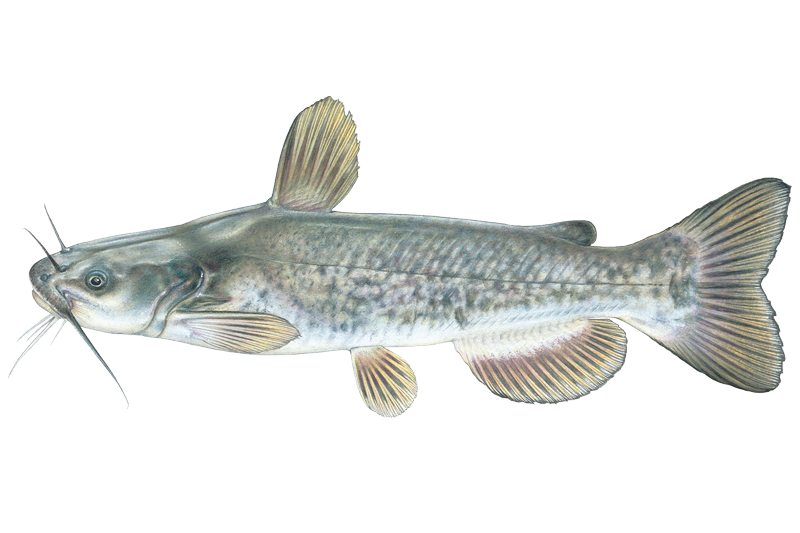
Smallest of the three commonly fished American catfishes, white catfish are native to Atlantic and Gulf Slope rivers from New York to Florida and Alabama, with major introduced populations on the West Coast.
They thrive in slow, muddy tidal rivers, estuaries, and lowland lakes — water where channels and blues don't dominate — and they're more willing to bite in daylight than their larger cousins.
Scientific Name: Ameiurus catus
Also known as White Bullhead, Schuylkill Catfish
- Gray to blue-black above, white to pale yellow below, with a dusky-to-black adipose fin and no dark blotch at the base of the dorsal.
- Tail is moderately forked with rounded lobes — separates them at a glance from channel and blue catfish, which have deeply forked tails.
- Chin barbels are white or light-colored while the upper barbels are dusky; combined with the forked tail, this rules out yellow bullhead, which has a square tail.
- Typical fish run 12–13 inches and a pound or two; East Coast trophies push 5–7 pounds, while introduced California fish can exceed 20 pounds.
What to know
Habitat Distribution
- Native to Atlantic and Gulf Slope drainages from the lower Hudson south through the Chesapeake watershed to the Florida peninsula and west to the Apalachicola basin.
- Introduced and well established in California's Central Valley and Sacramento–San Joaquin Delta since the 1870s, with additional populations in the Columbia River, parts of New England, and scattered interior states from fee-fishing escapes.
- Sluggish, mud-bottomed water is the signature: lowland river pools, backwaters, oxbows, impoundments, and the fresh-to-brackish reaches of tidal rivers. Tolerates salinities up to 12–14 PSU, which puts them deep into estuarine zones other catfish can't reach.
Specific Spots
- Soft mud and silt bottoms with low to moderate current — outside river bends, deep holes below structure, and the slack water behind points.
- In lakes and reservoirs, deeper structure with wood cover (sunken timber, brush, laydowns) and the lips of drop-offs, especially through the warm months.
- In tidal systems, the brackish transition zone — flooded sloughs, creek mouths, and tidal channels where their salt tolerance lets them feed in water saltier than other catfish will hold in.
White Catfish FAQ
Answers from onWater's species guide.
What are the best lures and bait for White Catfish?
Nightcrawlers and live worms cover the field, productive on white catfish of every size in nearly every water type they occupy. Chicken liver is a classic for this species; cut shad, herring, or bluegill chunks shine in tidal rivers and bigger river systems where baitfish are the main forage.
What do White Catfish eat?
Omnivorous bottom feeders that work on scent: aquatic insects, crayfish, amphipods, worms, and small fish like shad and herring. The diet shifts toward fish as they get bigger, but they'll eat plant matter and invertebrates throughout life. This drives bait selection more than lure selection.
Where do White Catfish live?
Native to Atlantic and Gulf Slope drainages from the lower Hudson south through the Chesapeake watershed to the Florida peninsula and west to the Apalachicola basin.
See it in the app
Most maps show you water.
onWater shows you White Catfish.



- 01 · Species map filter
Map every White Catfish water
Pick White Catfish and the map zeroes in on the waters they call home. No more guessing which lake holds them.
- 02 · Waterbody species
Tap any water. See what lives there.
Species, behavior and seasonal patterns for every lake, river and pond, before you leave the driveway.
- 03 · Angler Intelligence
Ask how to catch White Catfish
Tactics, gear and timing from onWater's AI fishing guide, tuned to the species and the water you're on.
Stop guessing where White Catfish are.
Open the map, filter by White Catfish, and head to water that holds them. Download onWater and plan your next trip in minutes.
- Species map filter
- Angler Intelligence
- Fishing journal
Explore other species
Trout, bass, salmon, panfish and everything in between. Each guide unpacks the behavior, seasons, and tactics that put fish in the net.
No species information available.

Smarter Fishing Starts in the App.
onWater Fish gives you everything you need to plan smarter, fish better, and own every trip from first cast to last.