White Bass
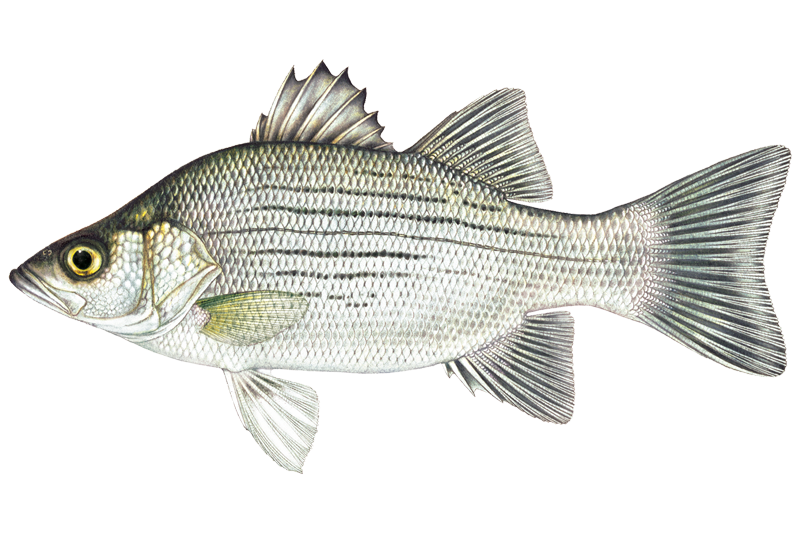
A schooling, open-water member of the temperate bass family found across the Great Lakes, Mississippi, and Missouri-Ohio drainages and widely stocked beyond.
White bass run shad in tight, fast-moving schools and produce some of the most concentrated bites in freshwater — especially during the spring tributary run, when dense schools push into rivers to spawn over gravel.
Scientific Name: Morone chrysops
Also known as Sand Bass, Silver Bass, Sandbass
- Silver-white sides with a blue-gray to nearly black back, white belly, and several narrow dark stripes running lengthwise — the topmost stripe is usually the only one that runs unbroken to the tail.
- Two clearly separated dorsal fins (a spiny front and soft rear), which separates them from white perch, where the two are joined and rise together.
- The tongue carries a single heart-shaped tooth patch — striped bass and hybrid stripers have two — and the gill cover ends in one sharp point rather than two.
- Most fish run 12–15 inches and roughly a pound; a true giant pushes 17–18 inches and 4+ pounds, with the all-tackle record at 6.81 pounds.
What to know
Habitat Distribution
- Native to the St. Lawrence–Great Lakes, Hudson Bay, and Mississippi basins from the upper Midwest south to Louisiana and west into the Rio Grande drainage; widely stocked outside that range, especially across the south-central and western US.
- An open-water, pelagic species that does best in large reservoirs, deep natural lakes, and the deeper pools of slow rivers — reservoirs in particular tend to grow the densest populations.
- Avoids heavy aquatic vegetation and chronically muddy water; abundance drops as weed cover increases. Clean sand, gravel, and rock bottoms with open water above are the rule.
Specific Spots
- In summer, schools suspend over main-lake humps, channel edges, and drop-offs, often 15–30 feet down. Without electronics to find them, you're guessing — sonar work is the heart of the warm-season game.
- Dawn and dusk pull schools up to herd shad on the surface; midday usually means deeper, tighter pods sitting on structure.
- During the spring run, fish stack in tributary rivers and on windswept rocky shorelines over gravel in 2–10 feet of water, with strong homing back to the same stretches year after year.
- Post-spawn and into fall, look at main-lake points, secondary creek mouths, and flats next to deep water where shad concentrate.
White Bass FAQ
Answers from onWater's species guide.
What are the best lures and bait for White Bass?
Shad imitators in the 2–4 inch range carry the program: curly-tail grubs and paddle-tail swimbaits on 1/16–1/4 oz jigheads, inline spinners in white or silver, small crankbaits, and slab spoons. White, silver, and chartreuse cover most water; brighter in stained, darker and more natural in clear.
What flies work for White Bass?
Small baitfish streamers carry the day. Clouser Minnows in sizes 4–8 (which imitate shad and silversides with their sink-and-dart action) and Lefty's Deceivers are the core patterns; Zonkers and white/chartreuse marabou jigs round out the box. Retrieve fast in short, sharp strips to mimic fleeing shad.
What do White Bass eat?
Once they hit about 10 inches, the diet is dominated by shad, gizzard and threadfin especially, along with silversides and the occasional young sunfish. Match that with 2–4 inch shad-profile lures: white or silver paddle-tails, curly-tail grubs on a jighead, slab spoons, and small crankbaits.
Where do White Bass live?
Native to the St. Lawrence–Great Lakes, Hudson Bay, and Mississippi basins from the upper Midwest south to Louisiana and west into the Rio Grande drainage; widely stocked outside that range, especially across the south-central and western US.
See it in the app
Most maps show you water.
onWater shows you White Bass.



- 01 · Species map filter
Map every White Bass water
Pick White Bass and the map zeroes in on the waters they call home. No more guessing which lake holds them.
- 02 · Waterbody species
Tap any water. See what lives there.
Species, behavior and seasonal patterns for every lake, river and pond, before you leave the driveway.
- 03 · Angler Intelligence
Ask how to catch White Bass
Tactics, gear and timing from onWater's AI fishing guide, tuned to the species and the water you're on.
Stop guessing where White Bass are.
Open the map, filter by White Bass, and head to water that holds them. Download onWater and plan your next trip in minutes.
- Species map filter
- Angler Intelligence
- Fishing journal
Explore other species
Trout, bass, salmon, panfish and everything in between. Each guide unpacks the behavior, seasons, and tactics that put fish in the net.
No species information available.

Smarter Fishing Starts in the App.
onWater Fish gives you everything you need to plan smarter, fish better, and own every trip from first cast to last.